
Stock Research Workflow
School 04 — Security Analysis and Portfolio Design
Listen — 15-second overview
A quick spoken preview of this class
School 5 · Security Analysis and Portfolio Design · About 15 minutes
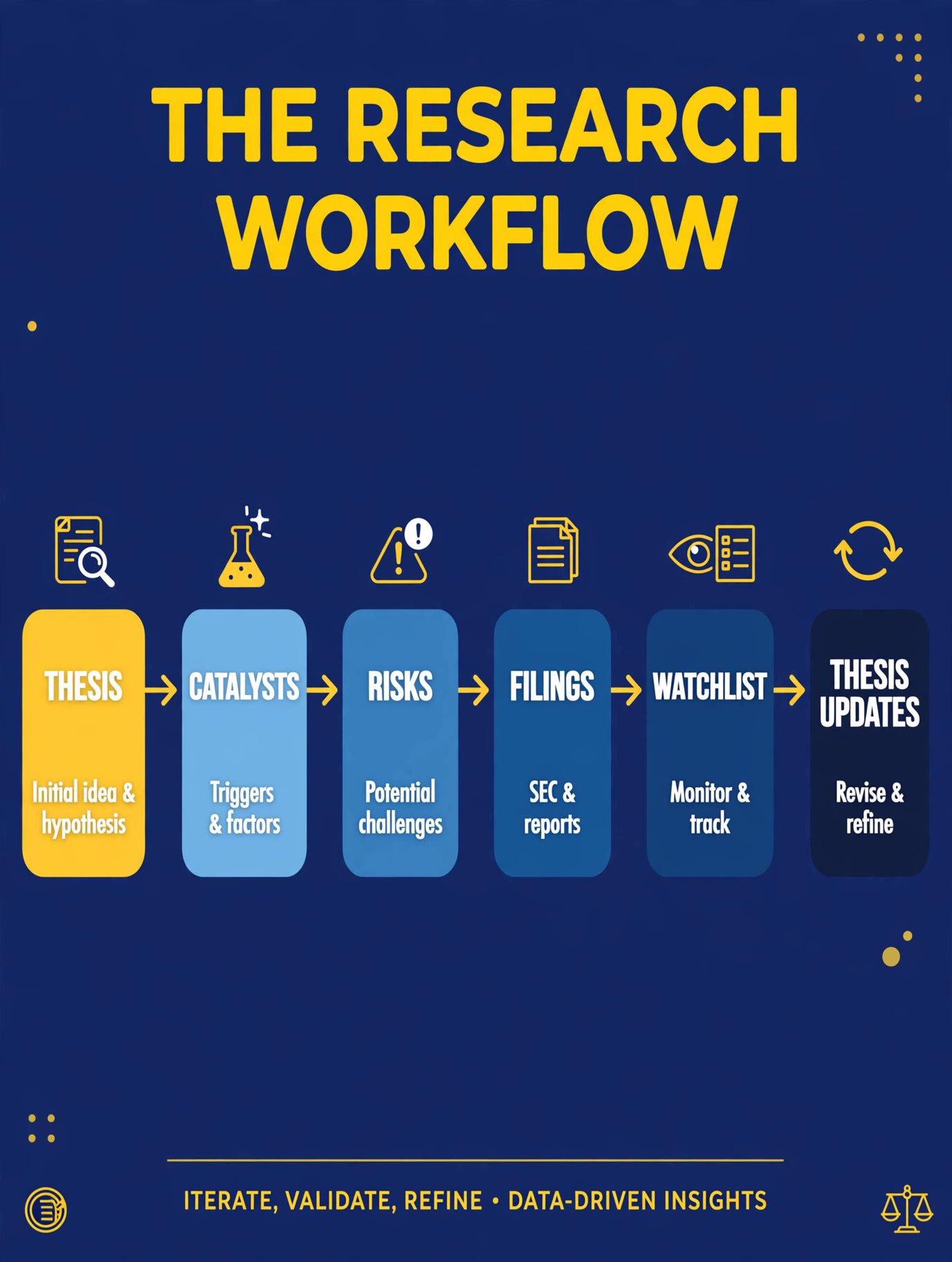
You now know how to judge a business (AP-203) and how to judge its price (AP-204). What remains is the process that turns those skills into actual decisions — a repeatable workflow you run before every purchase and revisit after. Without a workflow, research is a pile of notes and a gut feeling; with one, every position has a reason, a price, and an exit plan. We will now teach you about the investment thesis, catalysts and risks, primary sources, watchlists, and keeping the thesis alive.
The One-Paragraph Thesis: Write WHY Before You Buy
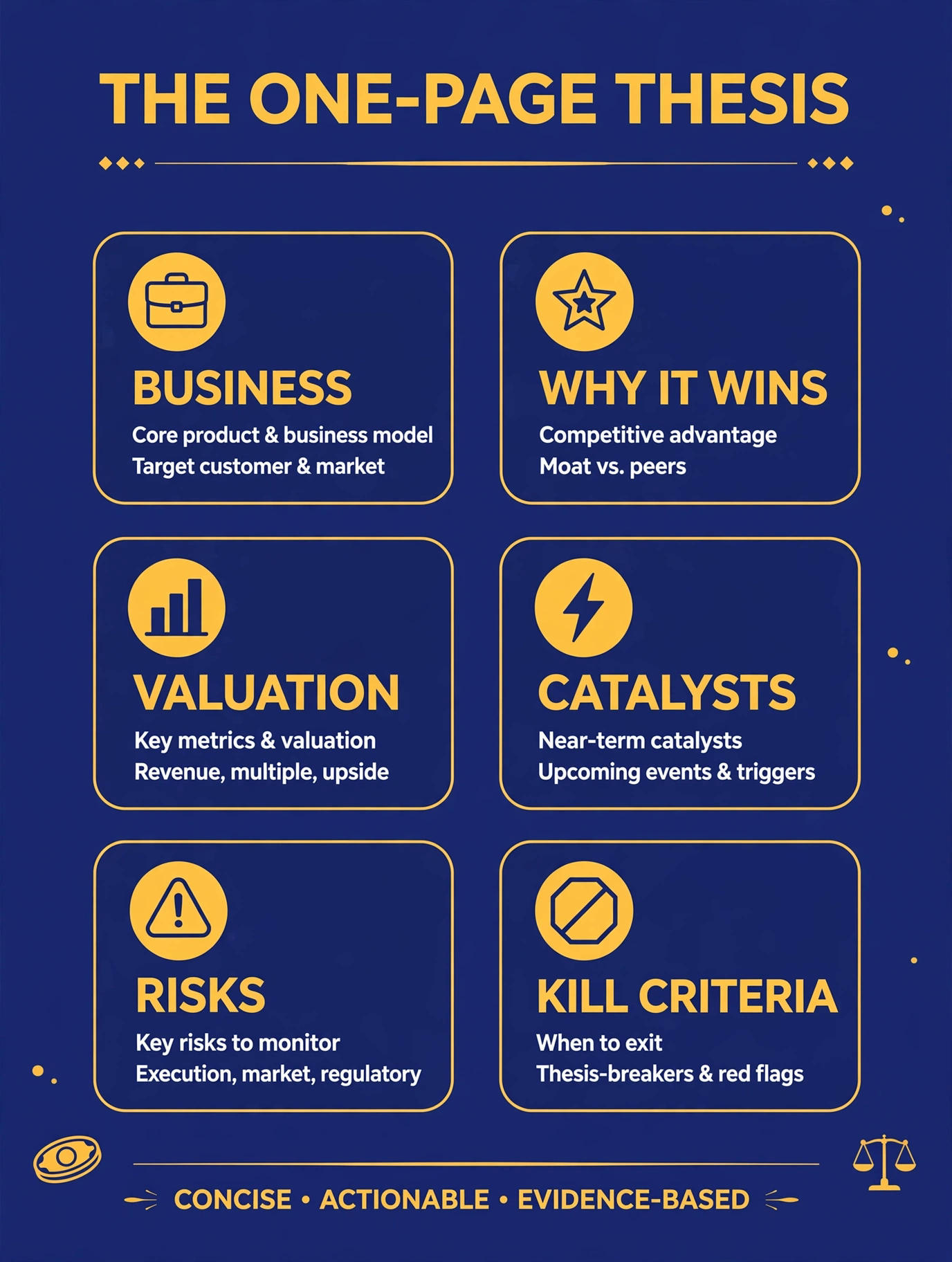
An investment thesis is a short written statement of why you own a stock — the few sentences that explain the bet you are making. Before you buy anything, force yourself to write it down in one paragraph: this is a quality business because X, the market is mispricing it because Y, and I expect to be proven right when Z happens. If you cannot write it, you do not understand it well enough to buy it.
This is the single most protective habit in investing. Writing forces clarity — vague excitement ("I think AI is the future") collapses on the page, while a real thesis survives it ("this company has a network-effect moat, earns 25% returns on capital, and trades at a P/E of 14 while peers trade at 22 because the market is pricing in a growth scare that its latest 10-K disproves"). The written thesis also becomes your anchor later: when the stock drops 20% and panic whispers, you reread the paragraph and ask whether the reason you bought still holds.
Keep it short on purpose. One paragraph, plain words. A thesis that needs three pages is not a thesis — it is a fog. If a smart friend cannot follow your reasoning in sixty seconds, simplify it until they can.
Catalysts and Risks: The Pre-Mortem
Every thesis needs two lists: what could make you right, and what could prove you wrong. A catalyst is an event that could unlock the value you see — an earnings report that beats expectations, a new product launch, a spin-off, a change in management. Catalysts give your thesis a clock: without one, you might be right but wait years for the market to notice.
The second list is harder and more important: the pre-mortem. Imagine it is two years from now and this investment failed badly. Write down what went wrong. New competition? A regulatory crackdown? Management fraud? A recession that crushed demand? The pre-mortem forces you to hunt for the thesis's weak points before your money is at stake, when you can still think clearly. For each risk, ask two questions: how likely is it, and how badly would it hurt?
Be honest about which list is stronger. If the risks are bigger and more likely than the catalysts, you do not have a thesis — you have a hope. Walk away and find a better setup. The market always offers another one.
Where the Facts Live: Primary Sources
Most investors research backwards: they read pundits' opinions first and the facts never. Flip it. A primary source is information straight from the company itself, not filtered through someone else's agenda — and it beats pundits every time. Three primary sources carry almost everything you need.
The 10-K is the company's annual report filed with the SEC: a long, dense, honest document where the business describes its operations, its risks, its financials, and — critically — management's own discussion of what happened this year. The "Risk Factors" section alone is worth the read: the company is legally required to list what could go wrong. Earnings calls are the quarterly conference calls where management presents results and analysts ask questions — listen for what management emphasizes and what they dodge. Investor presentations are the slide decks companies publish for shareholders: concise, visual, and full of the metrics management itself watches.
Pundits, forums, and finfluencers come last, if at all. They are entertainment with an agenda — selling subscriptions, pumping positions, or just filling airtime. Build your view from the company's own words first; then, and only then, check what others think to stress-test your thesis.
The Watchlist: Tracking Without Owning
Not every good business is a buy today — sometimes the quality is there but the price is not. A watchlist is where those companies wait. It is a short list of businesses you have researched, you admire, and you would buy if the price were right. Tracking without owning keeps you ready: when the market panics and hands you your price, you act in minutes instead of starting research from scratch.
The practical tool is the price alert: set a notification at your buy price — the price your valuation work says offers a margin of safety — not at whatever the market is doing today. The market's noise is not your signal. Your alert fires only when the stock reaches the price you decided, calmly and in advance, was a good deal.
Keep the watchlist short — ten to twenty names. A watchlist of a hundred stocks is a hobby, not a plan. Review it when alerts fire or when your thesis notes say a catalyst is approaching. The goal is a bench of researched opportunities, each with a price tag attached, waiting for the market to cooperate.
Keeping the Thesis Alive: Updates and Sell Discipline
Research does not end at purchase — it becomes maintenance. A thesis update is a quarterly check-in: reread your one-paragraph thesis, then ask what changed versus what you expected. Did earnings confirm the story? Did the catalyst arrive? Did a new risk appear that the pre-mortem missed? Ten minutes per holding, four times a year, keeps you honest.
Sell discipline is deciding in advance when you will sell — because in the moment, emotion decides for you. There are three good reasons to sell, and you should know which ones apply before you buy. One: the thesis is broken — the reason you bought is no longer true. Two: a better opportunity cost appeared — your money would work harder elsewhere (opportunity cost is what you give up by keeping money in this stock instead of the better option). Three: the price ran past value — the market now prices in perfection and your margin of safety is gone.
Write these sell rules into your one-pager next to the thesis. Then, when the moment comes, you are executing a plan you made calmly — not improvising under pressure. That is the whole workflow: thesis, catalysts and risks, facts, watchlist, updates, and exits. Run it the same way every time, and your results become a skill instead of a streak.
Key terms
- Investment thesis
- a short written statement of why you own a stock; the bet you are making, in plain words.
- Catalyst
- an event that could unlock the value you see, like strong earnings or a new product launch.
- Pre-mortem
- imagining the investment failed and writing down what went wrong, to find weak points before buying.
- 10-K
- the company's annual report filed with the SEC, including operations, financials, and risk factors.
- Annual report
- the company's yearly account of its business; the 10-K is its formal SEC version.
- Earnings call
- the quarterly call where management presents results and analysts ask questions.
- Primary source
- information straight from the company itself, unfiltered by pundits' agendas.
- Watchlist
- a short list of researched companies you would buy if the price were right.
- Price alert
- a notification set at your buy price, not the market's noise.
- Thesis update
- a quarterly check-in comparing what happened against what your thesis expected.
- Sell discipline
- deciding in advance when you will sell: thesis broken, better opportunity, or price past value.
- Opportunity cost
- what you give up by keeping money in this stock instead of a better option.
What's next
The research workflow completes the equity half of School 5; AP-206 "Fixed-Income Analysis" turns to bonds — yield curves, duration, and credit quality.
The quiz
Stock Research Workflow — Quiz
3 questions · pass with 3 correct
1.Why should you write your investment thesis down before you buy?
2.What is a pre-mortem?
3.Which of these are primary sources?
Ready to Start
Hand-picked resources that fit this lesson — only ever one or two, and only when they're genuinely useful.
- Learn more
Webull
A brokerage with powerful research tools to run your workflow in.
- Learn more
Public.com
Research stocks and buy fractional shares in one place.
We may earn a commission if you sign up — at no extra cost to you.