
Valuation
School 04 — Security Analysis and Portfolio Design
Listen — 15-second overview
A quick spoken preview of this class
School 5 · Security Analysis and Portfolio Design · About 15 minutes
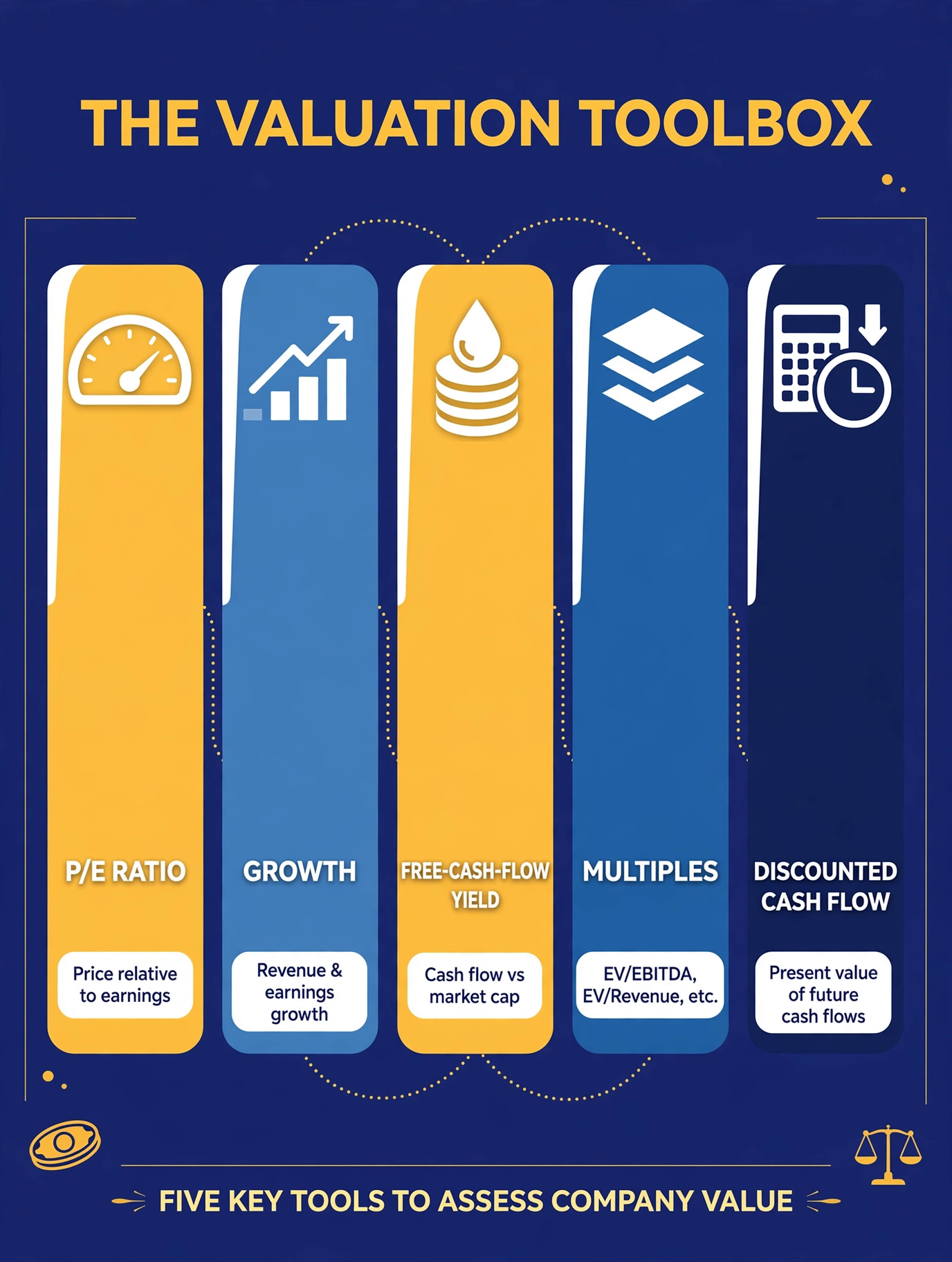
AP-203 taught you how to judge whether a business is good. Now comes the other half of the equation: what is a fair price to pay for it? A great business bought too expensively can be a poor investment for years. Valuation is the discipline of figuring out what something is worth — so you can tell the difference between a fair price, a bargain, and a trap. We will now teach you about valuation, the P/E ratio, free-cash-flow yield, multiples, discounted cash flow, and thinking in scenario ranges.
What Valuation Answers
Valuation does not answer "is this a good business?" — that was AP-203's job. It answers a narrower, harder question: at this price, is this a good investment? Price and worth are two different things. The market quotes a price every second; worth is your independent judgment of what the business's future cash flows are really worth to an owner. Valuation is the bridge between the two.
This distinction is what keeps investors out of trouble. A wonderful company trading at a price that assumes perfection has no room left for surprise — any disappointment hits the stock hard. A mediocre company priced as if it were dying can be a fine investment if it merely survives. Valuation forces you to stop admiring the business and start interrogating the price.
One warning before the tools: valuation is an estimate, not a measurement. You are making reasoned guesses about an uncertain future. The goal is not a precise number to the penny — it is a range, a judgment, and a decision rule about what you will and will not pay. Precision is a fantasy; a sensible range is a superpower.
The P/E Ratio
The P/E ratio — price-to-earnings — is the most famous valuation tool in the world. It is simply the stock price divided by the company's annual earnings (its yearly profit). If a stock costs $100 and the company earned $5 per share over the last year, the P/E is $100 ÷ $5 = 20. That number has a plain meaning: you are paying $20 for every $1 of yearly profit the company makes.
What does high vs. low mean? A low P/E — say 8 or 10 — means you are buying each dollar of profit cheaply; the market is not excited about this company. A high P/E — say 40 or 60 — means you are paying dearly for each dollar of profit; the market is very excited. High P/Es are not automatically bad: growth expectations explain them. Investors pay up for earnings they believe will grow fast, because today's small profit becomes tomorrow's large one.
But that belief is a bet, and bets can be wrong. When a company with a P/E of 50 stops growing as expected, the stock can fall hard even though the business is still fine — the price was the problem. The lesson of the P/E is simple: know what growth you are paying for, and ask yourself whether that growth is realistic.
Free-Cash-Flow Yield: The Owner's Earnings View
Earnings can be a slippery number — accounting rules let companies recognize profit in ways that do not always match cash. Free-cash-flow yield cuts through that by asking the owner's question: how much cash did this business truly produce this year, compared to what I would pay for the whole thing? It is the free cash flow (cash left over after the business paid for everything it needs to run and maintain itself) measured against the price.
Think of it like a rental property. If a building costs $500,000 and truly puts $25,000 of cash in your pocket each year after all expenses, you are earning 5% on your money — that is the yield. A stock works the same way: the free-cash-flow yield tells you what the business pays you, the owner, in cold hard cash terms. A higher yield means more cash per dollar of price — a cheaper claim on the business's real money.
This view also protects you from a classic trap: companies that report growing earnings while their cash flow shrivels. Profits on paper mean little if the cash never arrives. Whenever a P/E looks attractive, check the free-cash-flow yield too — if the cash tells a worse story than the earnings, trust the cash.
Multiples and Comparisons
No valuation number means much in isolation — is a P/E of 18 high or low? Peer comparison gives the answer by setting the company's multiple against similar companies. A multiple is just a valuation ratio like P/E: "the market pays 18 times earnings for this company." If its close competitors trade at P/Es of 12 while this one trades at 22, you have a real question to answer: what justifies the premium? Sometimes the answer is quality — it deserves to cost more. Sometimes the answer is hype.
The other comparison is against the company's own history. If a business has traded at a P/E of 14–18 for a decade and now trades at 30, the market is pricing in something new — find out what. History is not destiny, but a sudden break from it is a signal worth investigating.
The discipline here is that multiples are relative, not absolute. They tell you whether a stock is expensive compared to its cousins and its past — not whether it is worth buying. A whole sector can be overpriced together. Use comparisons to sharpen your questions, then answer the absolute question — what is it actually worth — with scenarios.
Thinking in Ranges: Scenarios and Margin of Safety
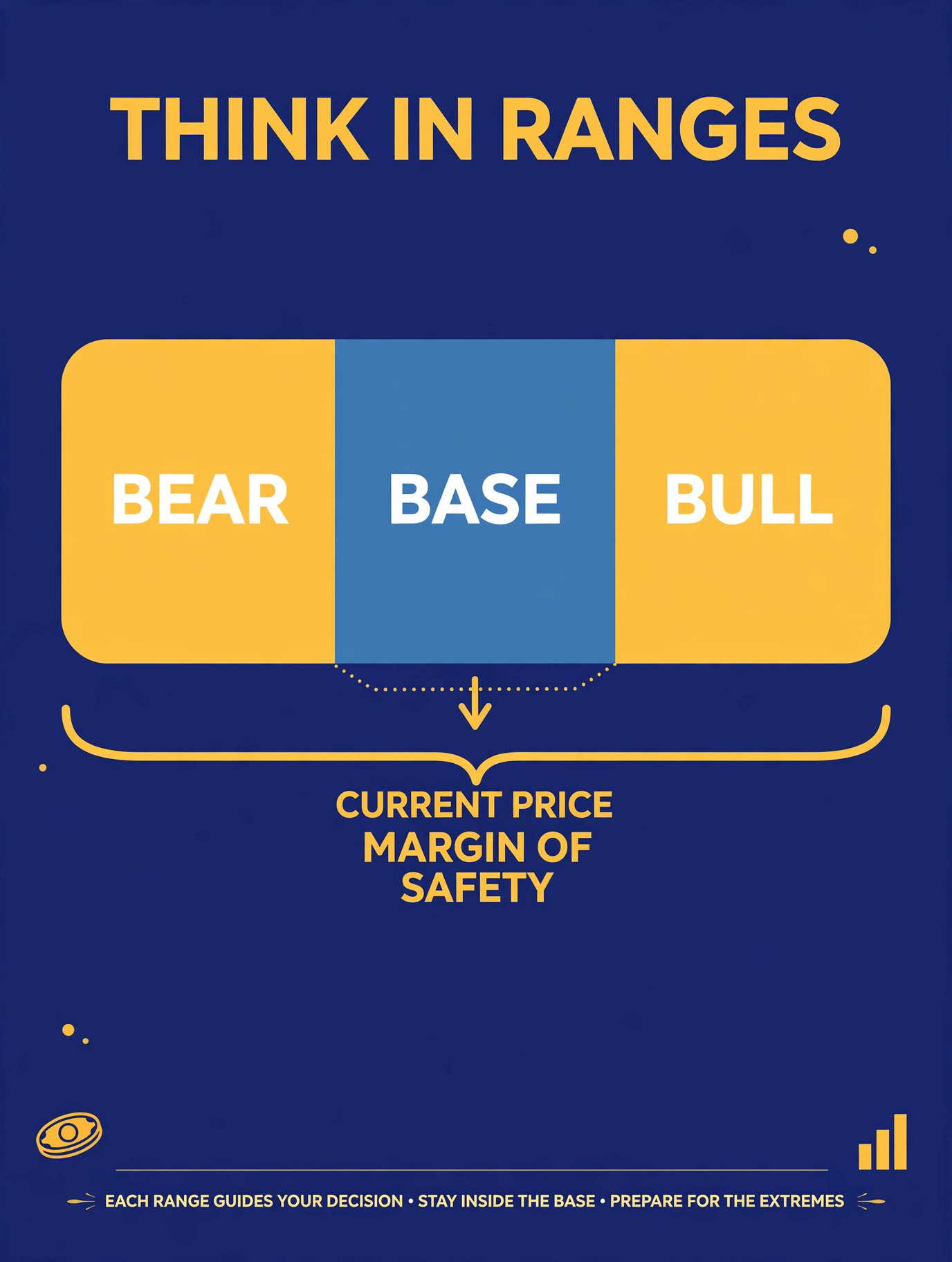
Because the future is uncertain, good investors think in ranges, not points. Scenario analysis means sketching three futures for the business: the bull case (things go well — strong growth, expanding margins), the base case (the most likely path), and the bear case (things go wrong — growth stalls, a recession hits). You value the business under each, and you get a range of worth instead of a single fragile number.
There is a formal method behind this called discounted cash flow: valuing a business by estimating the cash it will produce in future years and bringing that future cash back to today's value, since a dollar next year is worth less than a dollar today. You do not need to run the math yourself — the concept is what matters: a business is worth the cash it will hand its owners over its lifetime, adjusted for the wait.
All of this leads to the final discipline: margin of safety. If your analysis says a business is worth about $80–$100 a share, you do not pay $95. You pay $60 or $70 — a price comfortably below even your bear case. The margin of safety is your protection against being wrong, and you will be wrong sometimes. Valuation is not about finding the perfect price; it is about refusing to pay a price that leaves you no room for error.
Key terms
- Valuation
- the discipline of figuring out what a business is worth, to judge whether its price is fair.
- P/E ratio
- stock price divided by annual earnings; how many dollars you pay per $1 of yearly profit.
- Earnings
- a company's yearly profit; the "E" in P/E.
- Growth
- the expected increase in earnings over time; high growth expectations explain high P/Es.
- Free-cash-flow yield
- the cash a business truly produced, measured against its price; the owner's-earnings view.
- Multiple
- a valuation ratio like P/E; "the market pays X times earnings for this company."
- Peer comparison
- judging a valuation by setting it against similar companies and the company's own history.
- Discounted cash flow
- valuing a business by its future cash, brought back to today's value.
- Scenario analysis
- valuing a business under bull, base, and bear cases to get a range of worth.
- Bull case
- the optimistic scenario: things go well for the business.
- Base case
- the most likely scenario for the business's future.
- Bear case
- the pessimistic scenario: things go wrong for the business.
- Margin of safety
- paying comfortably less than a business is worth, as protection against being wrong.
What's next
Valuation turns analysis into a decision; AP-205 "Stock Research Workflow" assembles everything into a repeatable process — thesis, catalysts, risks, and the one-page write-up.
The quiz
Valuation — Quiz
3 questions · pass with 3 correct
1.A stock costs $100 and the company earned $5 per share last year. What is the P/E?
2.What usually explains a high P/E ratio?
3.What does margin of safety mean in practice?
Recommended Tools
Hand-picked resources that fit this lesson — only ever one or two, and only when they're genuinely useful.
- Learn more
Motley Fool
Valuation data and stock research to check your work against.
We may earn a commission if you sign up — at no extra cost to you.