
Business Quality
School 04 — Security Analysis and Portfolio Design
Listen — 15-second overview
A quick spoken preview of this class
School 5 · Security Analysis and Portfolio Design · About 15 minutes
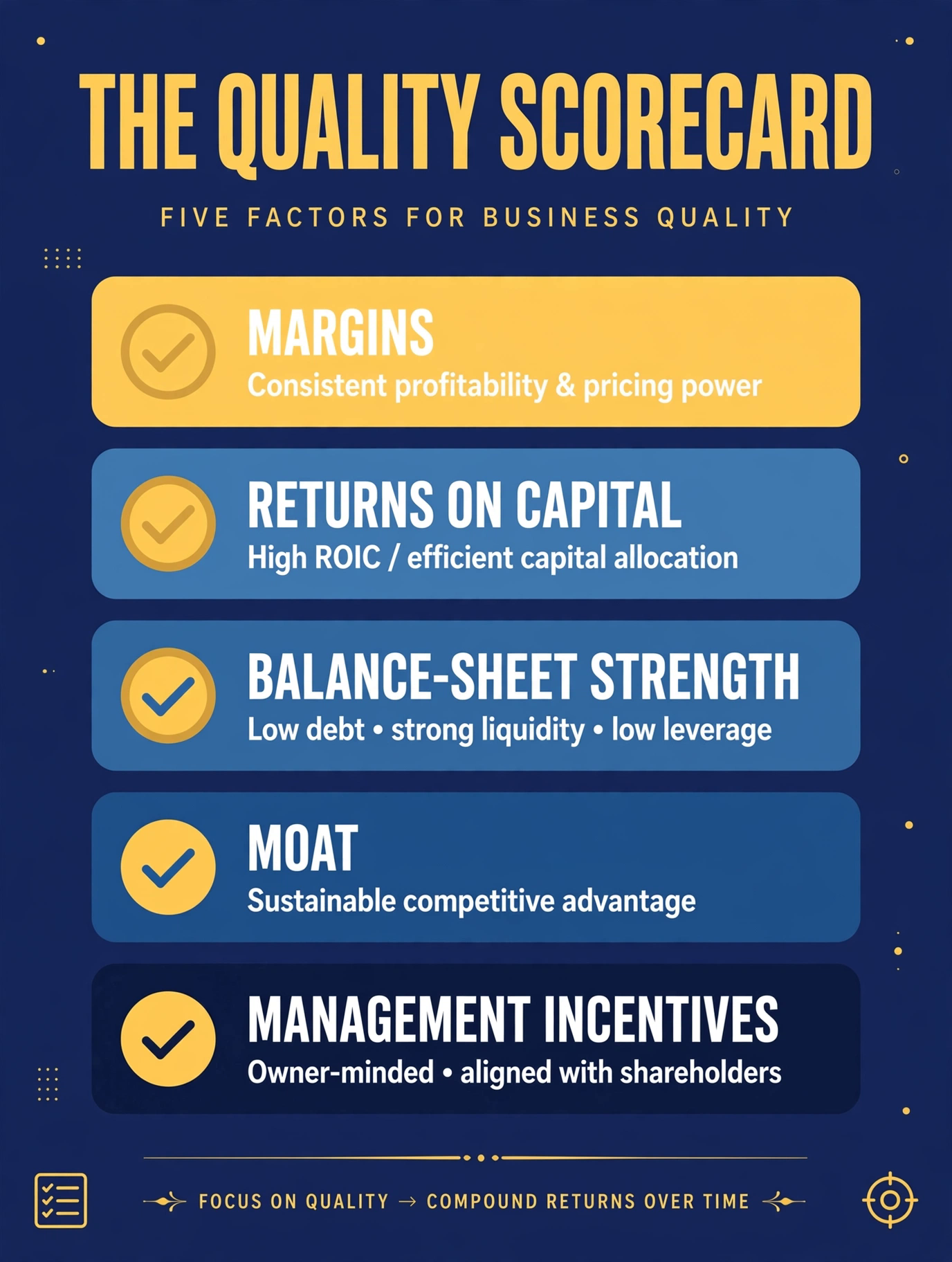
A great stock is not the same thing as a great business — a wonderful company can be a terrible investment if you overpay for it, and a mediocre company can be a fine investment if it is cheap enough. But analysis starts with the business itself. Quality comes first, price comes second: you want to know whether the machine works before you haggle over the price tag. We will now teach you about business quality, margins, returns on capital, balance-sheet strength, moats, and management incentives.
A Great Business vs. a Great Stock: Quality First, Price Second
Business quality is how good the underlying company is — how reliably it turns effort and assets into profit, year after year. A great business earns strong profits with little drama: customers keep coming back, competitors struggle to take share, and it does not need constant luck or heroics from its managers. A great stock, by contrast, is a great business bought at a price that leaves room for the buyer to profit.
Why does the order matter? Because quality is sticky and price is a moment. A high-quality business tends to stay high-quality for years — its advantages compound. A low price, though, is a snapshot: the stock is cheap today and fairly priced tomorrow. So the disciplined sequence is: find quality first, then wait for (or demand) the right price. AP-204 covers the pricing half.
There is a practical reason too. Owning a great business gives you patience for free — when the stock dips, you hold because you trust the machine. Owning a mediocre business bought cheaply gives you nothing to hold onto: every dip feels like a warning. Start with quality, and everything downstream gets easier.
Margins and Returns on Capital
Gross margin is the slice of each sales dollar the company keeps after paying the direct cost of what it sold. If a company sells a product for $100 and it cost $60 to make, the gross margin is the $40 kept — a high gross margin means the company has pricing power, the ability to charge more than things cost it. Net margin is the stricter measure: the slice kept after all expenses — rent, salaries, taxes, everything. Gross margin tells you if customers value the product; net margin tells you if the whole operation is efficient.
Return on invested capital — often shortened to ROIC — is the most revealing quality metric of all. Think of it as "profit per dollar tied up in the business." A company has money tied up in factories, inventory, equipment, and cash. ROIC asks: for every dollar the business has tied up, how many cents of profit does it produce each year? A company that earns 20 cents per tied-up dollar is a better machine than one that earns 5 cents per tied-up dollar, even if the second company is bigger.
Why do high returns on capital signal a good business? Because they are hard to fake and hard to sustain without a real advantage. Any business can grow by pouring in more money — open more stores, buy more equipment. But earning high returns on the money already in the business means customers keep paying, competitors cannot easily copy the formula, and the company can fund its own growth instead of constantly borrowing or selling new shares. Consistently high ROIC is the fingerprint of quality.
Balance-Sheet Strength: Low Debt, Cash Cushion
The balance sheet is the company's financial snapshot: what it owns (assets) versus what it owes (debts). Balance-sheet strength means the snapshot looks sturdy — modest debt, a comfortable pile of cash, and no bills it cannot pay. It is the corporate version of a household with an emergency fund and no credit-card balances.
Debt is borrowed money the company must repay with interest, on schedule, no matter what. In good times debt looks clever — it juices returns because the company grows using someone else's money. But debt turns downturns into disasters: sales fall, the interest bill does not, and the company can be forced to sell assets at fire-sale prices or go bankrupt. That is why analysts check the debt load before anything else — a quality business should be able to survive a bad year without begging lenders for mercy.
The other half of strength is the cash cushion: money in the bank that lets the company handle surprises. Cash buys options — it lets a business ride out a recession, invest when rivals are retreating, or buy back its own shares cheaply. When you read a balance sheet, the two-line test is: is debt low enough that a bad year would be painful but not fatal, and is there enough cash to keep the lights on while it recovers?
The Moat: What Keeps Competitors Out
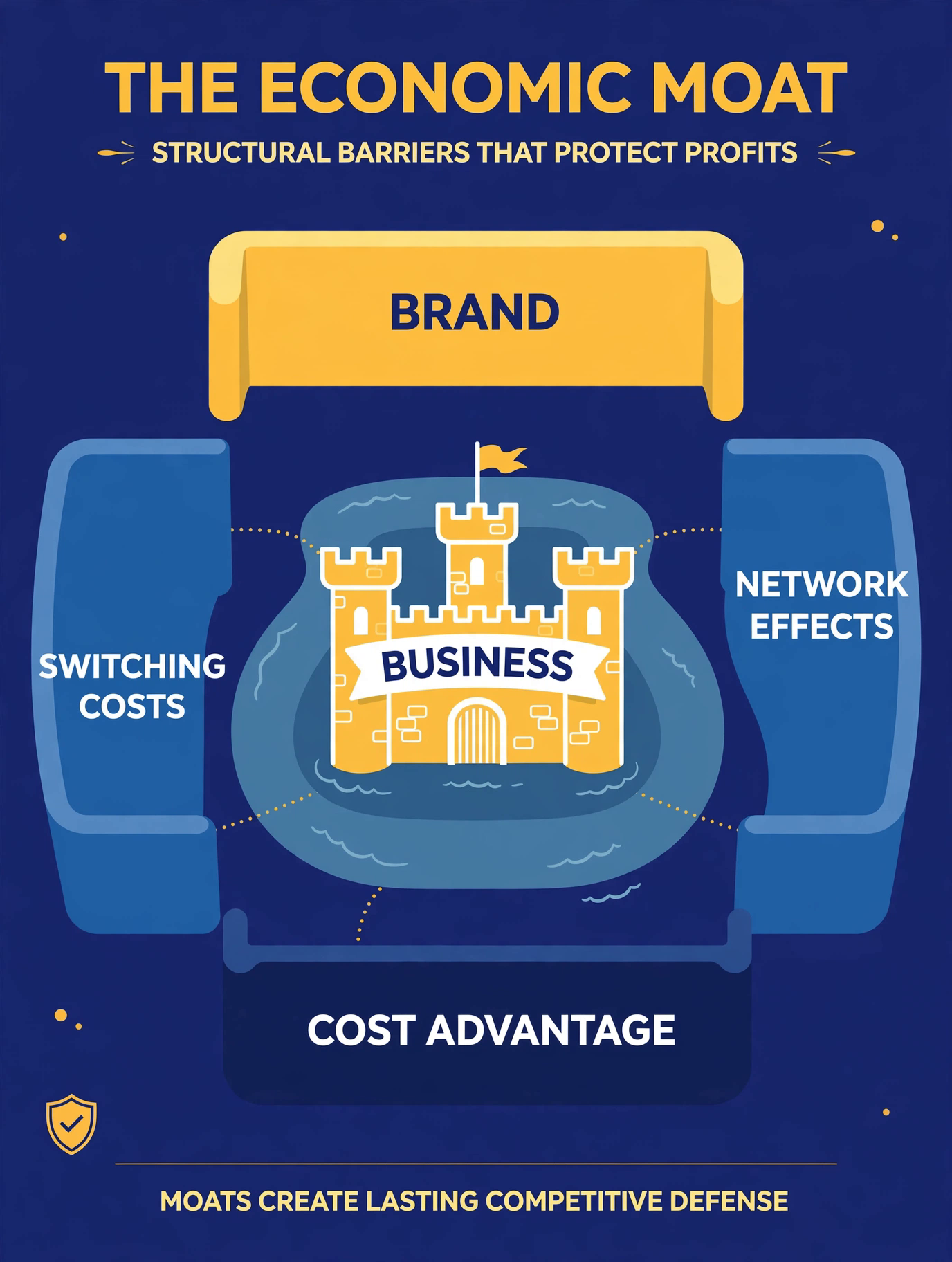
A moat is a durable competitive advantage — the reason a company's profits do not get competed away. The name comes from a castle's water defense: just as a moat kept invaders out, a business moat keeps competitors from stealing the company's profits. There are four classic sources.
A brand moat is customer loyalty strong enough that people pay more or refuse substitutes — think of a soft drink people insist on by name. Switching costs are the pain of leaving: a company whose software runs your whole business can raise prices because replacing it would be a nightmare. Network effects mean the product gets better as more people use it — a marketplace with millions of buyers attracts millions of sellers, which attracts more buyers, in a loop newcomers cannot easily copy. A cost advantage is simply being able to make or deliver something cheaper than rivals — through scale, a better process, or a resource they cannot access.
Moats matter because profits attract competition. A business earning fat margins with no moat is a billboard advertising "easy money here" — rivals arrive, prices fall, margins shrink. A business with a genuine moat earns those margins for years. When you evaluate quality, always ask: what would stop a well-funded competitor from doing exactly this?
Management Incentives: Skin in the Game
The best business in the world can be run for the managers instead of the owners. Skin in the game means the people running the company share your fate: they own a meaningful amount of the stock themselves, so when you win they win and when you lose they lose. A CEO with most of their wealth in the company's shares thinks like an owner, because they are one.
The second question is whether pay is tied to long-term results. Shareholder-friendly management is rewarded for growing the business's real value over years — not for hitting this quarter's numbers or growing the empire. Warning signs include huge bonuses tied to short-term stock pops, pay that rises while the stock falls, and managers who sell their own shares while telling you to buy. Good signs include insider buying, conservative pay, and leaders who talk about returns on capital rather than vanity metrics.
You can check this in the company's annual filings, which disclose executive pay and insider ownership. It takes ten minutes and it tells you whose side the managers are really on.
Key terms
- Business quality
- how reliably a company turns effort and assets into profit over time; comes first, price second.
- Gross margin
- the slice of each sales dollar kept after the direct cost of what was sold; signals pricing power.
- Net margin
- the slice of each sales dollar kept after all expenses; signals overall efficiency.
- Return on invested capital
- profit per dollar tied up in the business; high sustained returns are the fingerprint of quality.
- Balance-sheet strength
- a sturdy financial snapshot: low debt, a cash cushion, and bills the company can pay.
- Debt
- borrowed money that must be repaid with interest on schedule; turns downturns into disasters.
- Moat
- a durable competitive advantage that keeps rivals from eroding profits.
- Brand moat
- customer loyalty strong enough that people pay more or refuse substitutes.
- Switching costs
- the pain of leaving a product, which lets the company keep customers and pricing power.
- Network effects
- a product that gets better as more people use it, creating a loop newcomers cannot copy.
- Cost advantage
- the ability to make or deliver something cheaper than rivals, through scale, process, or resources.
- Skin in the game
- managers owning meaningful stock themselves, so their fate matches yours.
- Shareholder-friendly
- management rewarded for growing real long-term value, not short-term numbers or empire size.
What's next
A quality business is only half the equation — AP-204 "Valuation" asks what it is worth, and what price leaves you a margin of safety.
The quiz
Business Quality — Quiz
3 questions · pass with 3 correct
1.What is the correct order of analysis according to this lesson?
2.What does return on invested capital measure?
3.What is a business moat?
Recommended Tools
Hand-picked resources that fit this lesson — only ever one or two, and only when they're genuinely useful.
- Learn more
Motley Fool
Research tools for digging into business quality and competitive moats.
We may earn a commission if you sign up — at no extra cost to you.