
Read Financial Statements
School 04 — Security Analysis and Portfolio Design
Listen — 15-second overview
A quick spoken preview of this class
School 5 · Security Analysis and Portfolio Design · About 15 minutes
Every public company is required to publish its financial results, and those reports are free for anyone to read. That is a staggering advantage for you as an investor: before you buy a single share, you can look inside the business — its sales, its costs, its debts, its cash. Most people never open these documents because they look intimidating. They are not. We will now teach you about the three financial statements, how profit is actually calculated, what the balance sheet reveals about debt, why cash flow is the truth serum, and how to spot the quality of a company's earnings.
The Three Statements: A Map
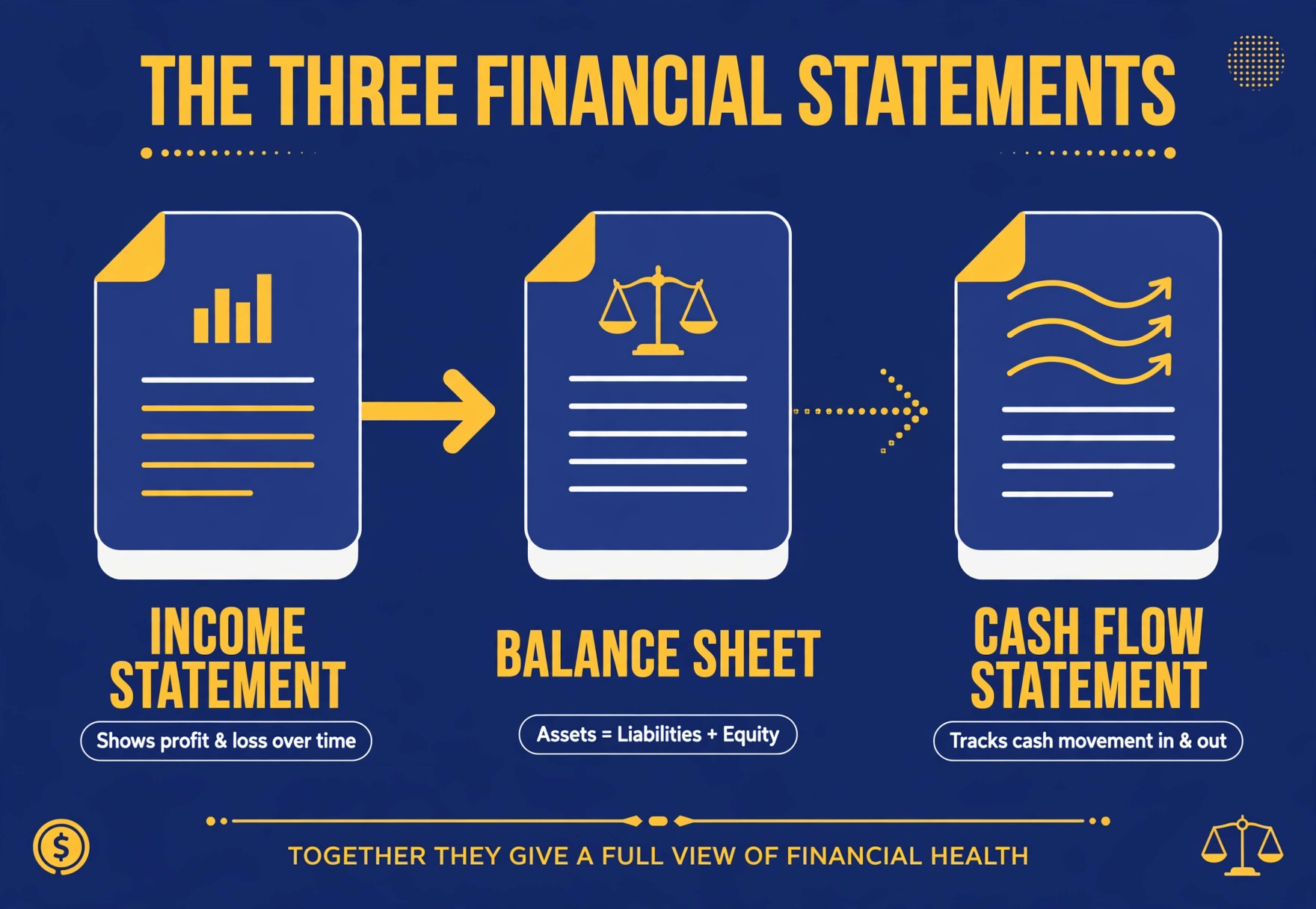
A company reports on itself with three core documents, and each one answers a different question. Learn the map once and you will never be lost.
The income statement answers: did the business make money this period? Think of it as the movie — it plays out over a stretch of time (a quarter or a year), showing sales coming in and costs going out.
The balance sheet answers: what does the business own and owe right now? Think of it as the snapshot — a single photograph taken at one moment, showing everything the company has and everything it owes.
The cash flow statement answers: where did the cash actually go? Think of it as the truth serum — because profits can be massaged by accounting choices, but cash moving in and out of the bank account is much harder to fake.
All three live inside the company's 10-K: the big annual report every public company files with the government. The 10-K is long and dry, but the three statements sit right in the middle of it, and you already know how to read each one after this lesson.
The Income Statement: Tracing One Dollar
The income statement starts with revenue — the total money customers paid the company. Call it one dollar of sales, and follow it down the page.
First, subtract what it cost to make or deliver what was sold — materials, factory labor, shipping. What is left is gross profit: sales minus the direct cost of the product. This is the first great health check. If a company sells a $100 gadget that costs $60 to make, its gross profit is $40 per gadget. High gross profit means customers value the product far above its cost — a sign of pricing power.
Next come operating expenses: the costs of running the business itself — salaries, rent, advertising, research. Subtract those from gross profit and you get operating profit: what the core business earned before financing and taxes.
Finally, subtract interest on debt and taxes, and you arrive at net income — the famous "bottom line." This is the profit the company officially reports. Our one dollar of sales has now become, say, twelve cents of net income. That twelve cents belongs to the shareholders — it can be reinvested in the business or paid out as dividends.
Watch the journey, not just the destination. A company can grow revenue every year and still be a bad business if its costs grow faster. The income statement shows you exactly where each dollar dies — and whether management is keeping costs under control as sales grow.
The Balance Sheet: What It Owns, What It Owes
The balance sheet is built on one simple equation: assets = liabilities + equity. In plain words: what the company owns equals what it owes plus what is left over for the owners.
Assets are what the company owns: cash in the bank, inventory on shelves, factories and equipment, money customers owe it. Liabilities are what it owes: loans, bonds, bills from suppliers, wages it has not paid yet. Equity is the leftover — assets minus liabilities — the owners' slice. If the company sold everything and paid every debt, equity is what shareholders would pocket.
Why should you care? Because of debt. A company can report lovely profits on its income statement while quietly drowning in liabilities. Debt is not automatically evil — borrowing to build a profitable factory can be smart — but heavy debt makes a company fragile. When a recession hits (see AP-201), sales fall, but debt payments do not. The companies that survive downturns are usually the ones whose balance sheets were strong going in.
A quick reader's habit: glance at total liabilities versus total equity. If a company owes far more than its owners' stake is worth, it is living on borrowed time and borrowed money. If it owns far more than it owes, it has a cushion — room to stumble without collapsing.
The Cash Flow Statement: The Truth Serum
Here is the secret the pros know: net income is an opinion, but cash is a fact. The income statement follows accounting rules that let companies record sales before the customer pays, or spread big costs across years. The cash flow statement ignores all of that and simply tracks money moving in and out.
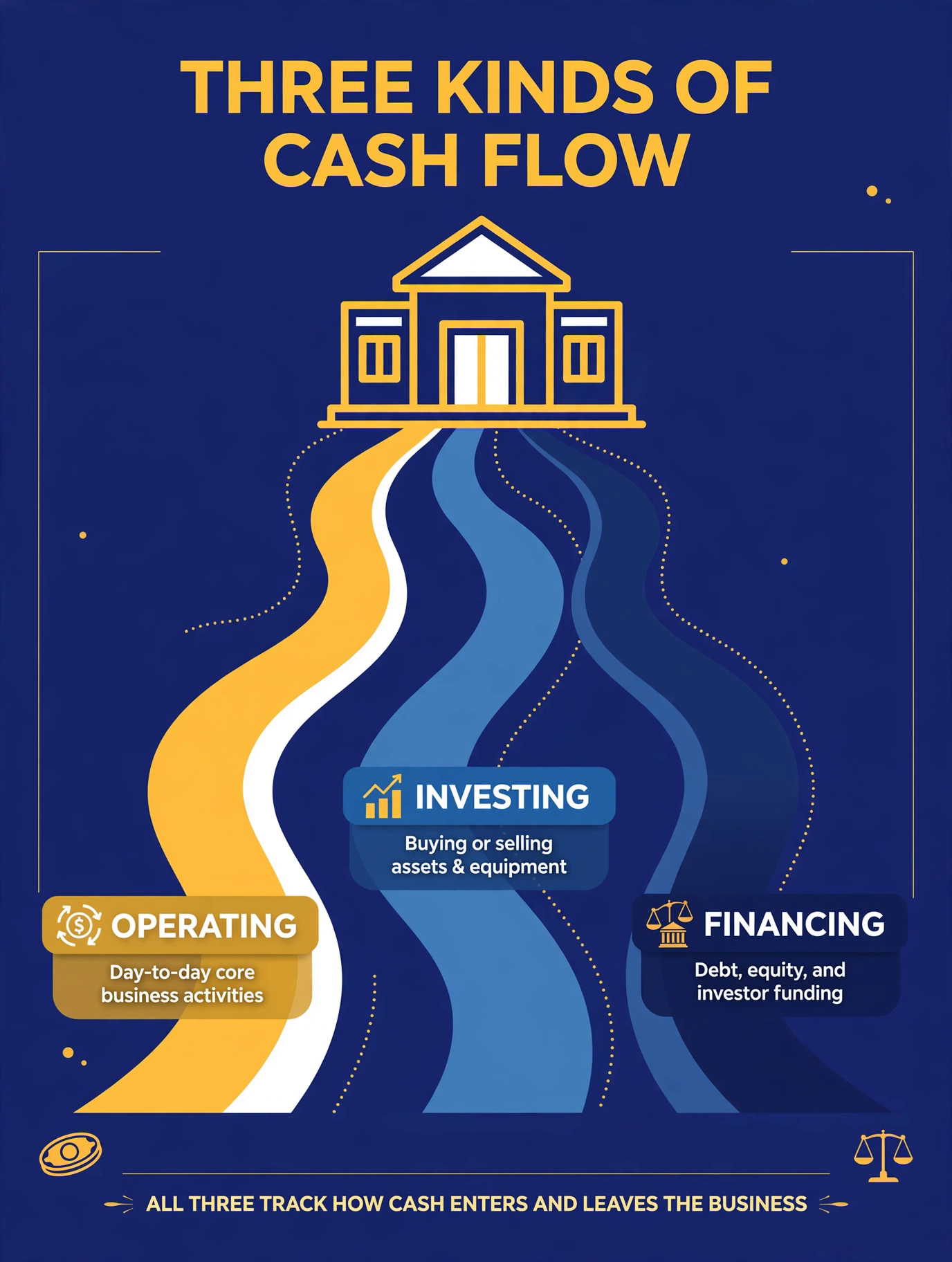
It splits cash into three pipes. Operating cash flow is cash from the actual business — customers paying, suppliers and employees being paid. This is the pipe that matters most: a healthy company should consistently generate more operating cash than it reports in net income, because real cash collected is worth more than profits promised.
Investing cash flow covers buying and selling long-term assets — building factories, buying equipment, acquiring other companies. It is usually negative for growing businesses, and that is fine: they are planting seeds. Financing cash flow covers borrowing, repaying debt, issuing shares, and paying dividends — money moving between the company and its funders.
What is left after the business pays for the equipment and upkeep it needs to keep running is called free cash flow — the cash the owners could truly pocket. You do not need to calculate it precisely; just understand the idea. A company with rising net income but shrinking operating cash flow is waving a red flag: its profits exist on paper, but the cash is not arriving.
Quality of Earnings and Footnotes
Not all profits are created equal. Quality of earnings is the investor's term for asking: how real are these profits? High-quality earnings are backed by cash; low-quality earnings live mostly in accounting assumptions.
The gap between reported profit and cash comes from accruals — accounting entries that record revenue or expenses before cash changes hands. Accruals are legal and normal, but they are also where trouble hides. The classic red flag: a company's receivables (money customers owe it) are growing much faster than its sales. That means it is booking revenue aggressively while customers are slow to pay — or may never pay. Profits on paper, cash never arriving.
Other warning signs worth knowing: profits rising while operating cash flow falls, frequent one-time "adjustments" that always seem to flatter the numbers, and debt growing faster than the business itself.
And then there are the footnotes — the small print at the back of the financial statements. This is where companies disclose the details they would rather you skip: how they recognize revenue, what their debt really costs, lawsuits they might lose, deals with insiders. Professionals read the footnotes first, because that is where the honest version lives. You do not need to read every line, but never skip them entirely — the most important sentence in a 10-K is often hiding in footnote 12.
Key terms
- Income statement
- the financial statement showing revenue, costs, and profit over a period of time; the movie.
- Revenue
- the total money customers paid the company; the top line where the income statement begins.
- Gross profit
- revenue minus the direct cost of making or delivering what was sold; the first health check on pricing power.
- Operating expenses
- the costs of running the business itself: salaries, rent, advertising, research.
- Net income
- the bottom line: profit after all costs, interest, and taxes; what officially belongs to shareholders.
- Balance sheet
- the financial statement showing what a company owns and owes at a single moment; the snapshot.
- Assets
- what the company owns: cash, inventory, equipment, money customers owe it.
- Liabilities
- what the company owes: loans, bonds, unpaid bills.
- Equity
- the owners' leftover slice: assets minus liabilities.
- Cash flow statement
- the financial statement tracking actual cash moving in and out; the truth serum.
- Operating cash flow
- cash generated by the core business; the most important pipe on the cash flow statement.
- Free cash flow
- cash left over after the business pays for what it needs to keep running; what owners could truly pocket.
- Accruals
- accounting entries that record revenue or expenses before cash changes hands; the gap between profit and cash.
- Quality of earnings
- how real a company's reported profits are; high quality means backed by cash.
- Footnotes
- the small print behind the financial statements where companies disclose the honest details.
- 10-K
- the big annual report every public company files, containing all three statements plus the footnotes.
What's next
Reading the statements is step one; AP-203 "Business Quality" teaches you to judge what you read — margins, returns on capital, and the moat.
The quiz
Read Financial Statements — Quiz
3 questions · pass with 3 correct
1.Which statement is called the truth serum because it is hardest to fake?
2.What is gross profit?
3.Which of these is a red flag for low-quality earnings?
Recommended Tools
Hand-picked resources that fit this lesson — only ever one or two, and only when they're genuinely useful.
- Learn more
Motley Fool
Stock research and investor education that pairs with the statements you'll now read.
We may earn a commission if you sign up — at no extra cost to you.