
Workplace Retirement Plans
School 05 — Retirement and Long-Term Planning
Listen — 15-second overview
A quick spoken preview of this class
School 4 · Retirement and Long-Term Planning · About 15 minutes
Your employer's retirement plan is the easiest wealth-building tool most people will ever touch — and the one most often underused. Money comes straight out of your paycheck before you can spend it, your employer may add free money on top, and the account grows tax-advantaged for decades. We will now teach you about 401(k)s, 403(b)s, and the TSP, how the employer match works, what vesting means, how to choose from the investment menu, and what to do with the account when you change jobs.
401(k), 403(b), and TSP: The Three Flavors
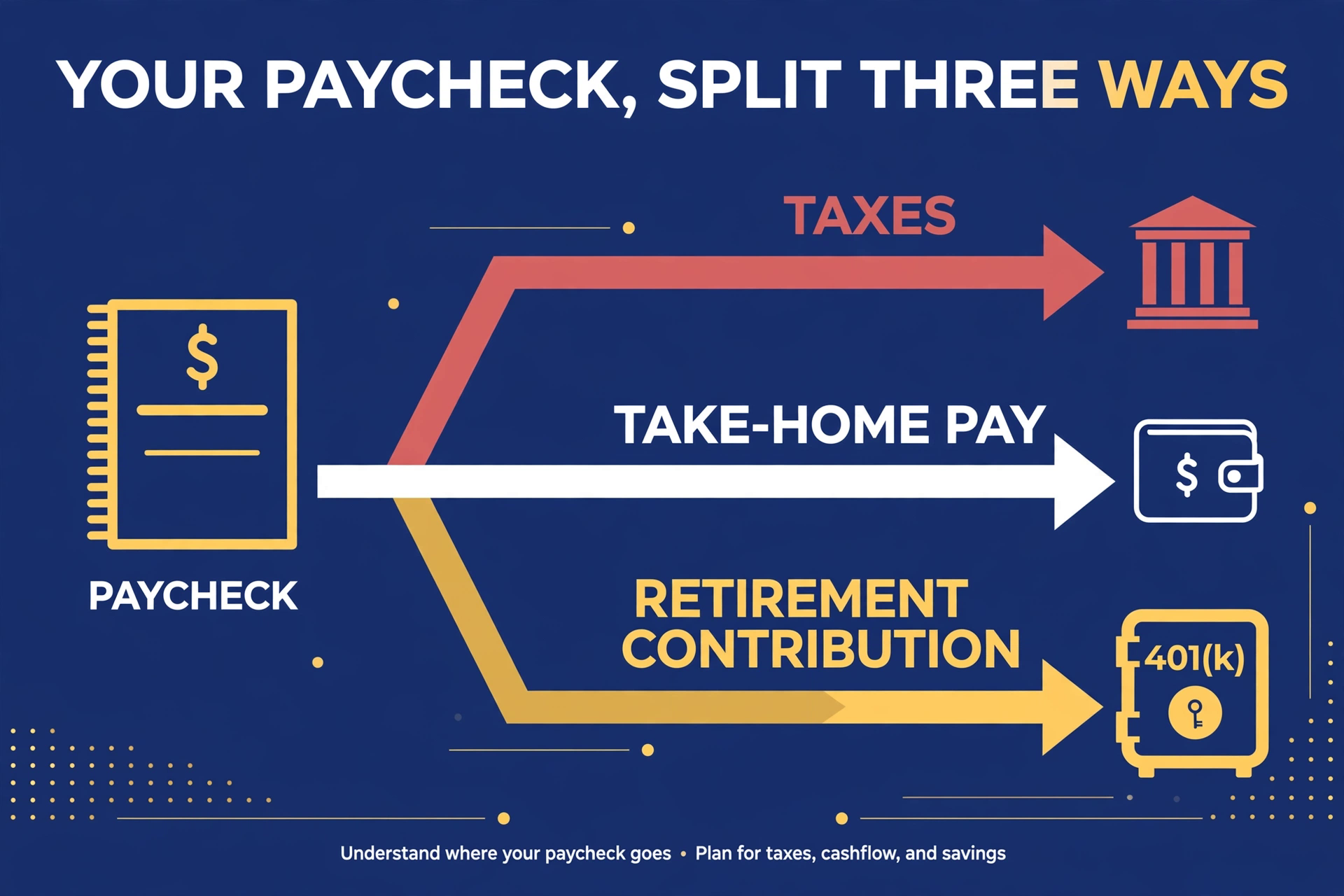
A workplace retirement plan is an account your employer offers that lets you invest part of your paycheck for retirement with special tax treatment. The money is deducted automatically, which is the plan's hidden superpower: you never see the money, so you never miss it, and you invest consistently without any willpower at all.
The plan you get depends on where you work. A 401(k) is the standard plan at most private companies. A 403(b) works nearly the same way but is offered by schools, hospitals, and nonprofits. The TSP — the Thrift Savings Plan — is the federal government's version, used by military members and federal employees. All three follow the same playbook: contribute from your paycheck, choose investments, and pay less tax now or later.
The main choice inside these plans is traditional vs. Roth contributions. Traditional contributions come out before income tax, lowering this year's tax bill; you pay tax when you withdraw in retirement. Roth contributions come out after tax — no deduction now — but the money grows and is withdrawn tax-free in retirement. Many plans let you split between the two. We will go deeper on this tradeoff in LP-102.
The Employer Match: The Closest Thing to Free Money
Many employers match a portion of your contributions. A common formula is 50% of what you put in, up to 6% of your salary. If you earn $60,000 and contribute 6% ($3,600 a year), your employer adds $1,800. That is an instant 50% return before the money is even invested — there is no stock, fund, or trade anywhere that offers that reliably.
Run the numbers. Skip the match for a year and you have lost that $1,800. Over 30 years at a 7% average return, that single year's missed match would have grown to about $13,700. Multiply that by a career of missed matches and the cost is staggering. The practical rule is simple: contribute at least enough to get the full match before you invest anywhere else. It is the highest-return move in personal finance.
One nuance: some employers match with a true-up, some per paycheck. If your plan matches per paycheck and you max out your contributions early in the year, you can accidentally miss late-year matches. Check your plan's summary description — a free document your employer must provide — for the details.
Vesting: When the Employer's Money Becomes Yours
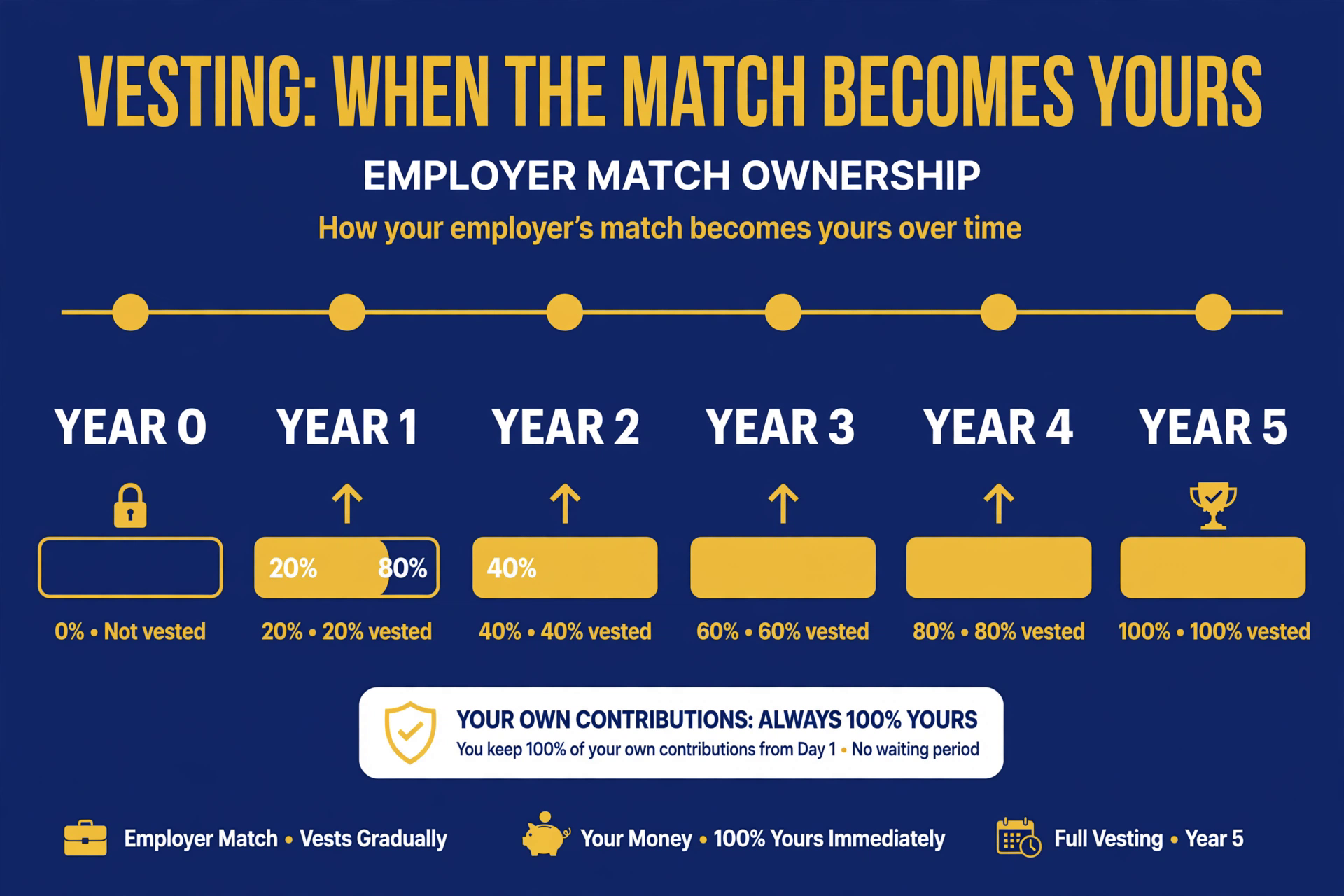
Vesting is the schedule on which your employer's contributions actually become yours to keep. Your own contributions are always 100% yours from day one. The match, though, may take time to vest — commonly three to five years.
A typical graded vesting schedule might give you 20% ownership of the match after year one, 40% after year two, and so on until you are fully vested at year five. If you leave after two years, you keep your own contributions plus 40% of the match, and the rest goes back to the employer. Some plans use cliff vesting: you own 0% until a single date — often three years — then 100%.
This matters most when you are thinking about changing jobs. Leaving one month before your vesting cliff can cost you thousands in match money you were nearly entitled to. Always check your vesting schedule before you resign.
The Investment Menu: Picking from a Short List
Your plan will not offer every stock on earth. Instead it gives you a menu — usually 15 to 25 funds, a mix of stock funds, bond funds, and cash options. This is a feature, not a bug: fewer choices means fewer ways to hurt yourself.
The simplest pick on most menus is the target-date fund — a fund named with a year near your expected retirement (like "Target 2060"). It automatically holds a mix of stocks and bonds that starts aggressive and grows more conservative as the date approaches. For most people, putting everything in the age-appropriate target-date fund is a completely respectable choice.
If you want to build your own mix, look for index funds on the menu — funds that track the whole market for a tiny fee. The key number is the expense ratio: the annual percentage the fund charges. A 0.05% index fund costs you $5 a year per $10,000 invested; a 1% actively managed fund costs $100. Over decades, that gap compounds into a fortune. Fees are covered in detail back in IF-110, but the rule travels with you: lower fees win.
Rollovers: What Happens When You Change Jobs
When you leave an employer, you do not lose your 401(k) — but you do need to decide what to do with it. The best option for most people is a rollover: moving the money directly into your new employer's plan or into an IRA, with no tax and no penalty.
The critical word is direct. A direct rollover moves the money institution to institution — it never touches your hands. An indirect rollover sends you a check and gives you 60 days to redeposit it, with 20% withheld for taxes and a real risk of missing the deadline. Never take the indirect route if you can avoid it.
What you should not do is cash out — withdraw the money outright. You will owe income tax plus a 10% early-withdrawal penalty if you are under 59½, and you permanently remove money that was compounding. A $10,000 cash-out at age 30 could have become roughly $76,000 by age 65 at a 7% return. That is an expensive pair of shoes.
Key terms
- Workplace retirement plan
- a tax-advantaged investment account offered by an employer, funded by automatic paycheck deductions.
- 401(k)
- the workplace retirement plan used by most private companies.
- 403(b)
- the workplace equivalent for schools, hospitals, and nonprofits.
- TSP (Thrift Savings Plan)
- the retirement plan for federal employees and military members.
- Employer match
- extra contributions your employer adds, usually a percentage of your own contributions; the highest-return move in personal finance.
- Vesting
- the schedule on which employer contributions become yours to keep; your own contributions are always 100% yours.
- Graded vesting
- ownership of the match increases gradually, often over 3–5 years.
- Cliff vesting
- ownership of the match jumps from 0% to 100% on a single date.
- Investment menu
- the limited list of funds your plan offers; look for index funds and check expense ratios.
- Target-date fund
- a fund that automatically adjusts its stock-bond mix toward a target retirement year.
- Rollover
- moving retirement money to a new plan or IRA; direct rollovers avoid taxes and penalties.
- Cash-out
- withdrawing retirement money outright; triggers taxes plus a 10% penalty under 59½.
What's next
Workplace plans are powerful, but they are not the only tax-advantaged account. LP-102 "IRAs and HSAs" shows you the accounts you open yourself — Traditional vs. Roth, who can contribute, and the health savings account with its triple tax advantage.
The quiz
Workplace Retirement Plans — Quiz
3 questions · pass with 3 correct
1.What is the single best first move inside a workplace plan?
2.What does vesting apply to?
3.When you change jobs, what is the safest way to move your old 401(k)?