
IRAs and HSAs
School 05 — Retirement and Long-Term Planning
Listen — 15-second overview
A quick spoken preview of this class
School 4 · Retirement and Long-Term Planning · About 15 minutes
Workplace plans cover you at the job — but the accounts you open yourself are where you take control. An Individual Retirement Account, or IRA, is available to almost anyone with earned income, and the Health Savings Account, or HSA, is arguably the most tax-favored account in the entire tax code. We will now teach you about Traditional vs. Roth IRAs, who is eligible to contribute, how each is taxed, and why the HSA deserves a place in almost every long-term plan.
The IRA: Your Own Retirement Account
An IRA is a tax-advantaged investment account you open yourself — no employer required. You can open one at any major brokerage in about fifteen minutes. The IRS sets an annual contribution limit (a few thousand dollars a year, adjusted periodically), and you must have earned income at least equal to what you contribute.
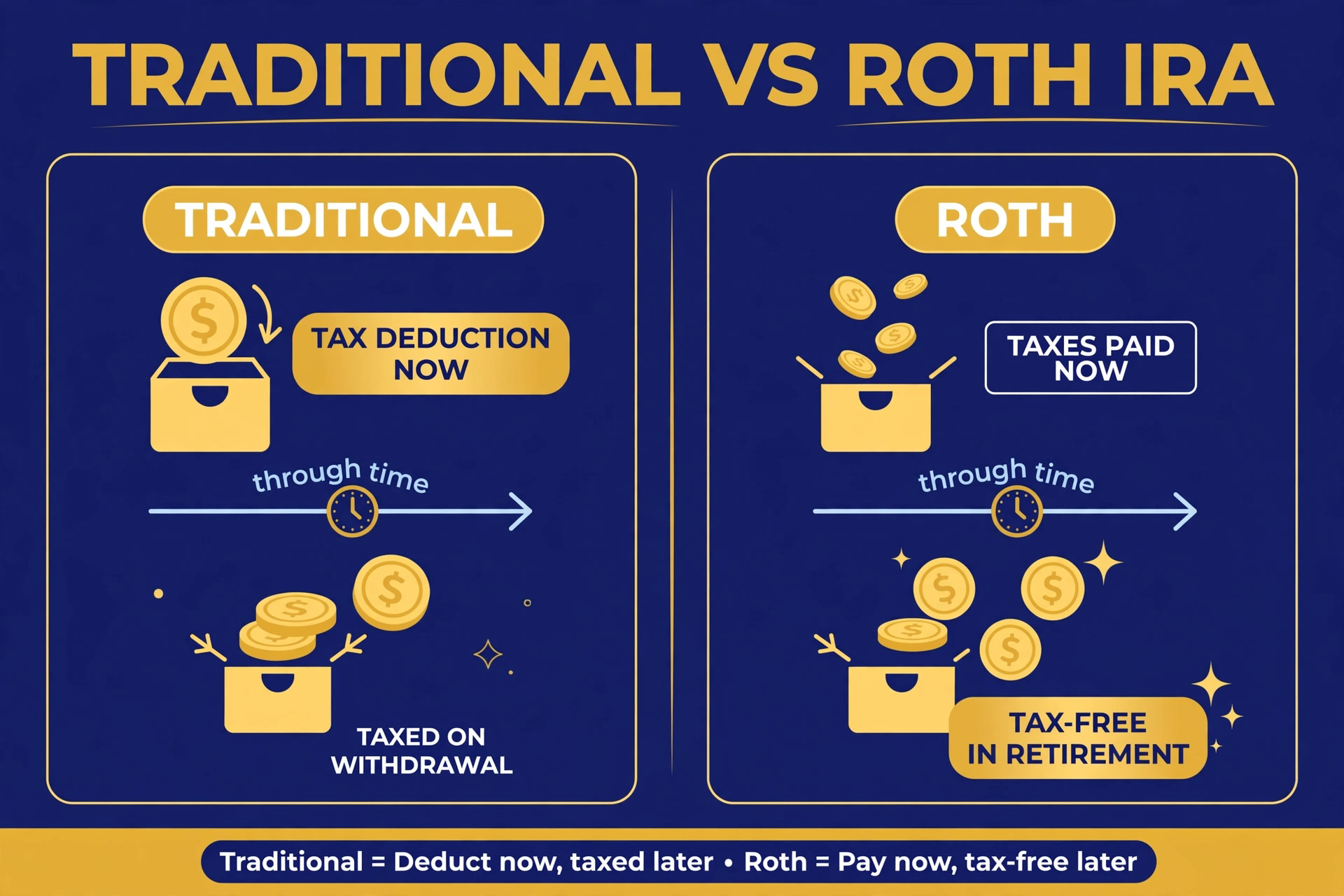
There are two flavors, and choosing between them is one of the most consequential small decisions in personal finance. A Traditional IRA gives you a tax deduction now: contributions lower this year's taxable income, the money grows tax-deferred, and you pay income tax when you withdraw in retirement. A Roth IRA flips it: no deduction now, but the money grows tax-free and withdrawals in retirement are tax-free too.
The one-line version: Traditional = pay taxes later. Roth = pay taxes now. If you expect to be in a higher tax bracket in retirement than you are today — common for young earners — Roth usually wins. If you expect to be in a lower bracket later, Traditional usually wins. When you cannot decide, splitting contributions between both is a perfectly reasonable hedge.
Eligibility: Who Can Contribute?
Almost anyone with earned income — wages, salary, self-employment income — can contribute to a Traditional IRA. Whether you can deduct the contribution depends on your income and whether you have a workplace plan. The IRS phases the deduction out above certain income levels, and the levels change yearly, so check the current IRS tables before you file.
Roth IRAs have their own wrinkle: there is an income ceiling. Earn above it and you cannot contribute directly to a Roth at all. There is a legal workaround called the backdoor Roth — contribute to a Traditional IRA (nondeductible) and convert it to Roth — but it has rules and pitfalls, so understand it fully before attempting it.
Two more rules that apply to both IRAs: you must have earned income to contribute (allowances and investment gains do not count), and the contribution deadline is tax day of the following year — you can make last year's contribution all the way up until April.
The HSA: The Triple Tax Advantage
A Health Savings Account is available only if you have a qualifying high-deductible health plan — a plan with lower premiums but higher out-of-pocket costs before coverage kicks in. If you have one, the HSA is the single most tax-favored account available, and it is criminally underused.
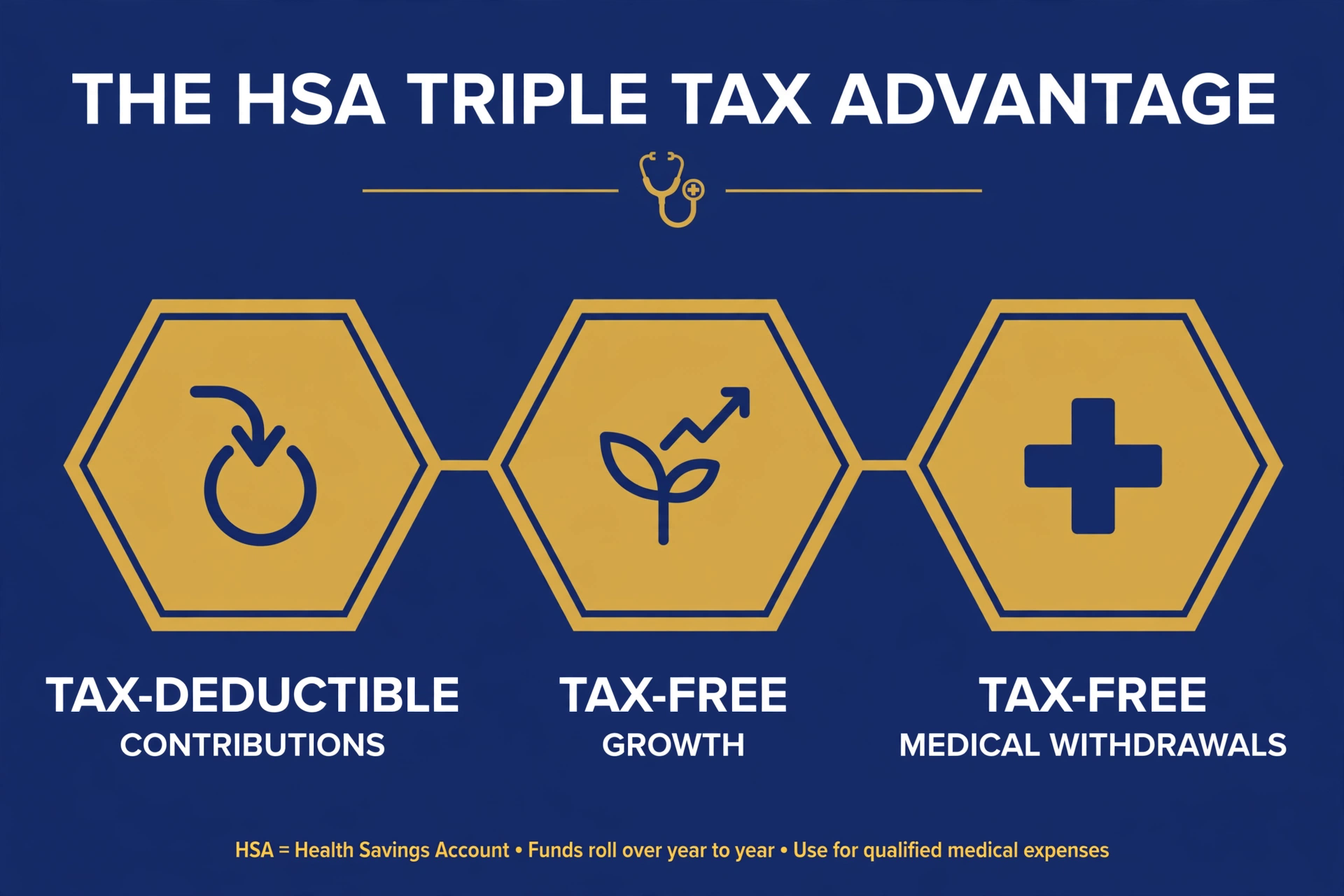
Here is why. The HSA is the only account with a triple tax advantage: contributions are tax-deductible, growth is tax-free, and withdrawals for qualified medical expenses are tax-free. Traditional accounts give you two of the three; Roth accounts give you two of the three. The HSA gives you all three at once.
The advanced move is to treat the HSA as a stealth retirement account. Instead of spending it on this year's medical bills, pay those bills from cash, save the receipts, and let the HSA compound untouched for decades. There is no time limit on reimbursement — you can withdraw tax-free against old receipts years later. Invest the HSA balance like retirement money (most HSA providers offer investment options), and it becomes a Roth-like account you could also deduct today.
How the Accounts Fit Together
Here is the practical funding order most planners recommend. First, contribute enough to your workplace plan to capture the full employer match (LP-101). Second, max out a Roth IRA (or Traditional, depending on your bracket) — you control the account, the fees, and the investments. Third, if you have a qualifying high-deductible plan, fund the HSA. Fourth, go back and add more to the workplace plan up to the limit. Fifth, a regular taxable brokerage account.
This is a guideline, not gospel — a high earner might prefer Traditional IRA deductions, and someone with expensive medical needs might skip the high-deductible plan entirely. But the order reflects a simple principle: take the free money first, then fund the most tax-advantaged accounts you control, then everything else.
Key terms
- IRA (Individual Retirement Account)
- a tax-advantaged retirement account you open yourself; available to anyone with earned income.
- Traditional IRA
- contributions may be tax-deductible now; you pay tax on withdrawals in retirement. Pay taxes later.
- Roth IRA
- contributions are after-tax; growth and withdrawals in retirement are tax-free. Pay taxes now.
- Annual contribution limit
- the maximum the IRS lets you contribute per year, adjusted periodically.
- Income ceiling
- the earnings level above which you cannot contribute directly to a Roth IRA.
- Backdoor Roth
- contributing to a Traditional IRA and converting it to Roth when income is too high for direct Roth contributions.
- HSA (Health Savings Account)
- available with a qualifying high-deductible health plan; the only account with a triple tax advantage.
- Triple tax advantage
- deductible contributions, tax-free growth, and tax-free withdrawals for qualified medical expenses.
- High-deductible health plan
- a health plan with lower premiums and higher out-of-pocket costs before coverage begins; required for HSA eligibility.
What's next
Accounts are the containers — now we need the math. LP-103 "Retirement Target Math" shows you how savings rate, time, and growth turn into a retirement target you can actually aim at, with simple numbers and no spreadsheets required.
The quiz
IRAs and HSAs — Quiz
3 questions · pass with 3 correct
1.What is the core tax difference between a Traditional and a Roth IRA?
2.Who cannot contribute directly to a Roth IRA?
3.What makes the HSA's tax treatment unique?