
Retirement Target Math
School 05 — Retirement and Long-Term Planning
Listen — 15-second overview
A quick spoken preview of this class
School 4 · Retirement and Long-Term Planning · About 15 minutes
"How much do I need to retire?" is the most-asked question in personal finance — and the answer is simpler than the industry wants you to think. Retirement math comes down to three levers: how much you save, how long you save, and how fast it grows. You only need to move one lever far enough. We will now teach you about savings rate, time horizon, return assumptions, the quiet tax of inflation, and why you should plan with ranges instead of single magic numbers.
The Three Levers: How Much, How Long, How Fast
Every retirement plan is three numbers multiplied together. How much you save each month — your savings rate, the percentage of your income you invest. How long the money compounds — your time horizon, usually decades. And how fast it grows — your assumed rate of return, what your investments earn on average per year.
Of the three, the two you control completely are how much and how long. The return is partly a choice (stocks vs. bonds) and partly luck (market cycles). That is why financial planners obsess over savings rate: a 20% savings rate with modest returns beats a 5% savings rate with great returns almost every time. Save more and start earlier — those two moves dominate everything else.
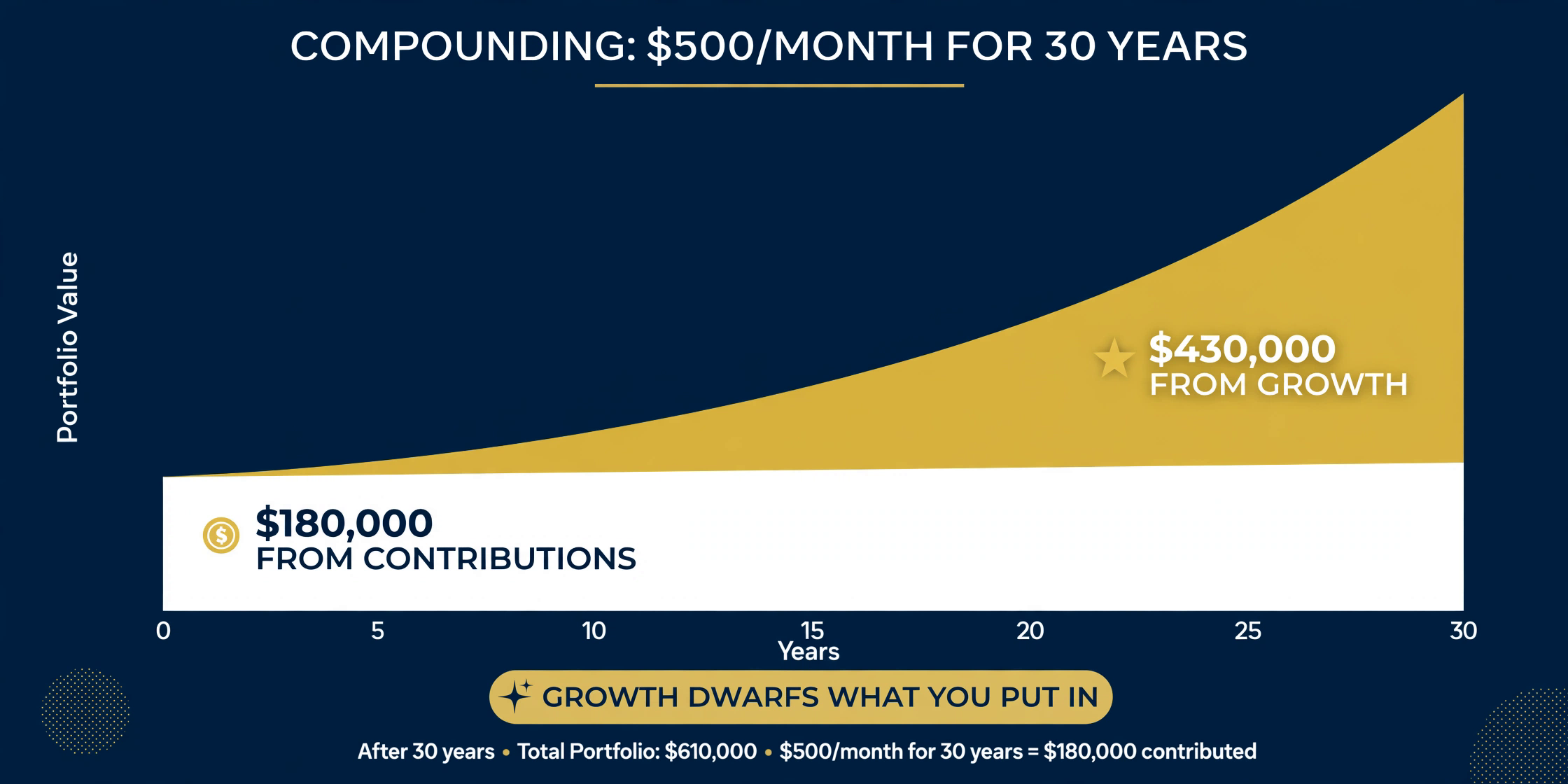
Run the numbers. Save $500 a month for 30 years at a 7% average annual return and you end up with about $610,000 — of which only $180,000 was your money; the rest is growth. Save the same $500 for 40 years instead and you get about $1.2 million. The extra ten years nearly doubled the total while adding only $60,000 of contributions. Time is the most powerful lever, and it is free if you start now.
Return Assumptions: Hope Is Not a Strategy
The long-run average stock market return is around 10% a year before inflation — but "average" hides decades of underperformance and overperformance. Prudent planners use conservative return assumptions: 6–7% nominal for a stock-heavy portfolio, less for bond-heavy mixes. Plan with 7% and get 9%, and you retire early. Plan with 10% and get 7%, and the plan breaks.
This is the argument for scenario ranges instead of single numbers. Run your plan at three returns — pessimistic (5%), base case (7%), optimistic (9%) — and see what savings rate each requires. If the pessimistic case needs a 25% savings rate you cannot afford, you know you need more time, lower spending goals, or both. A range tells the truth; a single number sells false certainty.
Keep the math simple. You do not need a spreadsheet with twelve tabs. You need three inputs — monthly savings, years, assumed return — and an honest look at the output. If the number is too small, raise the savings rate first, extend the horizon second, and raise the assumed return never.
Inflation: The Quiet Tax
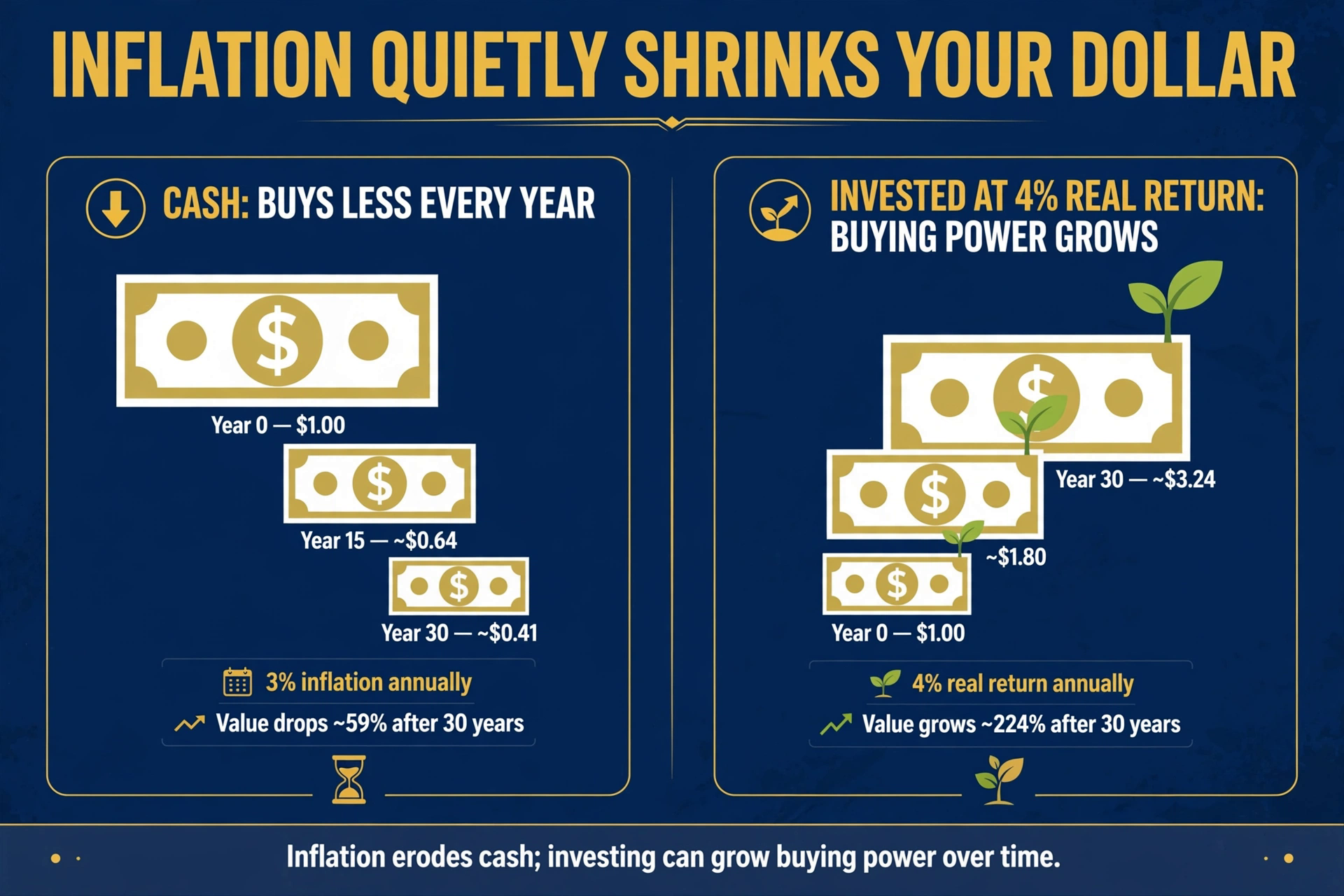
Inflation is the steady rise in prices that makes every dollar worth a little less each year. At 3% inflation, something that costs $100 today costs about $243 in 30 years — and your savings need to grow just to stand still. This is why "a million dollars" is a moving target: a million in 2055 will buy far less than a million today.
The useful concept is real return — your return after inflation. If your portfolio earns 7% and inflation is 3%, your real return is roughly 4%. Plan in real terms and you cannot fool yourself: a 4% real return doubles your purchasing power about every 18 years.
This is also why keeping long-term money in cash is a slow leak. Cash earns near zero while inflation takes 2–3% a year — a guaranteed loss of purchasing power. Investing is not optional for retirement; it is the only way to outrun inflation over decades.
Your Target: A Simple Rule of Thumb
A common starting target is 25 times your annual spending — the idea being that withdrawing 4% a year covers your costs indefinitely (the famous 4% rule, covered in LP-104). Spend $60,000 a year in retirement, target roughly $1.5 million. Spend $40,000, target roughly $1 million.
Treat this as a starting point, not a contract. It assumes a balanced portfolio, a 30-year retirement, and average markets — none of which are guaranteed. Your real target should come from your spending, adjusted for inflation, run through your three scenarios. But having any target beats having none: it turns "save more" into a monthly number you can automate today.
Key terms
- Savings rate
- the percentage of your income you save and invest; the lever you control most.
- Time horizon
- how many years your money compounds; the most powerful lever, and free if you start early.
- Assumed rate of return
- the average yearly growth you plan on; use conservative numbers (6–7% nominal for stocks).
- Scenario ranges
- running your plan at pessimistic, base-case, and optimistic returns instead of trusting one number.
- Inflation
- the steady rise in prices that erodes purchasing power, roughly 2–3% a year.
- Real return
- your investment return minus inflation; the only growth that actually buys more.
- 25x rule
- a starting retirement target of 25 times your annual spending (the basis of the 4% rule).
What's next
Saving is the buildup — spending it wisely is the second half of the game. LP-104 "Retirement Income" shows you how to turn a pile of savings into a paycheck: withdrawal order, sequence risk, Social Security, and required distributions.
The quiz
Retirement Target Math — Quiz
3 questions · pass with 3 correct
1.What are the three levers of retirement math?
2.Why is starting early more powerful than chasing higher returns?
3.What is the common starting rule of thumb for a retirement target?