
Retirement Income
School 05 — Retirement and Long-Term Planning
Listen — 15-second overview
A quick spoken preview of this class
School 4 · Retirement and Long-Term Planning · About 15 minutes
Building the pile is only half the job. The other half — turning a lifetime of savings into a steady paycheck that lasts as long as you do — has its own rules, and some of them are counterintuitive. We will now teach you about withdrawal sequencing, the hidden danger of sequence risk, the basics of Social Security, and the required distributions the government forces on you.
Withdrawal Sequencing: The Order You Spend Matters
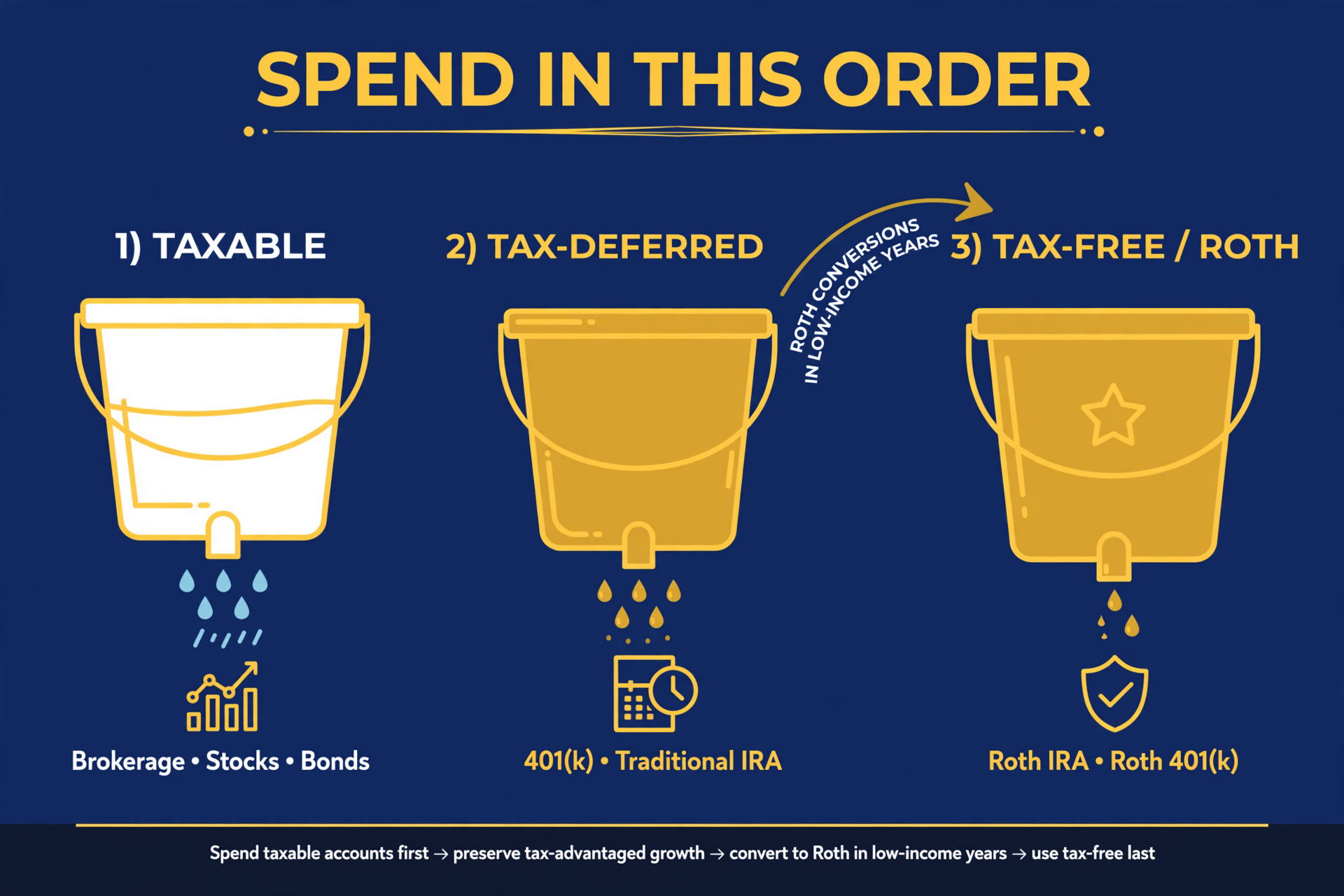
In retirement you will hold money in three tax buckets: taxable accounts (brokerage), tax-deferred accounts (Traditional 401(k)/IRA), and tax-free accounts (Roth). The order you draw from them changes how much tax you pay and how long the money lasts.
The conventional sequence is: spend taxable accounts first, then tax-deferred, then Roth last. Taxable accounts first because they generate ongoing tax drag anyway; tax-deferred next to start chipping away at the future tax bill; Roth last because every extra year of tax-free growth is precious — and Roth money is also the most flexible for large one-time expenses, since withdrawals do not push you into a higher bracket.
Reality is messier than the textbook. Many retirees do partial Roth conversions in low-income years — deliberately moving some Traditional money to Roth when their tax bracket is temporarily low, paying a small tax now to avoid a bigger one later. The sequence is a starting point; the conversions are where the real tax savings live.
Sequence Risk: When Bad Years Hit Matters More Than Average Returns
Here is the cruelest quirk of retirement math. Two retirees can earn the same average return over 30 years and have completely different outcomes — if one gets the bad years first. This is sequence risk: the danger that poor market returns early in retirement, combined with withdrawals, permanently cripple the portfolio.
Run the numbers. Retiree A starts with $1 million, withdraws $50,000 a year, and the market falls 30% in year one. She now has about $665,000 supporting $50,000 a year — a 7.5% withdrawal rate, deep in the danger zone. Retiree B gets the same 30% crash in year twenty, when the portfolio has grown for two decades — she barely notices. Same average return, wildly different retirements.
The defenses are simple: keep 1–2 years of spending in cash or short-term bonds so you never sell stocks in a crash; be flexible — cut spending a little after down years; and consider working part-time for the first year or two if markets are ugly. The first five years of retirement are the danger zone. Protect them.
Social Security Basics: The Foundation Floor
Social Security is the government retirement benefit you have been paying into with every paycheck — the 6.2% FICA tax (your employer matches it). It is not meant to fund your whole retirement; for most people it replaces roughly 40% of pre-retirement income. Think of it as the floor under everything else.
The key decision is when to claim. You can start as early as 62, wait until your full retirement age (66–67 depending on birth year), or delay until 70. Claiming early cuts your monthly check permanently — roughly 30% less than full retirement age. Delaying past full retirement age grows it about 8% a year until 70. For a healthy person who can wait, delaying is one of the best "investments" available: a guaranteed, inflation-adjusted, government-backed 8% annual raise.
One practical note: Social Security benefits can be partially taxable depending on your other income. Keeping withdrawals coordinated — the sequencing above — can reduce how much of your benefit gets taxed. And if you claim early while still working, earnings above a limit temporarily reduce your benefit.
Required Minimum Distributions: The Government Wants Its Cut
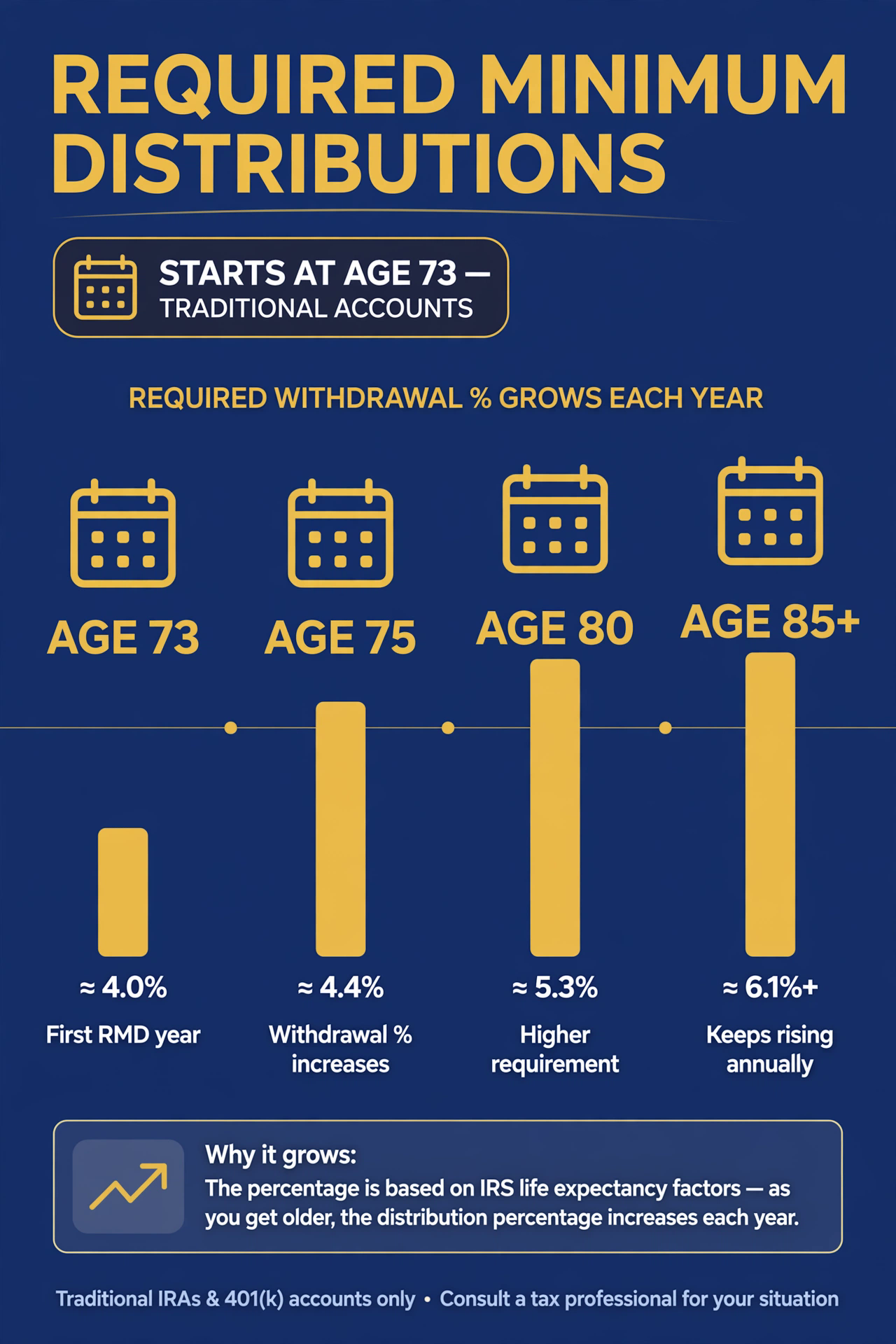
Remember the tax deduction you got on Traditional contributions? The IRS wants its money back. Starting at age 73 (under current law), you must take Required Minimum Distributions — RMDs — from Traditional 401(k)s and IRAs every year, whether you need the money or not.
The amount is set by an IRS life-expectancy table: roughly your balance divided by your remaining life expectancy. At 73 that is about 3.8% of the account; the percentage rises each year as you age. Miss an RMD and the penalty is severe — historically up to 50% of the amount you should have withdrawn (recent law reduced it, but it remains painful).
RMDs are why Roth conversions in your 60s matter: every dollar converted to Roth before 73 shrinks the future RMD and the taxes it triggers. And one more quirk — RMDs can push you into a higher Medicare premium bracket (IRMAA), so large RMDs cost more than just income tax. Planning withdrawals years before 73 is how you stay ahead of all of it.
Key terms
- Withdrawal sequencing
- the order you draw from taxable, tax-deferred, and tax-free accounts in retirement; usually taxable first, Roth last.
- Tax buckets
- taxable (brokerage), tax-deferred (Traditional 401(k)/IRA), and tax-free (Roth) accounts.
- Roth conversion
- moving Traditional money to Roth, paying tax now at a (hopefully) low rate to get tax-free growth later.
- Sequence risk
- the danger that poor market returns early in retirement permanently damage the portfolio, even if average returns are fine.
- Social Security
- the government retirement benefit funded by payroll taxes; replaces roughly 40% of income for typical earners.
- Full retirement age
- 66–67 depending on birth year; claiming at 62 cuts benefits ~30%, delaying to 70 grows them ~8% a year past full age.
- Required Minimum Distributions (RMDs)
- mandatory yearly withdrawals from Traditional accounts starting at age 73, taxed as income.
- IRMAA
- the surcharge that raises your Medicare premiums when your income (including RMDs) crosses certain thresholds.
What's next
Retirement is the biggest goal — but it is not the only one. LP-105 "Education and Major Goals" shows you how to fund college, weddings, and other big-ticket dreams without derailing the retirement plan.
The quiz
Retirement Income — Quiz
3 questions · pass with 3 correct
1.What is the conventional withdrawal sequence in retirement?
2.What is sequence risk?
3.What is the key tradeoff in when to claim Social Security?