
Education and Major Goals
School 05 — Retirement and Long-Term Planning
Listen — 15-second overview
A quick spoken preview of this class
School 4 · Retirement and Long-Term Planning · About 15 minutes
Retirement is the biggest financial goal — but it is rarely the only one. College for the kids, a wedding, a down payment, a sabbatical: these goals have something retirement does not — a fixed deadline and a non-negotiable price tag. We will now teach you how to name and price your goals, how 529 plans work, how to handle goals that compete with each other, and why prepaying future expenses is an underrated strategy.
Name It, Price It, Date It
A goal you cannot name is a wish. Goal funding starts with three specifics: what the goal is, what it will cost, and when the money is needed. "College for my daughter" becomes "$30,000 a year starting in 12 years." The difference matters, because the date determines everything about how you invest.
The rule: match the investment to the deadline. Money needed within five years belongs in safe, boring places — high-yield savings, short-term bonds, money markets. Money needed in ten-plus years can take stock-market risk, because time smooths the bumps. A college fund for a toddler can be aggressive; the same fund for a sixteen-year-old should be nearly all safe assets. As the deadline approaches, shift from growth to safety — the same glide path idea as a target-date fund (LP-101).
One more discipline: give every goal its own bucket. One account labeled "college," another labeled "house down payment." Mixed money gets spent on whatever shouts loudest; labeled money has a job.
529 Plans: The College-Funding Workhorse
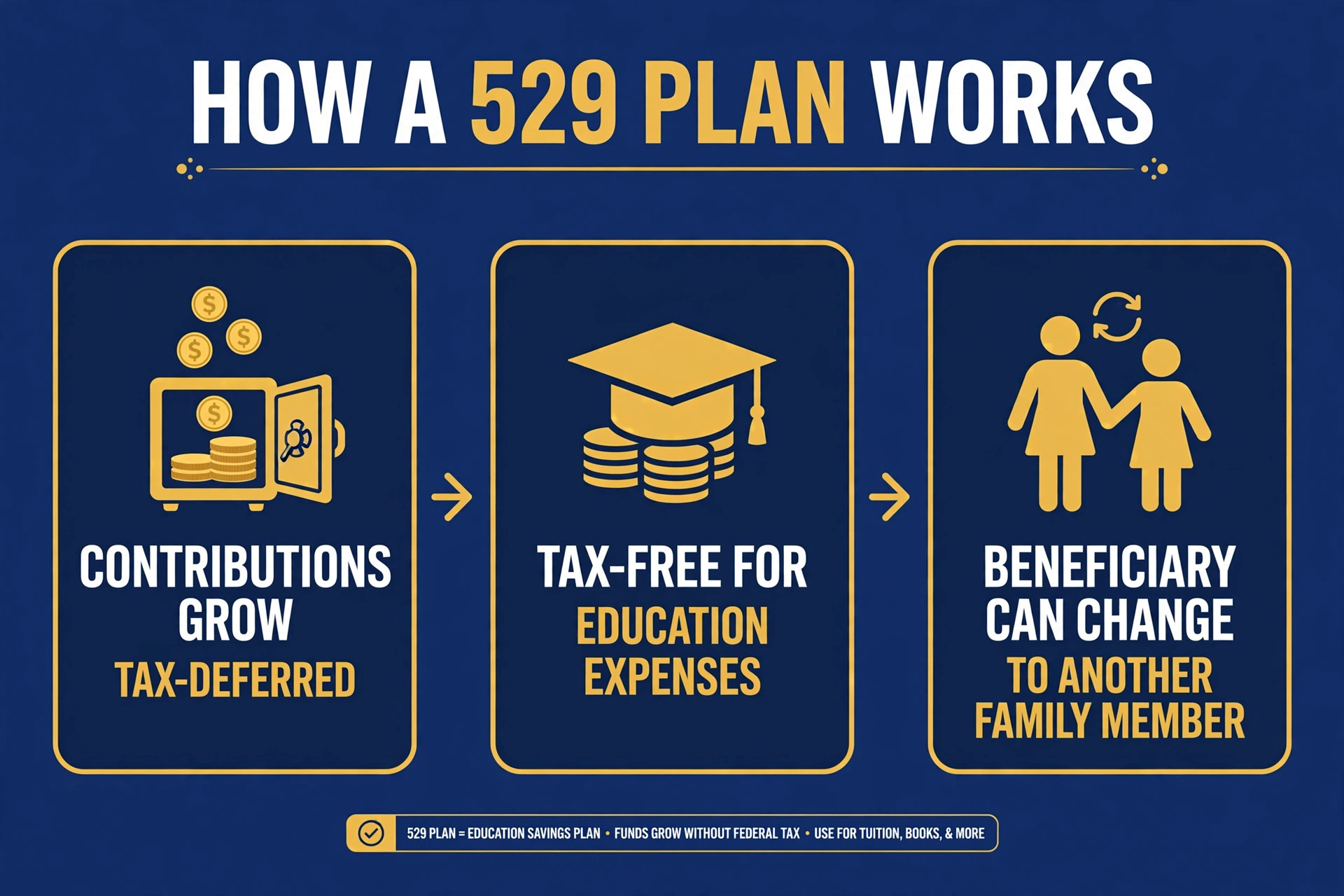
A 529 plan is a tax-advantaged account designed for education expenses. Every state runs one, and you can use any state's plan — you are not locked to your own. Contributions grow tax-deferred, and withdrawals are tax-free when used for qualified education expenses: tuition, room and board, books, even K-12 tuition up to a yearly limit.
Many states sweeten the deal with a state tax deduction for contributions — free money on top of the federal tax-free growth. And 529s are flexible: you can change the beneficiary to another family member if the first child does not need it all, and recent law lets you roll leftover 529 money into a Roth IRA (subject to limits) instead of paying penalties.
What if the child skips college? The money is not trapped — you can redirect it to another child, use it for trade school or graduate school, or take the Roth rollover route. The worst case is withdrawing for non-education expenses: earnings get taxed plus a 10% penalty, but your own contributions always come back untouched.
Competing Priorities: Which Goal Wins?
Here is the uncomfortable truth: most families cannot fully fund every goal. Retirement, college, the house, the emergency fund — the money runs out before the list does. Competing priorities are the norm, not the failure.
The standard ranking: retirement first, education second. It sounds cold, but the logic is airtight — there are no scholarships for retirement. You can borrow for college; you cannot borrow for old age. An underfunded 401(k) at 55 is a crisis; an underfunded 529 is a smaller college or a part-time job for the student. Secure your own oxygen mask first.
Within the remaining money, rank by deadline and flexibility. The house down payment in three years outranks the wedding in eight. And be honest about which goals are real: "maybe a boat someday" does not deserve a monthly contribution. Fund the top two or three goals well instead of starving five.
Prepaying Future Expenses: The Hidden Discount
One of the best "investments" available is one nobody talks about: prepaying future expenses. Paying down a 7% mortgage is a guaranteed 7% return — no market risk, no fees. Buying next year's insurance in full to dodge monthly fees, or paying cash for the car instead of financing at 8%, earns you the interest rate you would have paid.
Run the numbers. An extra $200 a month toward a 7% mortgage on a 30-year loan can shave roughly seven years and tens of thousands in interest off the loan. That is a return no bond can match with the same certainty. Prepaying is not exciting — but excitement is not the goal. Certainty is.
The principle generalizes: any guaranteed cost you eliminate is a guaranteed return you earn. Before reaching for riskier investments, ask what guaranteed returns are sitting on your balance sheet in the form of debts and future bills.

Key terms
- Goal funding
- naming, pricing, and dating each financial goal, and matching the investment to the deadline.
- Glide path
- shifting investments from growth to safety as a goal's deadline approaches.
- 529 plan
- a tax-advantaged education account; tax-free withdrawals for qualified education expenses, usable in any state.
- Qualified education expenses
- tuition, room and board, books, and supplies; what 529 withdrawals must cover to stay tax-free.
- Beneficiary
- the person the 529 funds are earmarked for; can be changed to another family member.
- Competing priorities
- the reality that money cannot fully fund every goal; retirement comes before education.
- Prepaying future expenses
- paying down debt or future bills early; a guaranteed return equal to the interest rate avoided.
What's next
Goals need money — but they also need protection. LP-106 "Insurance Planning Basics" covers the safety nets that keep one bad event from wiping out every plan you just made: health, life, disability, property, liability, and long-term care.
The quiz
Education and Major Goals — Quiz
3 questions · pass with 3 correct
1.What is the rule for investing goal money?
2.What is the main tax benefit of a 529 plan?
3.When retirement and college compete, which comes first?