
Insurance Planning Basics
School 05 — Retirement and Long-Term Planning
Listen — 15-second overview
A quick spoken preview of this class
School 4 · Retirement and Long-Term Planning · About 15 minutes
Insurance is the least exciting purchase in personal finance — and the one that matters most when everything goes wrong. Every plan in this school assumes you survive, stay healthy, and keep earning. Insurance is what keeps those assumptions from becoming a catastrophe. We will now teach you the six coverages that matter: health, life, disability, property, liability, and long-term care.
What Insurance Is For: Transferring Ruin
Insurance is a contract: you pay a small, certain cost (the premium) so that a large, uncertain cost (the risk) becomes someone else's problem. You are not buying an investment — you are buying a ceiling on how bad your worst day can get.
The rule for what to insure is simple: insure against losses you cannot afford. A $500 phone screen you can absorb; a $500,000 medical bill you cannot. That is why high deductibles — the amount you pay before coverage kicks in — are usually the smart choice: raising your deductible from $500 to $2,500 can cut premiums dramatically, and you self-insure only the small stuff you could handle anyway.
Two words that confuse everyone: premium is what you pay (monthly or yearly) to keep the policy active. Deductible is what you pay out of pocket when something happens, before the insurer pays a dime. Low premium usually means high deductible, and vice versa — pick the combination that fits the loss you are insuring against.
Life Insurance: Who Needs It, and How Much
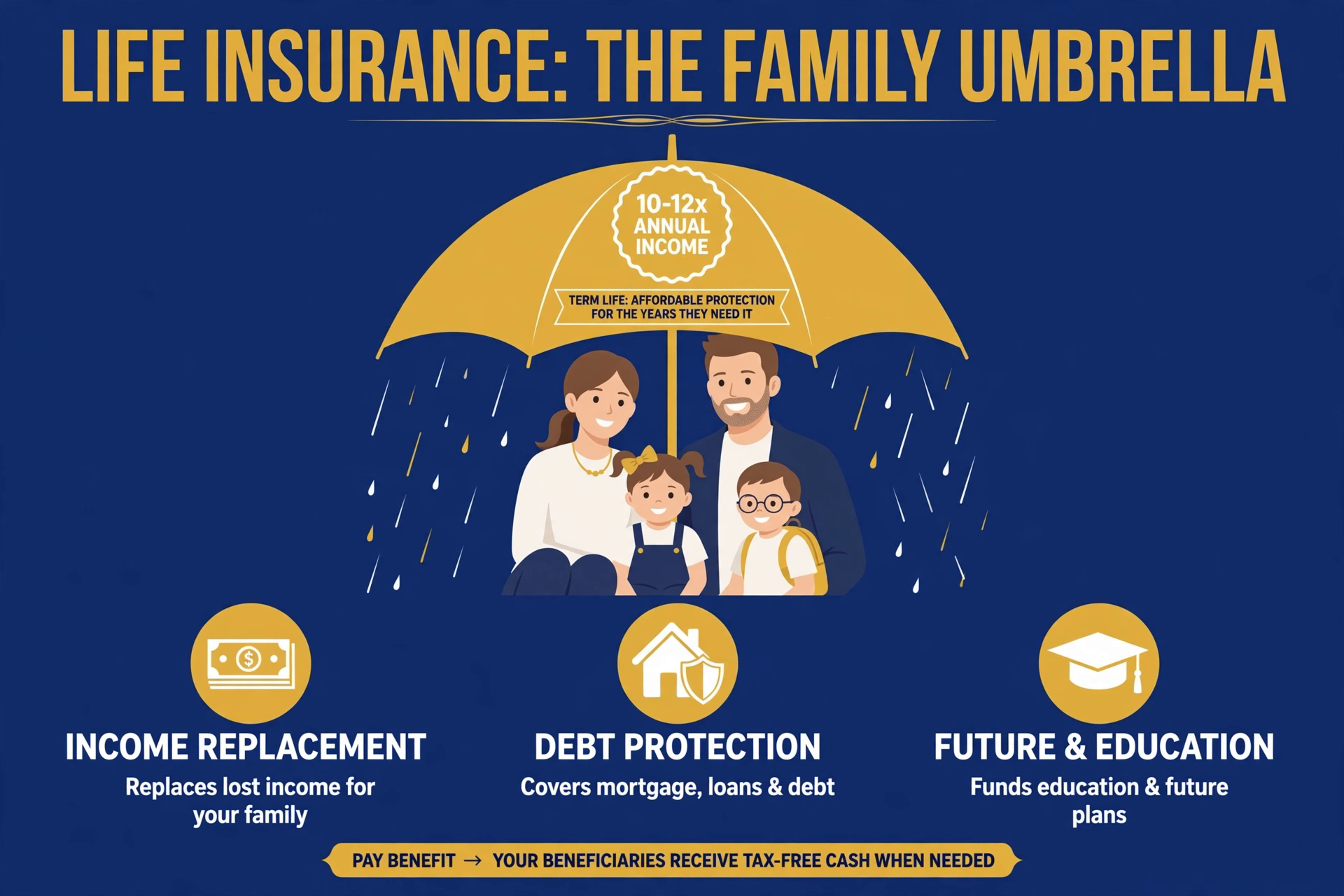
Life insurance pays your beneficiaries — the people you name — a lump sum (the death benefit) when you die. Its job is income replacement: if people depend on your paycheck, life insurance replaces it. If nobody depends on your income, you probably do not need it.
The two types could not be more different. Term life covers you for a set period — 20 or 30 years — for a low premium, and pays only if you die during the term. Whole life (and its cousins) covers you forever but costs many times more, mixing insurance with a cash-value investment that underperforms almost everything else. For most families, term life is the right answer: buy the protection cheap, invest the difference yourself.
How much? A starting rule is 10–12 times your annual income, plus debts and future big expenses like college. A $80,000 earner with a mortgage and two kids might carry $800,000–$1,000,000 in 20- or 30-year term. Get quotes from multiple insurers — prices vary wildly for identical coverage.
Disability Insurance: The Forgotten Coverage
Here is the coverage almost everyone skips and almost everyone needs more than life insurance. Your ability to earn is your biggest financial asset — a 30-year-old earning $60,000 will earn over $2 million in a career. Disability insurance replaces part of your income if injury or illness stops you from working.
The statistics are sobering: roughly one in four of today's 20-year-olds will experience a disability before retirement. And it is usually illness, not accidents — back problems, cancer, mental health conditions. Short-term disability covers the first months (often through your employer); long-term disability picks up after, typically replacing 40–60% of income.
Check what your employer offers first — many provide basic long-term coverage free. If you are self-employed or your employer's coverage is thin, an individual policy is worth pricing. The key features to look for: own-occupation coverage (pays if you cannot do your job, not just any job) and a benefit period that runs to retirement age.
Property, Liability, Health, and Long-Term Care
Property insurance — homeowners or renters — protects your stuff and your dwelling. Renters insurance is the steal of the insurance world: often $15–$25 a month for tens of thousands in coverage. Homeowners should check that their policy covers replacement cost (what it costs to rebuild) rather than actual cash value (depreciated), and understand flood and earthquake exclusions.
Liability coverage protects you when you cause the damage — the other driver's car, the guest injured on your stairs. Auto liability limits should be well above state minimums; a serious accident can easily exceed $25,000. An umbrella policy — $1–2 million of extra liability coverage for a few hundred dollars a year — is cheap protection for anyone with assets to protect.
Health insurance you likely get through work, but understand the tradeoff: high-deductible plans pair with HSAs (LP-102) and suit healthy people with savings; low-deductible plans suit those with ongoing medical needs. And long-term care insurance — covering nursing homes and assisted living, which Medicare barely touches — is worth evaluating in your 50s, when premiums are still affordable and a multi-year care need could otherwise consume a lifetime of savings.

Key terms
- Insurance
- a contract transferring a large uncertain loss to an insurer in exchange for a small certain premium.
- Premium
- what you pay to keep a policy active, usually monthly or yearly.
- Deductible
- what you pay out of pocket before the insurer pays; higher deductibles mean lower premiums.
- Beneficiary
- the person who receives the payout.
- Term life insurance
- affordable coverage for a set period (20–30 years); the right choice for most families.
- Whole life insurance
- permanent coverage mixing insurance with cash value; costs many times more than term.
- Death benefit
- the lump sum paid to beneficiaries when the insured dies.
- Disability insurance
- replaces part of your income if illness or injury stops you from working; short-term and long-term.
- Own-occupation
- disability coverage that pays if you cannot do your specific job.
- Umbrella policy
- $1–2 million of extra liability coverage for a few hundred dollars a year.
- Long-term care insurance
- covers nursing homes and assisted living, which Medicare barely covers.
What's next
Protection is in place — now the tax bill. LP-107 "Tax Planning Basics" shows you how marginal rates, deductions, credits, and capital gains really work, and how to keep more of what you earn, legally.
The quiz
Insurance Planning Basics — Quiz
3 questions · pass with 3 correct
1.What is the core rule of what to insure?
2.Which life insurance fits most families?
3.What does disability insurance do?