
Tax Planning Basics
School 05 — Retirement and Long-Term Planning
Listen — 15-second overview
A quick spoken preview of this class
School 4 · Retirement and Long-Term Planning · About 15 minutes
Taxes are the biggest bill most people will ever pay — bigger than the mortgage, bigger than the car, bigger than everything except the house itself. Yet most people treat taxes as something that happens to them in April, instead of something they plan for all year. We will now teach you how marginal rates, deductions, credits, and capital gains really work, where to hold your investments, and the recordkeeping habit that makes all of it painless.
Marginal Rates: Only the Top Slice
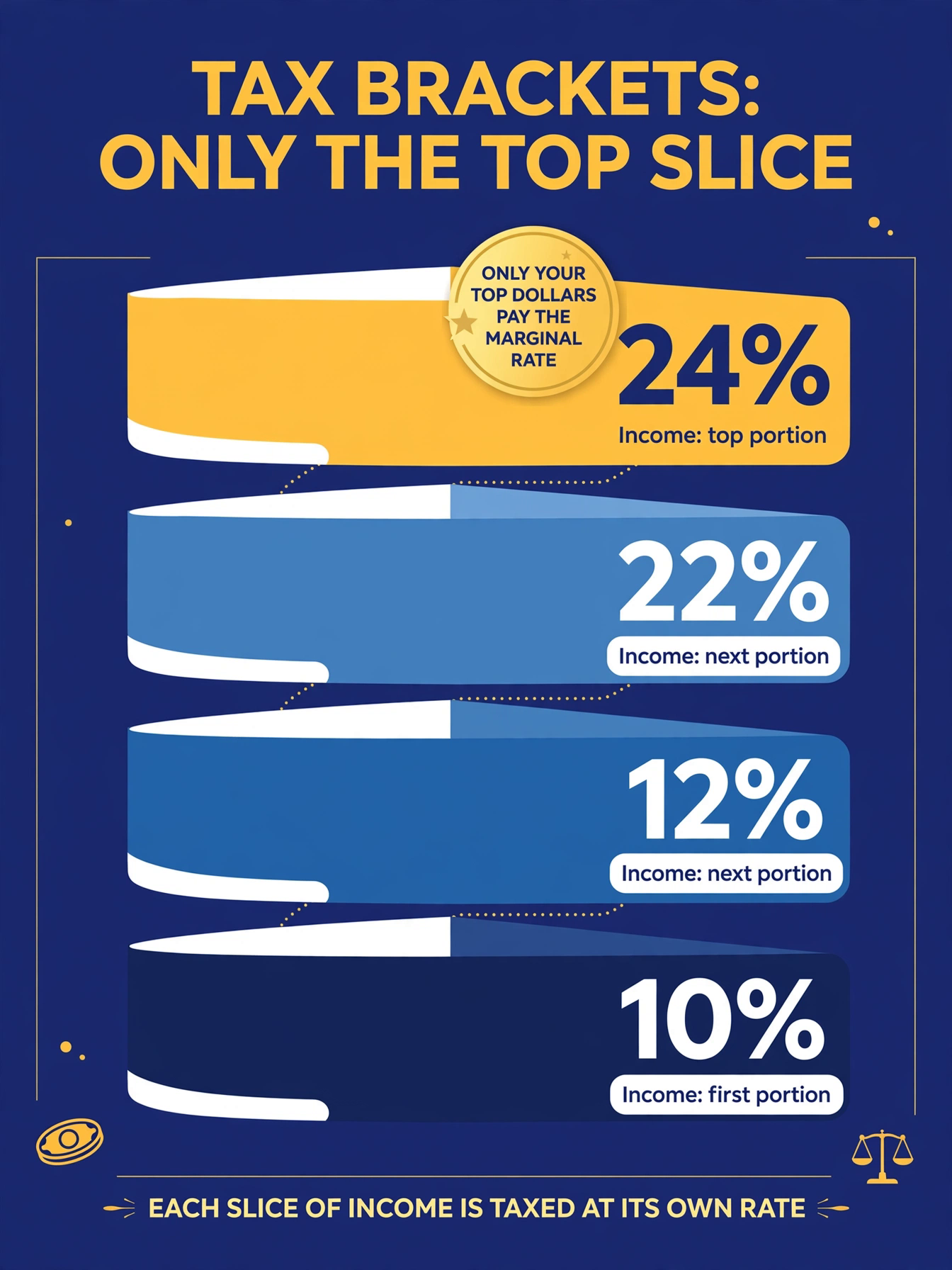
The single most misunderstood idea in taxes: your marginal tax rate is the rate on your next dollar, not on all your dollars. The U.S. uses tax brackets — income is taxed in slices, with each slice taxed at a higher rate. A single filer might pay 10% on the first slice, 12% on the next, 22% on the next, and so on.
Run the numbers. If the 22% bracket starts at $48,000 and you earn $50,000, only the top $2,000 is taxed at 22% — the first $48,000 is taxed at the lower rates. Your effective rate — total tax divided by total income — is always lower than your marginal rate. This is why "a raise pushed me into a higher bracket so I take home less" is a myth: only the dollars above the line get the higher rate.
This matters for planning because every tax decision is a marginal decision. A deduction saves you tax at your marginal rate. A Roth vs. Traditional choice (LP-102) is a bet on your marginal rate now vs. your marginal rate in retirement. Learn your marginal rate and half of tax planning clicks into place.
Deductions vs. Credits: Not the Same Thing
A deduction reduces the income that gets taxed. A credit reduces the tax itself, dollar for dollar. Credits are worth more: a $1,000 deduction in the 22% bracket saves you $220; a $1,000 credit saves you $1,000.
Most people take the standard deduction — a flat amount the IRS lets everyone subtract (tens of thousands for joint filers, adjusted yearly). You only itemize — listing mortgage interest, state taxes, charitable gifts, and the like — if your total exceeds the standard deduction. For most filers, the standard deduction wins, which means smaller itemizable expenses do not actually save tax.
The planning move: bunching. If your itemizable expenses are near the threshold, bunch two years of charitable gifts or medical expenses into one year — itemize that year, take the standard deduction the next. Same spending, more tax saved.
Capital Gains: Short vs. Long Term
When you sell an investment for more than you paid, the profit is a capital gain. Hold the investment more than a year and it is a long-term gain — taxed at preferential rates (0%, 15%, or 20% depending on income), far below ordinary income rates. Sell within a year and it is a short-term gain — taxed as ordinary income, like wages.
This is why patience is taxed less than impatience. A trader flipping stocks every few months pays ordinary rates on every gain; a buy-and-hold investor pays the lower long-term rates. The one-year line is one of the most valuable lines in the tax code.
Two companion ideas. Tax-loss harvesting is selling losers to offset winners — realized losses cancel realized gains, and up to $3,000 a year can offset ordinary income. And wash-sale rules forbid claiming the loss if you buy the same investment back within 30 days. Harvest in December, but respect the 30-day window.
Tax Location: Where You Hold Matters
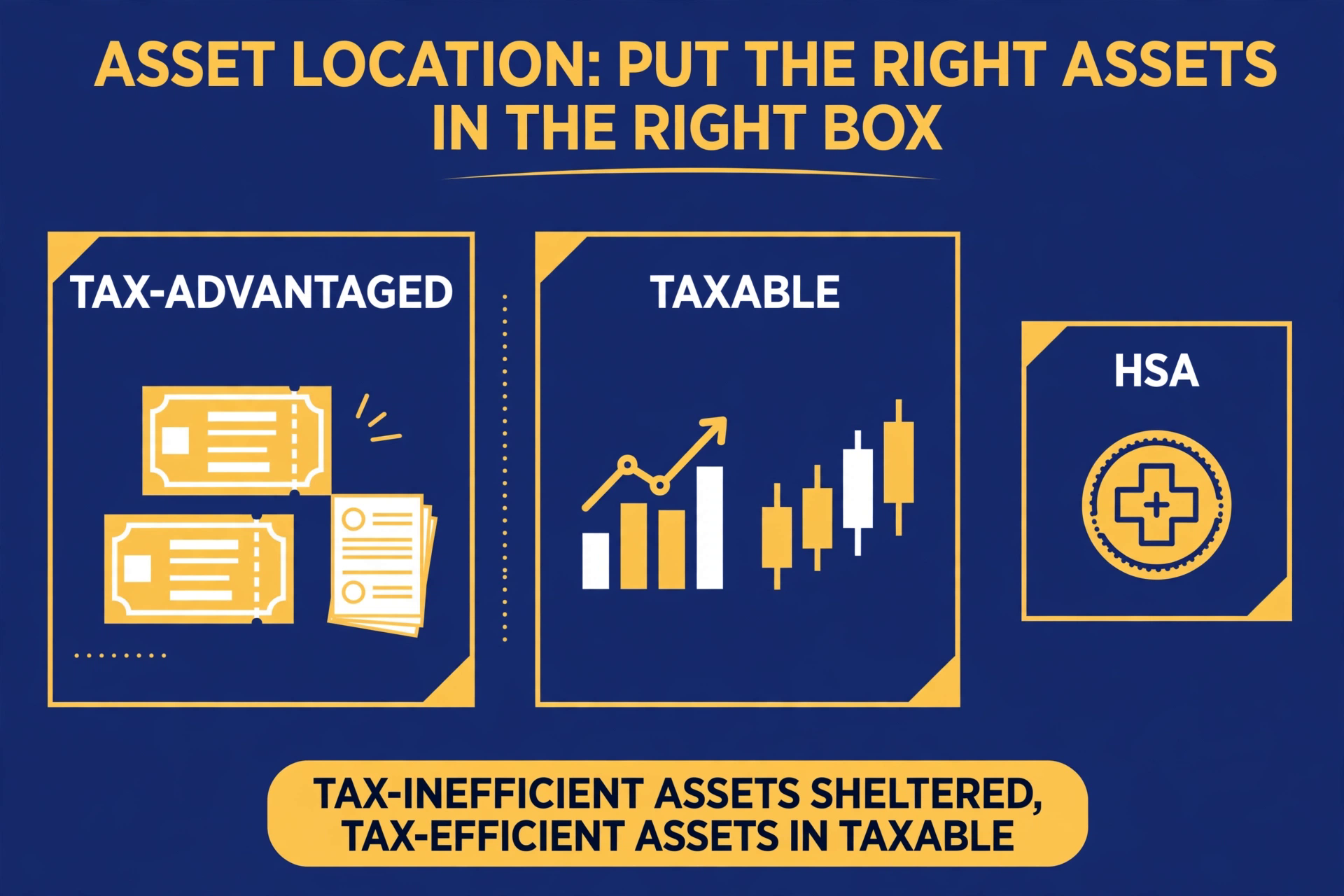
Asset location is the idea that different accounts should hold different investments. Put tax-inefficient assets — bonds, REITs, anything throwing off ordinary income — inside tax-advantaged accounts (401(k), IRA), where the tax drag disappears. Put tax-efficient assets — stock index funds you rarely sell — in taxable accounts, where long-term gains get the preferential rate anyway.
The hierarchy from LP-102 already does most of this automatically: max the match, fund the IRA, fund the HSA, then the taxable account. But within those accounts, the placement matters too. A bond fund in a taxable account bleeds taxes every year; the same fund in a Traditional IRA compounds untouched. Same investment, different account, different outcome.
Recordkeeping: The Boring Superpower
The final habit is the least glamorous and the most valuable: keep records. Every tax move in this lesson — deductions, credits, harvested losses, HSA receipts (LP-102), charitable gifts — only works if you can prove it. The IRS does not accept "I think I donated that."
The system can be simple: one folder (physical or digital) per tax year, with subfolders for income documents, deductions, and investment records. Save every 1099, every donation receipt, every HSA medical receipt. Keep tax returns and supporting documents at least three years — seven if you underreported income by a lot, which you will not, because you keep records.
Good records also make professional help cheaper. If you ever hire a CPA, organized records cut their hours — and their bill. The boring superpower compounds just like money does.
Key terms
- Marginal tax rate
- the tax rate on your next dollar of income, not your whole income.
- Tax brackets
- income slices taxed at increasing rates; only income above each line gets the higher rate.
- Effective tax rate
- total tax divided by total income; always lower than the marginal rate.
- Deduction
- reduces the income that gets taxed; worth your marginal rate.
- Credit
- reduces the tax itself dollar for dollar; worth more than a deduction.
- Standard deduction
- the flat amount everyone can subtract; itemize only if your total exceeds it.
- Bunching
- concentrating two years of itemizable expenses into one year to beat the standard deduction.
- Capital gain
- profit from selling an investment for more than you paid.
- Long-term capital gain
- gain on an asset held more than a year; taxed at preferential 0/15/20% rates.
- Short-term capital gain
- gain on an asset held a year or less; taxed as ordinary income.
- Tax-loss harvesting
- selling losers to offset gains, plus up to $3,000 a year against ordinary income.
- Wash-sale rule
- you cannot claim a loss if you repurchase the same investment within 30 days.
- Asset location
- placing tax-inefficient investments inside tax-advantaged accounts and tax-efficient ones in taxable accounts.
What's next
Taxes close out the core Retirement and Long-Term Planning school. LP-108 "Estate Planning Basics" continues the school with beneficiaries, wills, trusts, and the legacy checklist — making sure everything you built goes where you intend.
The quiz
Tax Planning Basics — Quiz
3 questions · pass with 3 correct
1.What is your marginal tax rate?
2.What is the difference between a tax deduction and a tax credit?
3.Why does holding an investment more than a year matter for taxes?