
Behavior and Financial Decisions
School 05 — Retirement and Long-Term Planning
Listen — 15-second overview
A quick spoken preview of this class
School 4 · Retirement and Long-Term Planning · About 15 minutes
The biggest drag on your returns is not fees, taxes, or bad luck — it is you. Study after study shows that the average investor earns far less than the very investments they own, because they buy high, sell low, and trade on emotion. Your brain was built for surviving on the savanna, not for compounding wealth. We will now teach you about the behavior gap, the biases that drive it, how to talk money with your family, and the decision rules that protect you from yourself.
Your Brain Is the Portfolio's Biggest Expense
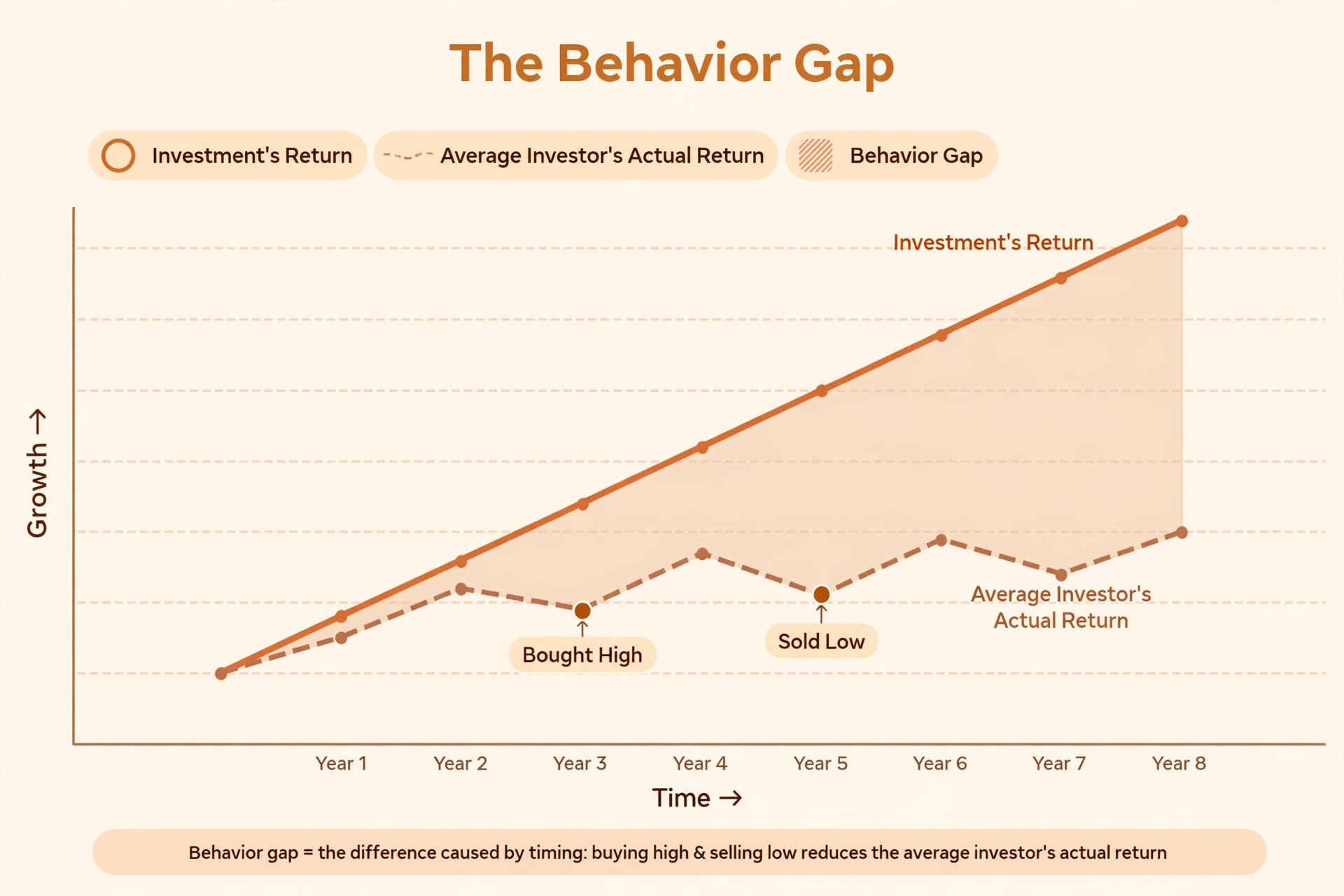
The behavior gap is the difference between what an investment earns and what the average investor in that investment actually earns. Here is how it works: a fund might average 9% a year over a decade, but the typical investor in that fund earns far less — because they piled in after a hot run and sold in a panic at the bottom. The investment did fine. The behavior around it did not.
This is not a story about dumb people. It is a story about normal human wiring. Our brains treat a falling portfolio the way our ancestors treated a predator — as danger to escape right now. But in investing, the "escape" (selling) is exactly what locks in the loss. Every panicked decision feels like self-protection and acts like a tax.
The good news: you do not need a better brain. You need better rules. Once you see the biases for what they are — predictable glitches, not personal failures — you can design around them, the way a good road is designed so a tired driver stays in the lane.
Loss Aversion and Fear
Loss aversion is the finding that losses hurt about twice as much as equal-sized gains feel good. A $1,000 gain makes your day; a $1,000 loss ruins your week. Because losses sting so badly, investors take irrational steps to avoid feeling them — like holding a terrible investment just to avoid "locking in" a loss, or selling a great one in a panic to stop the pain.
Fear turns this up to eleven during market crashes. Prices fall, headlines scream, and your gut insists that selling now is the safe move. But selling after a crash converts a temporary paper decline into a permanent real loss — and almost guarantees you miss the recovery, since the best rebound days usually arrive right when fear is highest. Panic selling is the behavior gap in action.
The antidote is perspective plus procedure. Perspective: every major market decline in history has eventually recovered — staying invested has always been the winning move given enough time. Procedure: decide your response to a crash before it happens, in writing, so a calm version of you is giving orders to a frightened version of you.
Overconfidence and the Herd
If fear makes us sell too soon, overconfidence makes us trade too much. Most investors rate their own skill as above average — which is mathematically impossible for most of them — and overconfident investors churn their accounts, paying fees and taxes on every hop. The data is brutal: the more people trade, the worse they do.
Overconfidence has two loyal friends. Recency bias is the habit of assuming whatever just happened will keep happening — after a hot year, "this time is different" feels true, so people buy at the top; after a crash, they assume the decline is permanent, so they sell at the bottom. Herd behavior is following the crowd into whatever is popular: the hot stock tip at the barbecue, the coin everyone at work is buying. Crowds are great at finding parties and terrible at finding entry prices.
Confirmation bias completes the trap: once you believe something, you notice only the evidence that agrees with it. The meme-stock buyer reads bullish forums and skips the bearish math. Anchoring is its cousin — fixating on one number, like the price you paid, and judging everything against it instead of against what the investment is actually worth today. Together these biases form a factory that turns confidence into losses.
Talking Money with Family
Your financial decisions do not happen in a vacuum — they happen at a kitchen table. If you share money with a spouse or partner, alignment is not optional. Two people pulling in different directions — one saving aggressively, the other spending freely — will quietly sabotage every plan. Sit down together, agree on the big goals, and give each person some no-questions-asked spending money so the budget never feels like a cage.
With kids, the goal is teaching, not lecturing. Let them see you save first, explain your choices in plain words, and give them small real decisions — save, spend, or share their allowance. Children learn money the way they learn language: by immersion, not by textbook.
Be thoughtful about what you share and when. Young kids do not need your net worth or your anxieties; teenagers can start learning the family philosophy — what you value and why. One firm rule: major money decisions (moving, big purchases, investment changes) get discussed before they happen, never announced after. Surprises are for birthdays, not budgets.
Decision Rules That Protect You
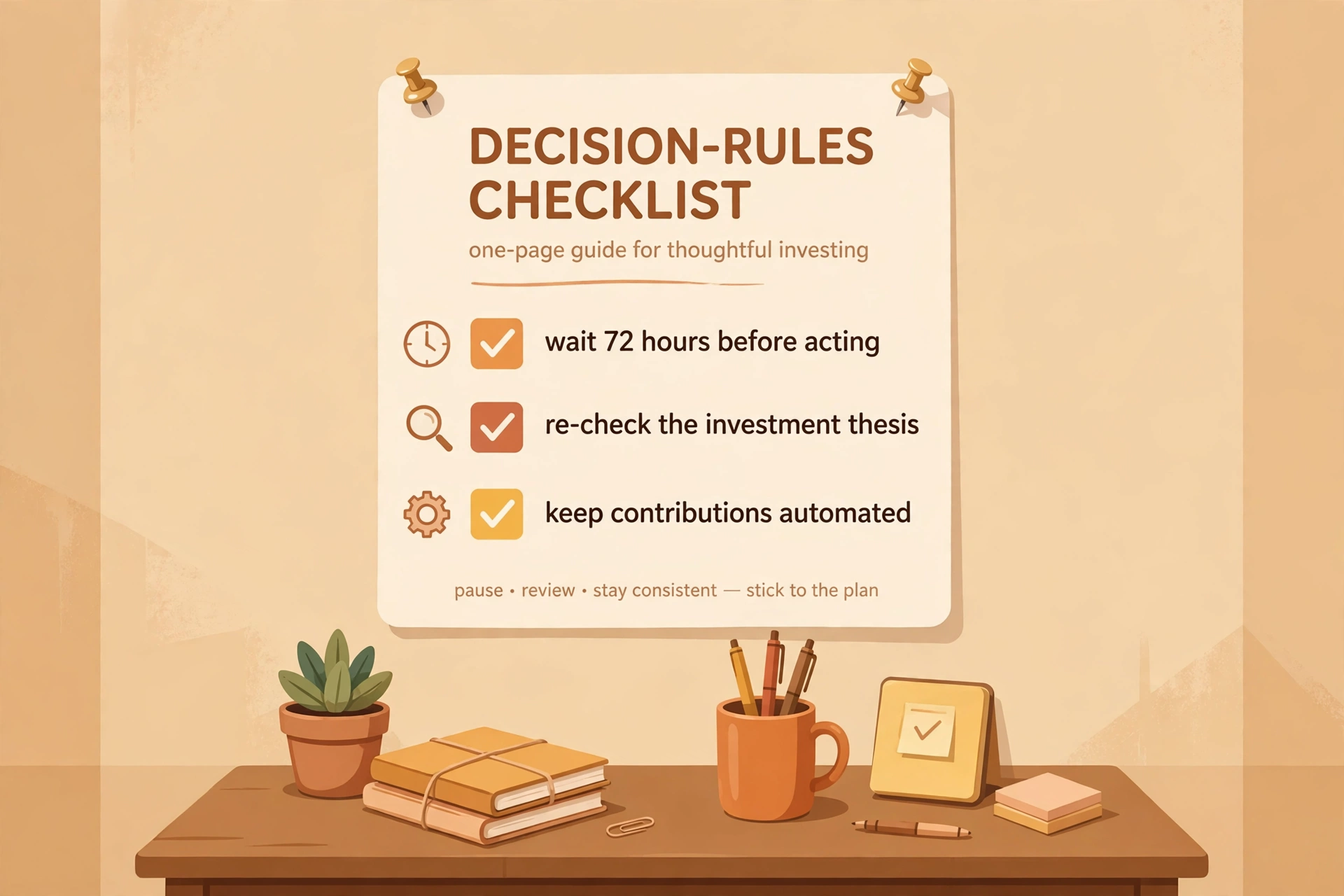
Willpower fails; systems endure. An investment policy statement is a short written document — one page is plenty — stating your goals, your strategy, and what you will and will not do. "I invest monthly in index funds and do not sell during declines" is a complete policy. Writing it down turns a vague intention into a commitment you can re-read when emotions run hot.
Build in a cooling-off period: no investment decision gets made the day the idea arrives. Wait 72 hours. If a "can't-miss opportunity" cannot survive three days of thought, it was never an opportunity — it was an impulse. During the wait, check the thesis: write down, in two sentences, why this investment makes sense. If you cannot, pass.
Then automate what matters and pre-commit the rest. Automatic monthly contributions mean your plan runs even when you are scared, busy, or bored — pre-commitment is deciding in advance so your future self has no choice to make. Keep a simple checklist for the decisions you do make by hand: does this fit my policy, am I chasing a hot tip, have I waited 72 hours? Boring rules, faithfully followed, beat brilliant instincts almost every time.
Key terms
- Behavior gap
- the difference between an investment's return and the lower return the average investor in it actually earns.
- Loss aversion
- losses feel roughly twice as bad as equal gains feel good, driving irrational decisions to avoid them.
- Overconfidence
- overrating your own skill, leading to excessive trading that fees and taxes punish.
- Recency bias
- assuming whatever just happened will keep happening, buying tops and selling bottoms.
- Herd behavior
- following the crowd into popular investments instead of judging value yourself.
- Confirmation bias
- noticing only evidence that agrees with what you already believe.
- Anchoring
- fixating on one number, like the price you paid, instead of what an investment is worth today.
- Investment policy statement
- a short written document stating your goals, strategy, and rules for what you will and will not do.
- Cooling-off period
- a mandatory wait (such as 72 hours) before acting on an investment idea.
- Pre-commitment
- deciding in advance — such as automatic monthly contributions — so your future self has no decision to make.
What's next
This closes the Retirement and Long-Term Planning school. School 5 begins with AP-201 "Economy and Market Cycles" — reading the economic weather (growth, inflation, rates) before you analyze a single company.
The quiz
Behavior and Financial Decisions — Quiz
3 questions · pass with 3 correct
1.What is the behavior gap?
2.What does loss aversion mean?
3.What is the cooling-off period rule?