
How to Use the Academy
School 00 — Orientation
Listen — 15-second overview
A quick spoken preview of this class
School 0 · Orientation · The First Class · About 15 minutes
Welcome. This is the first class of the Prosper Academy, and it is the only class in School Zero — because there is only one thing you need before anything else: to know how this place works.
What you will learn
By the end of this lesson, you will be able to:
- Name the three pillars of the Prosper Academy.
- Describe the 12-school path and why it is ordered the way it is.
- Navigate any course: lesson, pictures, key terms, quiz, checkpoint.
- Use worksheets and checkpoints to track your own progress.
- Read the Market Climate Dashboard and state what it is for.
- State the Academy's conduct expectations — and its limits.
1. What the Prosper Academy is
The Academy is built on three pillars:
- Make money — earning more: careers, skills, and side income.
- Save money — budgeting, cutting waste, and keeping what you earn.
- Invest money — putting your savings to work: markets, retirement, and trading.
Everything here is free while the library is being built. The Academy opens in full at launch, and the material stays free until there is a real library worth charging for. Nobody is asked to pay for a promise.
2. Your map: the 12 schools
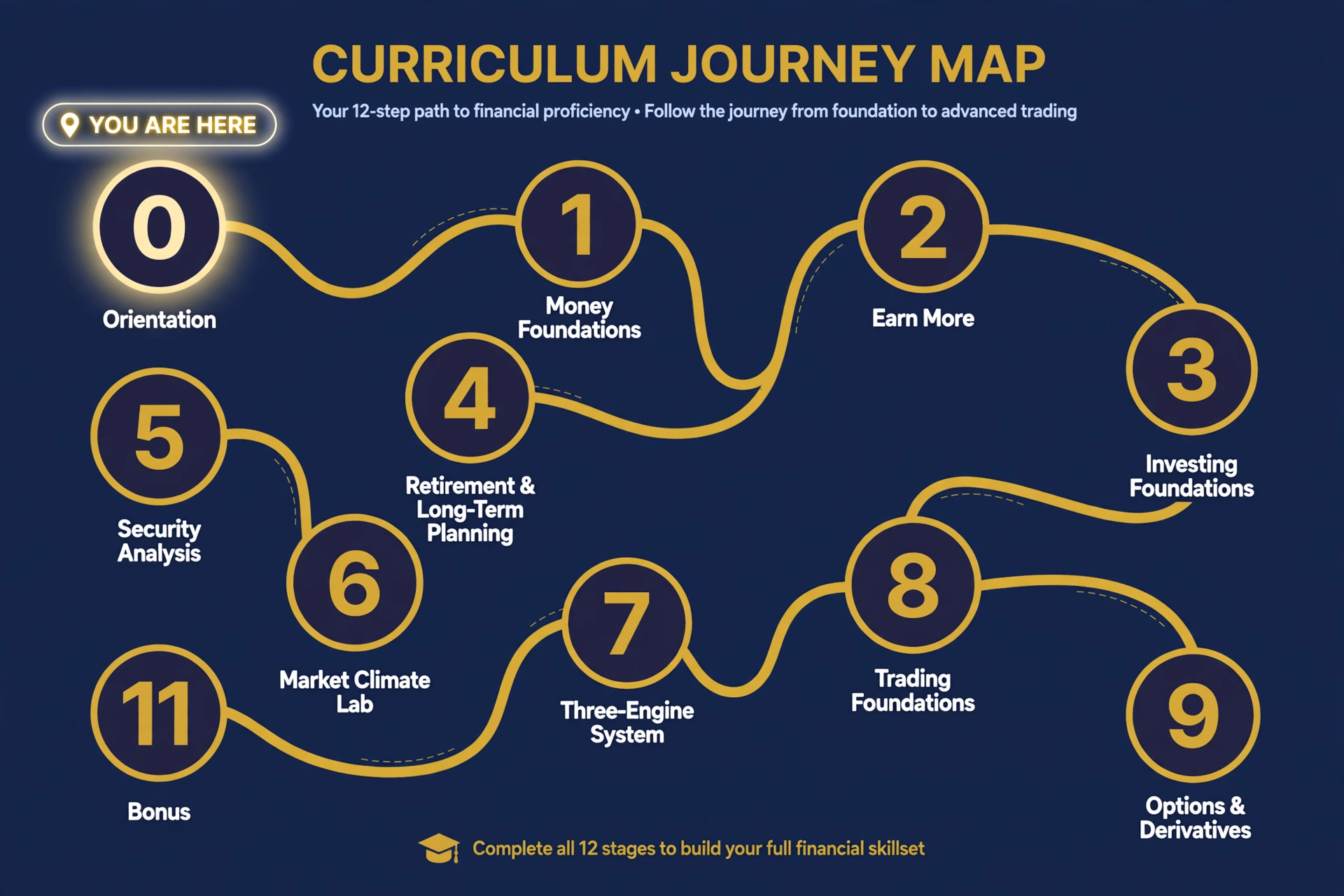
The curriculum is a path, and the order is deliberate:
- School 0 — Orientation. You are here. One lesson.
- Schools 1–2 — Make it and keep it. Money foundations, earning more.
- Schools 3–4 — Grow it. Investing foundations, security analysis and portfolio design.
- Schools 5–7 — Understand it. Retirement and long-term planning, the Market Climate Lab, and the
Three-Engine System — the divider between investing and trading.
- Schools 8–9 — Trade it, carefully. Trading foundations and options — the
gateway skills, taught risk-first.
Go in order. The path is designed so that every school assumes you finished the one before it. Skipping ahead to active trading without the foundations is how accounts get destroyed — which is exactly why the trading schools sit at the end, not the beginning.
3. Anatomy of a course
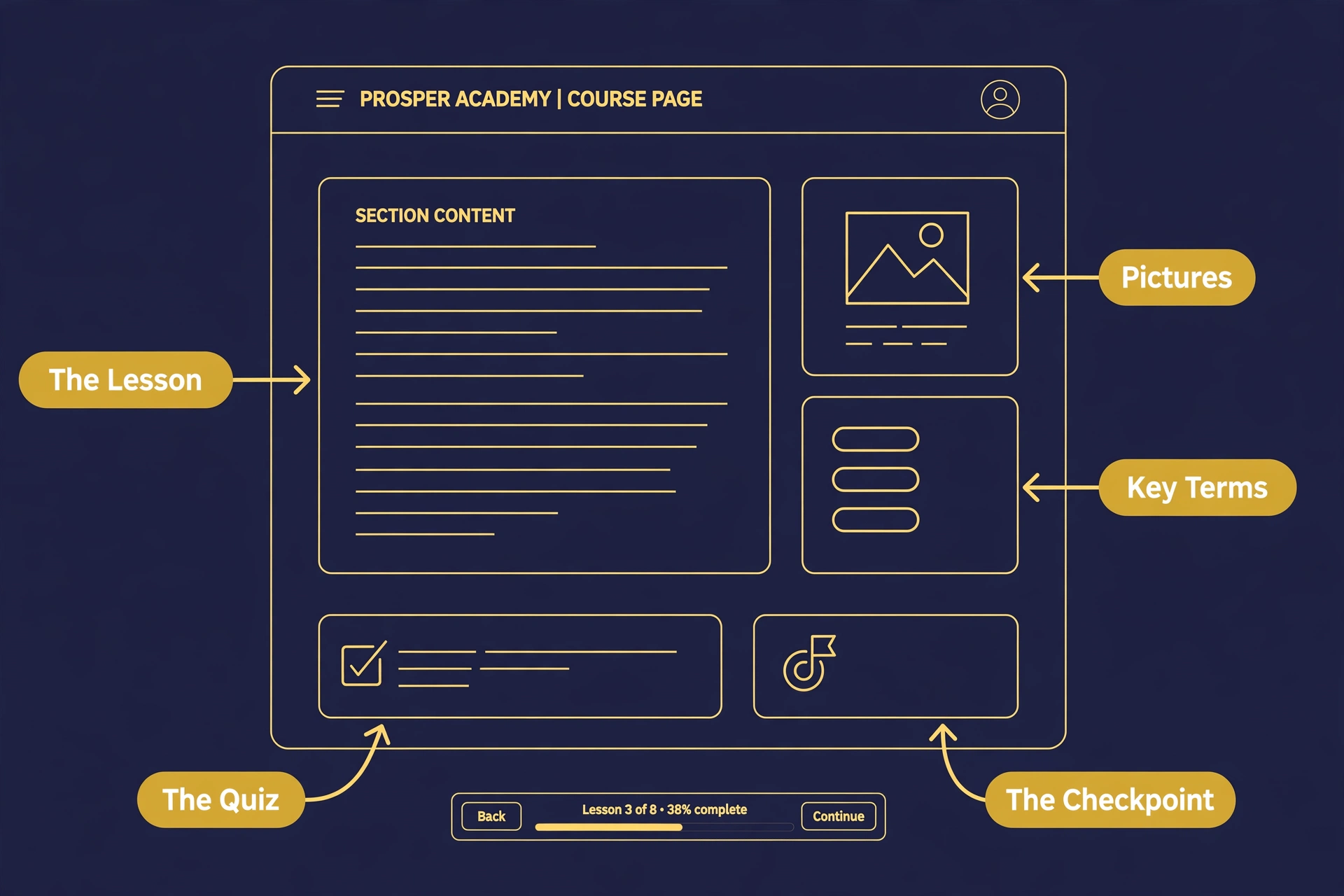
Every course in the Academy has the same five parts:
- The lesson — study-guide text, written plainly. This is the core.
- Pictures — diagrams and illustrations that show what words cannot.
- Key terms — the vocabulary of the lesson, defined in one place.
- The quiz — a short test. Pass it cold before you move on.
- The checkpoint — a worksheet or exercise that makes you use the lesson.
Courses launch text-first: the written guide, pictures, and quiz come first. Videos are added inside the courses over time as production ramps up. At least one video a week doubles as course material, so the public channel and the Academy grow together.
4. Worksheets and checkpoints
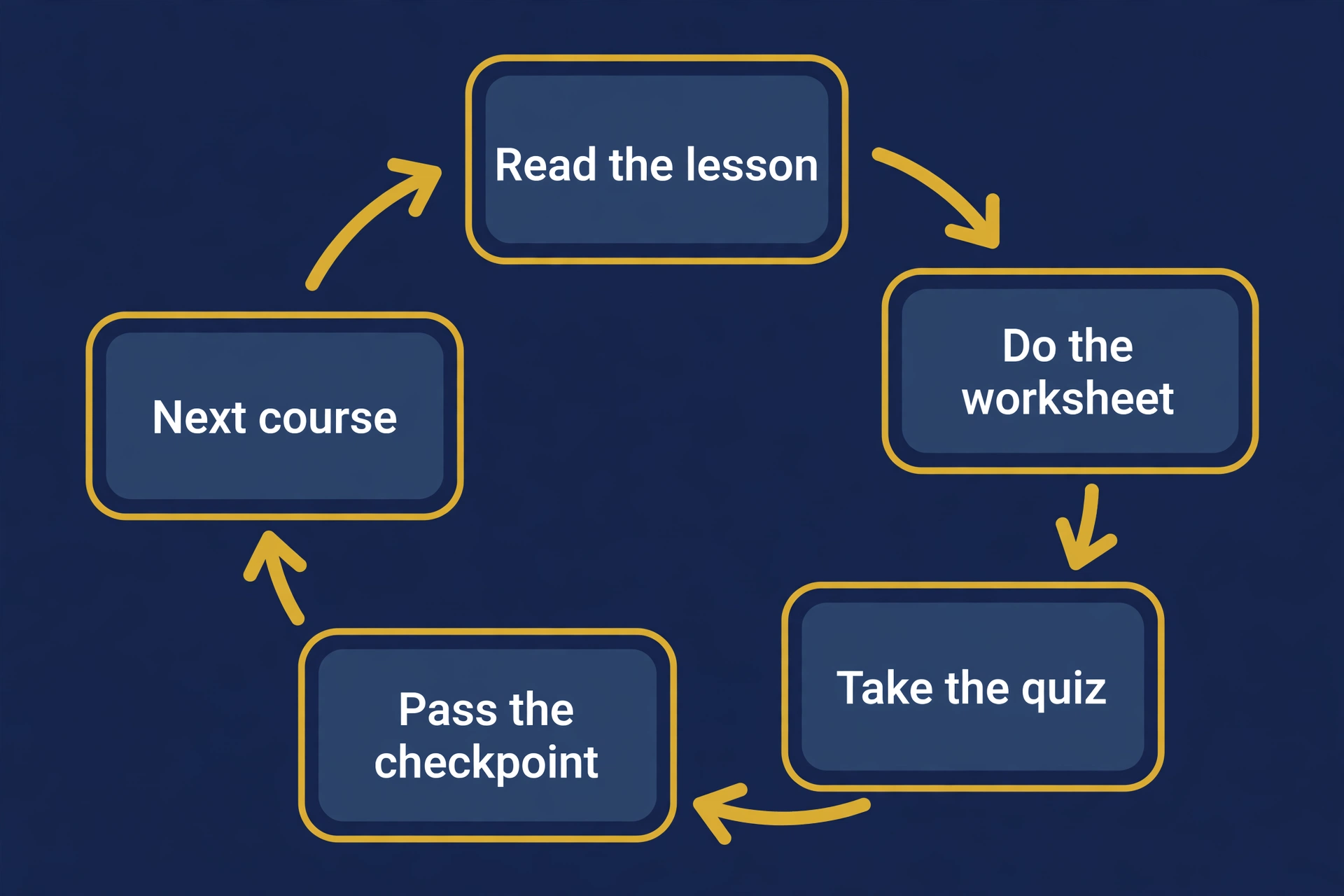
Most lessons end with something to do, not just something to read: build the budget, run the compound-interest math, size the position. Do the work yourself — reading about a budget never built anyone's savings.
Keep everything in one place: a binder, a notebook, or a folder on your computer. This becomes your personal manual. The rule is simple: do not move on until you can pass the quiz cold and explain the lesson in your own words. Speed means nothing here; retention means everything.
5. The Market Climate Dashboard
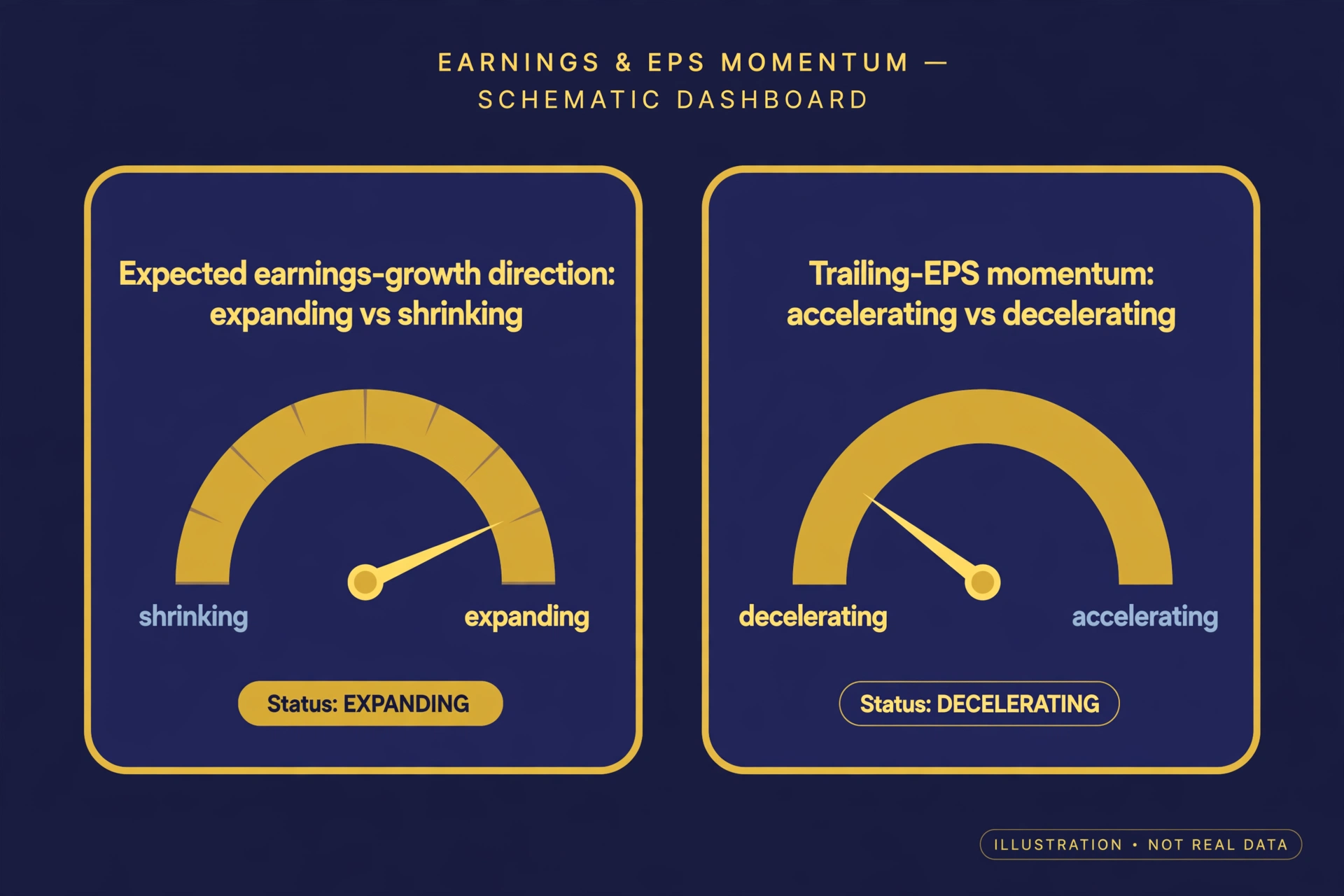
The Academy has its own weather station: the Market Climate Dashboard. It answers one question — what kind of market weather are we in? — using two reads:
- Expected earnings-growth direction — is expected growth expanding or shrinking?
- Trailing-EPS momentum — is the rate of earnings growth accelerating or decelerating?
Understand this clearly: the dashboard is a money-management tool for investing and longer-term swing trading. It tells you when conditions favor leaning into risk and when they favor caution. It is not a day-trading signal. Check it weekly, alongside the Market Climate Report video.
6. Conduct and expectations
- Go in order. The curriculum is sequenced for a reason.
- Master one thing at a time. One strategy, learned deeply, beats ten strategies
skimmed. You will hear this again.
- No hype, no guarantees. Anyone promising guaranteed returns — in markets or in
education — is someone to walk away from. (School 8 opens with Trading Safety First for exactly this reason.)
- Community comes later. For now, it is you and the material. Discussion
features arrive after launch.
7. What this Academy is not
This Academy is a classroom, not a trading desk. No strategy taught here guarantees profit, and none guarantees passing a prop-firm evaluation. Trading and investing involve real risk, including the loss of principal.
Key terms
- Curriculum
- the ordered set of courses that makes up the Academy.
- Checkpoint
- the exercise at the end of a lesson that proves you can use it.
- Worksheet
- a hands-on page where you do the lesson's math yourself.
- Market climate
- the Academy's read on current market conditions, from the dashboard.
- Three pillars
- make money, save money, invest money. The foundation of everything here.
What's next
School 1 is Money Foundations — starting with Know Your Numbers (MF-101), then How to Make a Budget (MF-102). Bring a notebook.
The quiz
How to Use the Academy — Quiz
3 questions · pass with 2 correct
1.What are the three pillars of the Prosper Academy?
2.Before moving to the next course, you should be able to…
3.Is the Academy's content financial advice?