
Foundations of Wealth
School 01 — Money Foundations
Listen — 15-second overview
A quick spoken preview of this class
School 1 · Money Foundations · About 15 minutes
Money touches everything in your life — where you live, what you eat, what you can do. Most people never learned the basics, so they just guess. When you know the basics, you stop guessing and you get control. This lesson gives you the building blocks: income, expenses, assets, liabilities, and net worth. We will now teach you about income, expenses, assets, liabilities, net worth, how to calculate your net worth, and building a simple cash flow statement.
Income
Income is the money that comes in to you. Your paycheck is income. Money from a side job is income. Any money that lands in your hands or your account counts.
Your pay comes in two forms. Gross income is your pay before taxes are taken out — the full amount your job says it pays you. Net income is what is left after taxes and other deductions are taken out — this is your take-home pay, the money that actually reaches your account.
Every money decision you make is based on your net income, not your gross. Your bills are paid with the money that actually arrives, not the money that disappeared before you saw it.
Expenses
An expense is any money that goes out of your account. Rent is an expense. Groceries are an expense. Every bill you pay is an expense.
Expenses come in two kinds. Fixed expenses stay about the same every month, like rent or a phone bill. Variable expenses change from month to month, like groceries or gas.
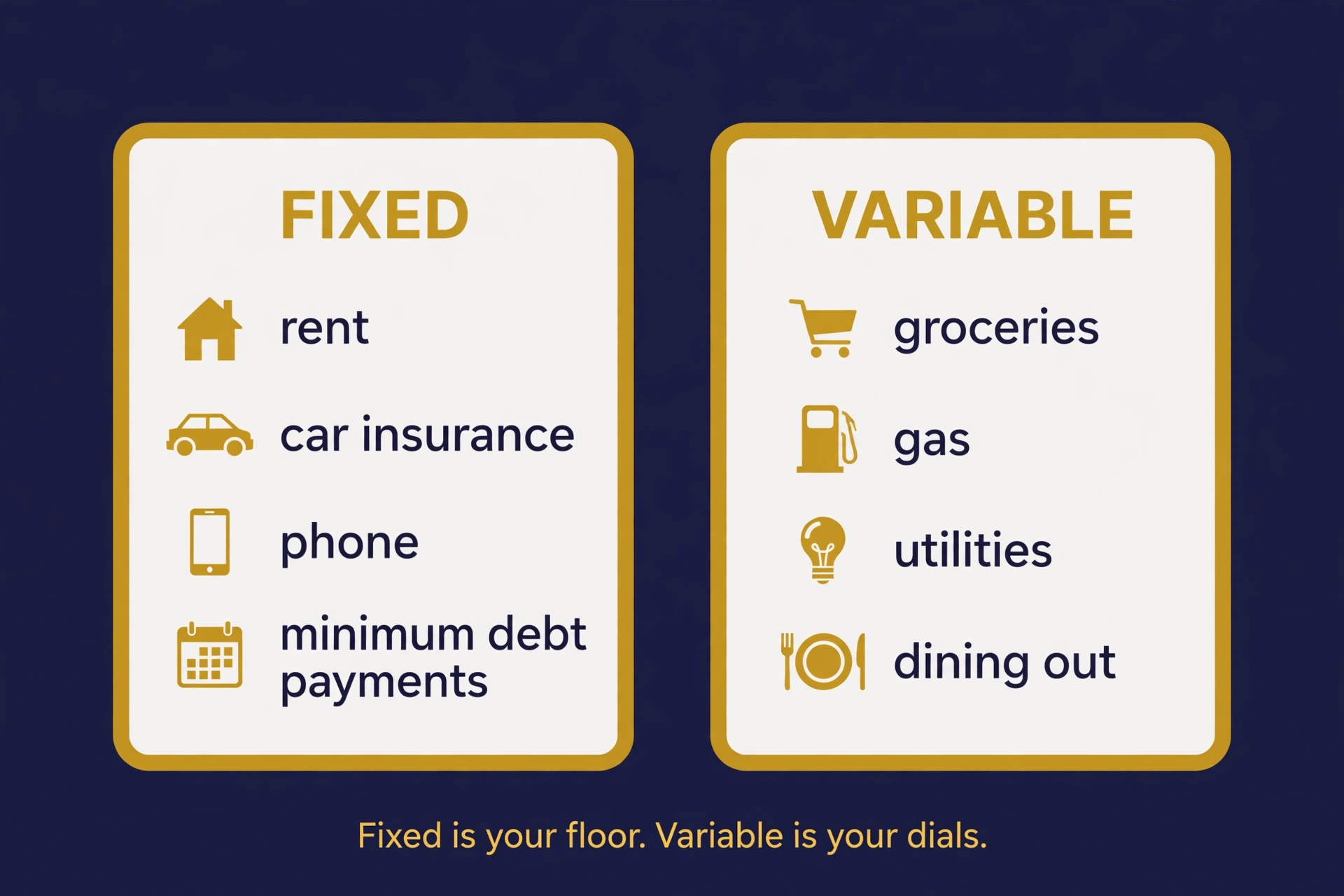
Knowing the difference matters. Your fixed expenses are your floor — the amount that must be paid no matter what. Your variable expenses are the parts you can adjust when you need to free up money.
Assets
An asset is something you own that has value. Money in your bank account is an asset. Your car is an asset. A home you own is an asset.
If you could sell it today and money would appear, it is probably an asset. Retirement accounts count as assets too, even if you cannot touch them yet — the money is still yours.
Liabilities
A liability is money you owe to someone else. A credit-card balance is a liability. A car loan is a liability. Student loans and a mortgage are liabilities.
When you owe money, you are on the paying side. That balance you still owe is the liability, no matter what it was for.
Net Worth
Net worth is what you own minus what you owe. Your assets minus your liabilities. That is the whole idea.
Your net worth can be positive or negative, and both are normal when you are starting out. Think of it as a snapshot of where you stand right now — not a verdict on you. It is simply a starting point you can improve.
Calculating Your Net Worth
First, list everything you own — your assets. Then, list everything you owe — your liabilities. Now subtract what you owe from what you own.
The number you get is your net worth. If what you own is bigger, your net worth is positive. If what you owe is bigger, your net worth is negative. There are no tricks here: list both sides honestly, then subtract.
Building a Simple Cash Flow Statement
A cash-flow statement is one page that shows your money in, your money out, and what is left. It is that simple: money in at the top, money out below it, and the result at the bottom.
If more money came in than went out, you have a surplus — there is money left over to save, invest, or pay down debt. If more money went out than came in, you have a deficit — you spent more than you earned, and the gap had to be filled somehow.
Every household is one or the other each month. This one page does not judge you. It just tells you the truth about your money.
Key terms
- Gross income
- your pay before taxes and other deductions are taken out.
- Net income
- your take-home pay, what actually reaches your account.
- Fixed expense
- a cost that stays about the same every month.
- Variable expense
- a cost that changes from month to month.
- Asset
- something you own that has value.
- Liability
- money you owe to someone else.
- Net worth
- what you own minus what you owe.
- Cash-flow statement
- one page showing money in, money out, and what is left.
- Surplus
- more money came in than went out.
- Deficit
- more money went out than came in.
What's next
Now that you know the building blocks of money, MF-102 "How to Budget" turns them into a plan. The blocks you just learned become the foundation your budget is built on.
---
The quiz
Know Your Numbers — Quiz
4 questions · pass with 4 correct
1.What is net income (take-home pay), and why does it matter?
2.Which of these is a FIXED expense?
3.Which of these is a LIABILITY?
4.If your liabilities are larger than your assets, what is your net worth?
Recommended Tools
Hand-picked resources that fit this lesson — only ever one or two, and only when they're genuinely useful.
- Learn more
Acorns
Invest your spare change automatically while you learn the basics.
- Learn more
SoFi
One app for banking, budgeting, and your first investments.
We may earn a commission if you sign up — at no extra cost to you.