
How to Budget
School 01 — Money Foundations
Listen — 15-second overview
A quick spoken preview of this class
School 1 · Money Foundations · About 15 minutes
A budget is a plan for your money. It means deciding ahead of time where each dollar goes, before the month even starts. That is it. It is good because it stops your money from quietly disappearing. It turns a wish like "I want to save" into an actual plan. And it takes away a lot of money stress. We will now teach you about your monthly income, zero-based budgeting, the 50/30/20 budget, conscious spending, and automation.
Your Monthly Income
Every budget runs on one number: your monthly income. This is your take-home pay — the money that actually arrives in your account after taxes.
Paychecks can come on different schedules. Some people get paid every week, some every two weeks, some once a month. For budgeting, you turn whatever you earn into one monthly take-home number. It is the starting point for everything below.
This is the number your whole budget is built on. Get this one number right, and the rest of the plan makes sense.
Zero-Based Budgeting
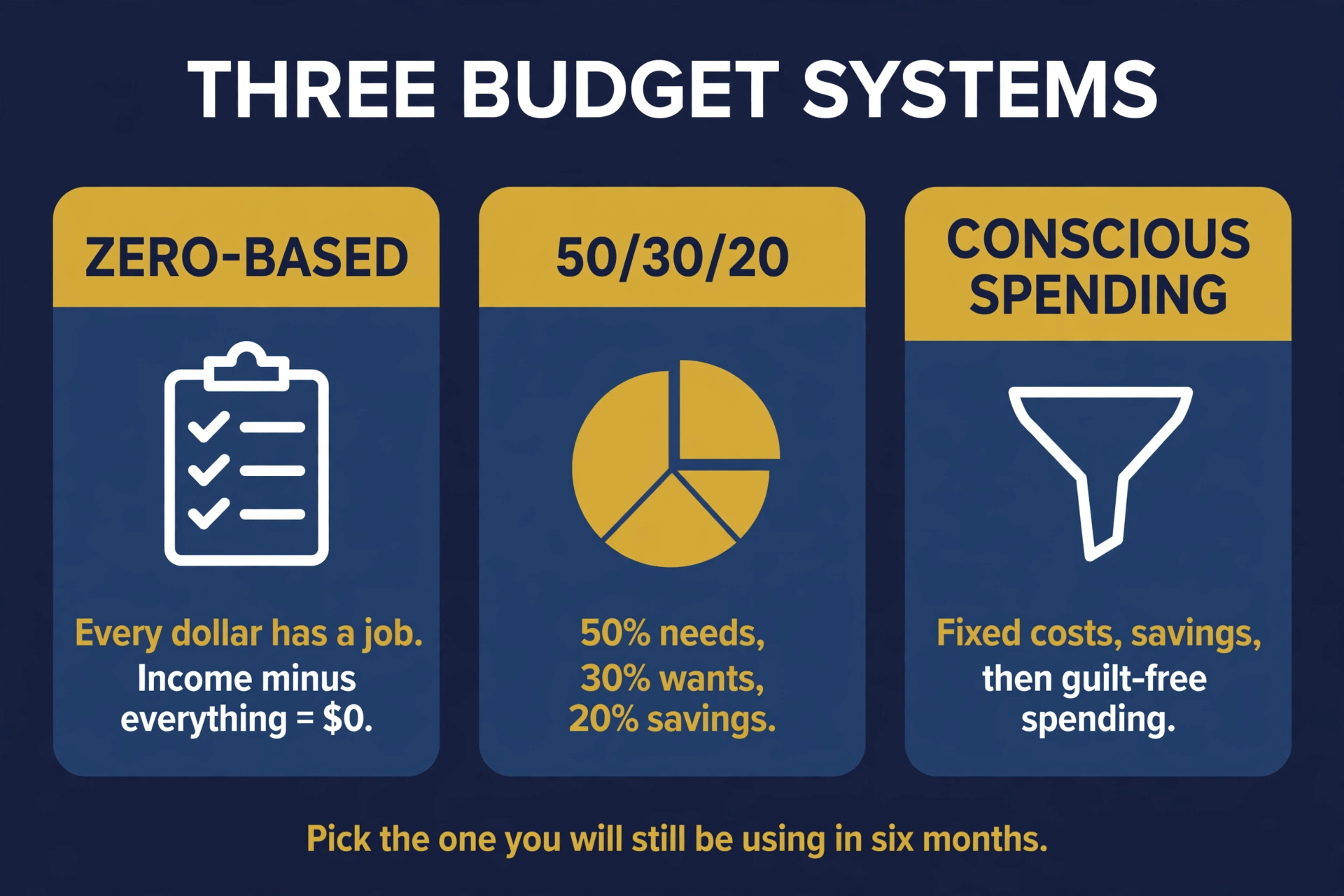
Zero-based budgeting means every dollar gets a job before the month starts. You take your income and assign every dollar somewhere: bills, savings, debt payments, fun money. Income minus everything assigned equals zero.
That zero does not mean zero money left. It means zero dollars unassigned. Nothing is just floating around with no plan.
This is the most detailed of the three systems, and it gives you the most control. It also takes the most effort to keep up. It fits people who like detail and want to know exactly where everything goes.
The 50/30/20 Budget
The 50/30/20 budget splits your take-home pay into three buckets. About 50% goes to needs — the things you must pay for, like housing, groceries, and utilities. About 30% goes to wants — the things you enjoy, like eating out and entertainment. About 20% goes to savings and debt payoff.
Think of it as a diagnostic mirror, not a law. You look at how your real spending lines up against the three buckets, and the picture tells you what is off. If your needs are eating up way more than half, no small cut to your wants will fix it — the problem is structural, like housing that costs too much.
It is a quick way to see your money clearly, without tracking every single dollar. Check it for a few minutes each month and believe what the mirror shows you.
Conscious Spending
Conscious spending uses only three buckets, and that is the whole system. Bucket one is fixed costs — rent, utilities, insurance, minimum debt payments. The non-negotiables. Bucket two is savings and investments — and this bucket gets filled first.
Bucket three is everything else, and it is guilt-free. Once the fixed costs and the savings are handled, the rest is yours to spend however you like. No tracking, no shame, no spreadsheets.
This is the lowest-maintenance system of the three. It fits people who would quit budgeting if they had to track every dollar. Its trade-off is that it hides detail — if the guilt-free bucket keeps swallowing the money, you will not know exactly where it went.
Automation
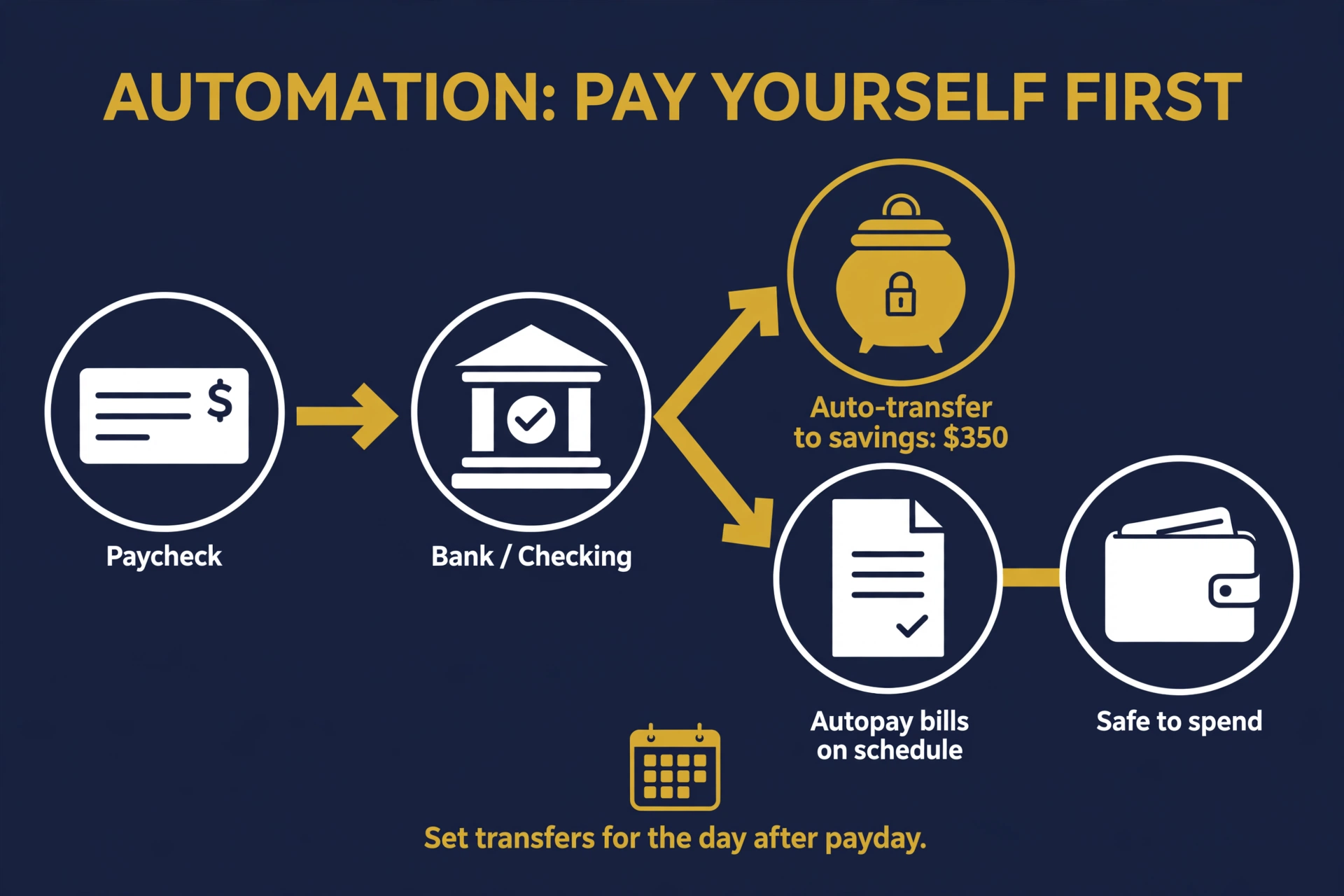
Automation means your budget runs itself. The key idea is to pay yourself first: your savings moves automatically, the day after payday, before you can spend it. You do not rely on remembering or on willpower.
The same goes for the bills. Fixed bills like rent, insurance, and debt payments can go out automatically on schedule. What is left in your checking account after the automatic moves is what you can safely spend.
Automation removes willpower from the whole thing, which is the part that usually breaks. One caution: make sure the money is actually there when a transfer fires. An automatic transfer that hits before payday causes overdrafts, which is the opposite of the plan.
Key terms
- Budget
- a plan for your money: deciding ahead of time where each dollar goes.
- Monthly income
- the one number your budget runs on: your take-home pay for the month.
- Zero-based budget
- a budget where every dollar gets a job, so income minus everything assigned equals zero dollars unassigned.
- 50/30/20 rule
- splitting take-home pay into about 50% needs, 30% wants, and 20% savings and debt payoff.
- Needs
- things you must pay for: housing, groceries, utilities, basic transportation, insurance, minimum debt payments.
- Wants
- things you enjoy but could live without: dining out, entertainment, hobbies, shopping, travel.
- Conscious spending
- a simple budget of three buckets: fixed costs, savings and investments first, and guilt-free spending for the rest.
- Pay yourself first
- moving savings automatically before spending, instead of saving whatever is left over.
- Automation
- scheduled transfers and payments that run your budget without monthly willpower.
What's next
A budget needs protection from surprises. MF-103 "Emergency Fund" shows you how to build a cash cushion that keeps an unexpected bill from wrecking your plan.
---
The quiz
How to Make a Budget — Quiz
4 questions · pass with 4 correct
1.Why do budgets start from net (take-home) income instead of gross income?
2.What is the 50/30/20 rule?
3.What does a zero-based budget require?
4.Conscious spending divides money into which buckets?
Recommended Tools
Hand-picked resources that fit this lesson — only ever one or two, and only when they're genuinely useful.
- Learn more
Acorns
Round up everyday purchases and save the difference without thinking about it.
- Learn more
SoFi
Built-in spending insights that sort your money automatically.
We may earn a commission if you sign up — at no extra cost to you.