
Salary and Offer Negotiation
School 02 — Earn More
Listen — 15-second overview
A quick spoken preview of this class
School 2 · Earn More · About 15 minutes
Most beginners accept the first offer they get, afraid that asking for more will make the offer disappear. Here is the truth employers already know: the first offer is a starting point, and they expect you to negotiate. Negotiation is not confrontation — it is a calm, professional conversation about value, and it is a learnable skill. One good negotiation can raise your pay for years, because raises and future offers build on where you start. This class is negotiation literacy education — it teaches you how the process works, not legal advice about your situation. We will now teach you about compensation research, negotiation scripts, benefits, and total-compensation comparison.
Compensation Research
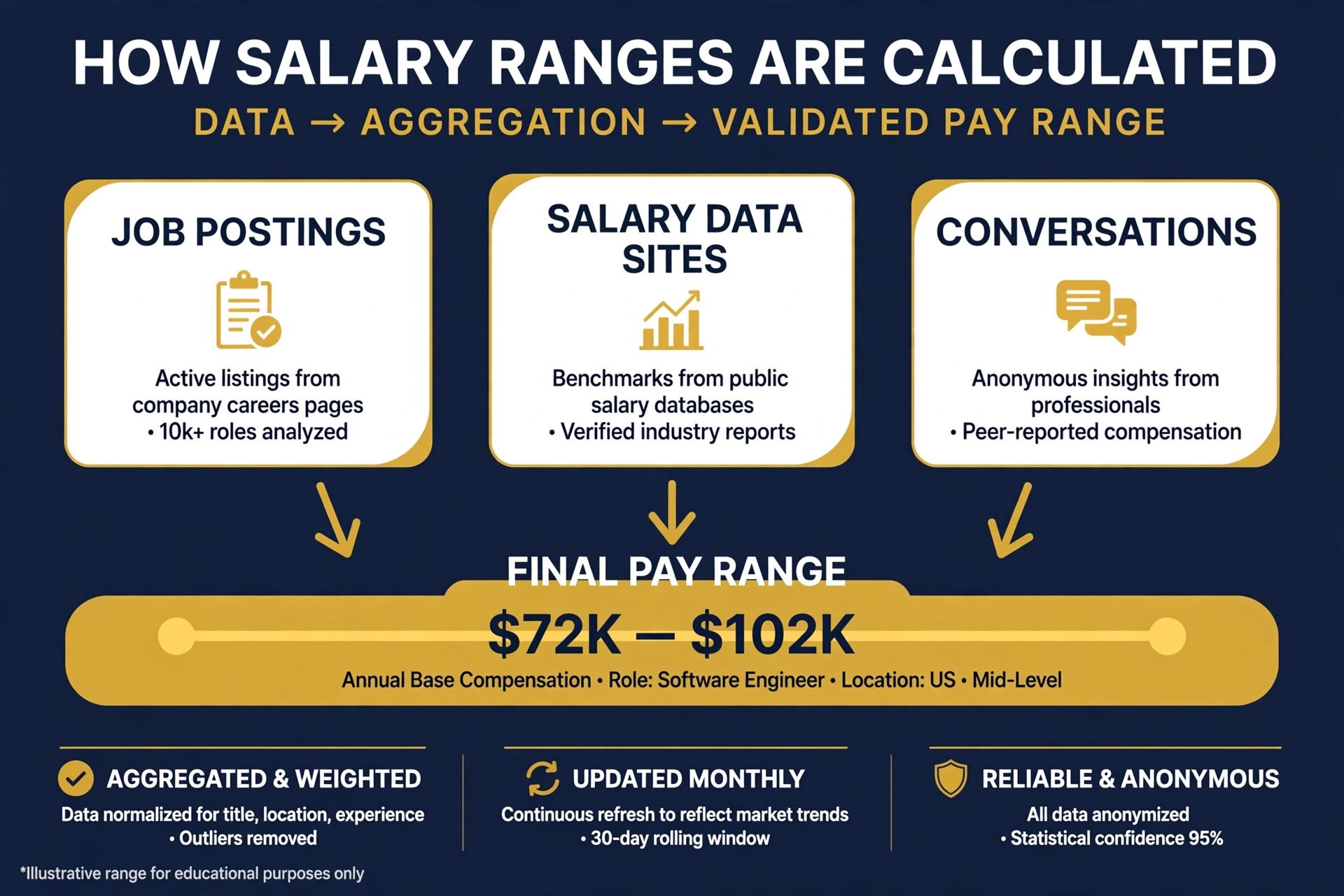
Never walk into a negotiation without research. Your goal is to learn the pay range for the role — the low end employers offer beginners, the middle most people earn, and the high end experienced people reach. A range, not a single number, because pay moves with experience, location, industry, and company size.
Start with job postings. Many now list pay ranges, and reading enough of them shows you the pattern for a role. Then check salary data websites, which collect reported pay by job title and city — remember these are self-reported, so treat them as a rough map, not exact truth. Finally, talk to people. Ask workers in the field what range they have seen for someone at your level. Most people will share a range if you ask politely and keep it general.
Do this research before anyone asks you for a number. The first number spoken in a negotiation anchors the conversation — everything after it is measured against it. If you must give a number first, give a researched range with your target near the top of it, and tie it to your proof: "Based on my research for this role in this area, and my experience doing X, I am looking for something in the range of..." Research turns a guess into a position.
Negotiation Scripts
Scripts are word-for-word phrases you practice in advance, so you are not inventing language under pressure. You will adapt them to your voice, but having the bones ready changes everything. Here are four every beginner should know.
The opener: "Thank you — I am excited about this role. Based on my research for this position and my experience with [your proof], I was hoping for something closer to [your target]. Is there flexibility there?" Polite, specific, and it ends with a question that invites a yes.
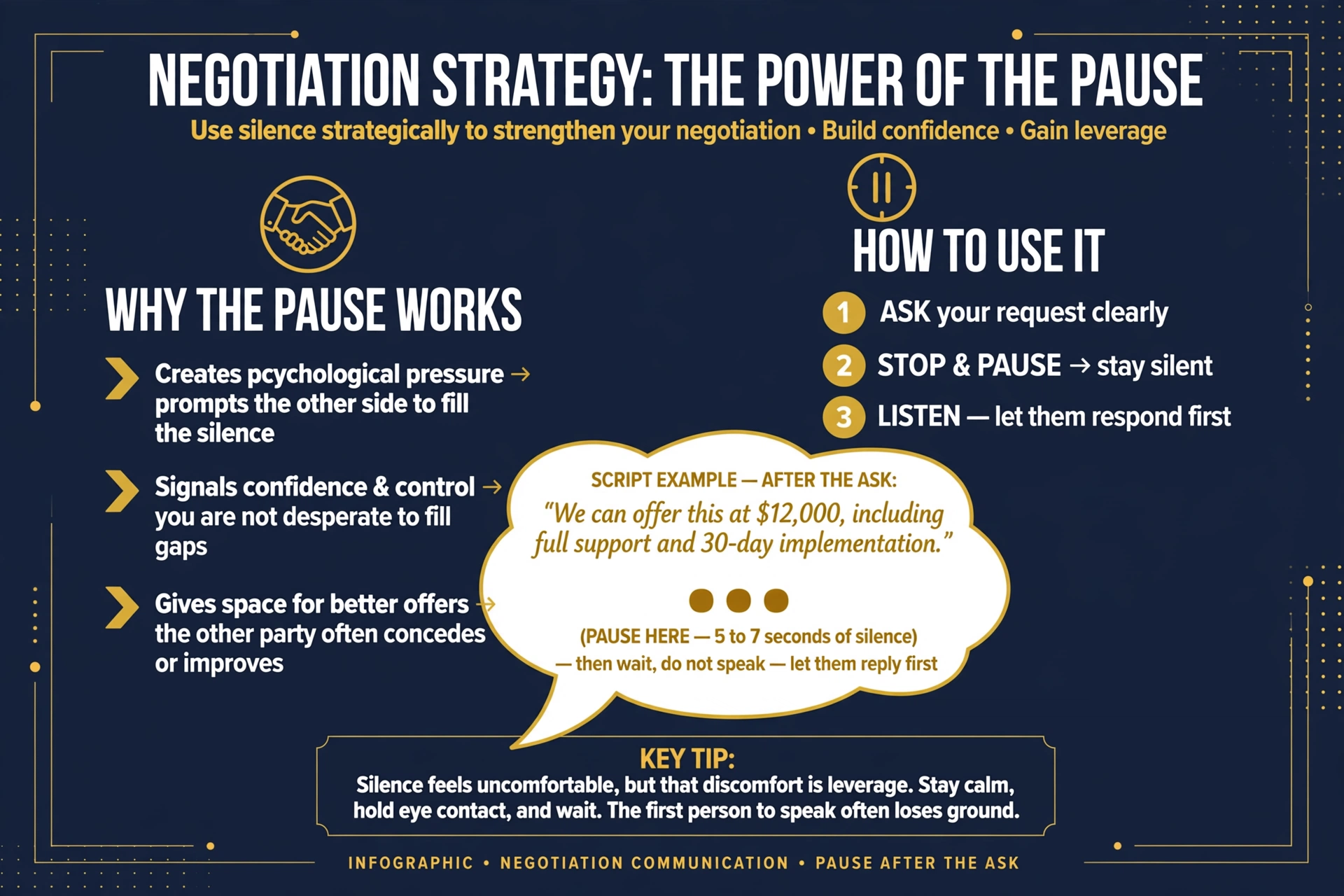
The pause: after you state your ask, stop talking. Silence feels unbearable, but the person who speaks first after an ask usually gives something away. State your number, then wait. Let them respond.
The ask for time: "Thank you for the offer. Can I have a few days to consider it?" Never accept on the spot, even if the offer sounds good. Time lets you compare, research, and come back calm instead of emotional.
The counter: if they move partway, you can move partway too — but always trade, never just drop. "If you can meet me at [number], I can accept today." Movement toward each other is how deals close.
And three things to never do: never lie about a competing offer — it is easy to check and destroys trust. Never issue ultimatums unless you truly mean them. And never negotiate against yourself by lowering your ask before they answer. Say your piece, then pause.
Benefits Have Real Dollar Value
Salary is only part of what an employer pays you. Benefits are the rest, and they have real dollar value even though they never appear on your paycheck. A lower salary with strong benefits can be worth more than a higher salary with weak ones — which is why you must learn to see them.
Health insurance is the big one. An employer plan can be worth a large sum each year compared with buying coverage yourself — and the difference between a plan with low out-of-pocket costs and one with high out-of-pocket costs is money out of your pocket when you get sick. Retirement matching is simpler to value: if an employer matches a percentage of what you put in your retirement account, that match is extra pay, plain and simple — leaving it on the table is leaving pay on the table. Time off has value too: more paid vacation, sick days, and holidays mean more of your life is yours while your pay stays the same. And remote flexibility saves commuting time and cost every single week, which adds up fast.
Also ask about the quiet benefits: training budgets, tuition help, parental leave, and bonus structures. None of these show up in the headline salary number, and all of them are negotiable more often than beginners think. When an employer says the salary is firm, the next sentence out of your mouth should be: "I understand. Can we talk about the benefits package instead?"

Total-Compensation Comparison
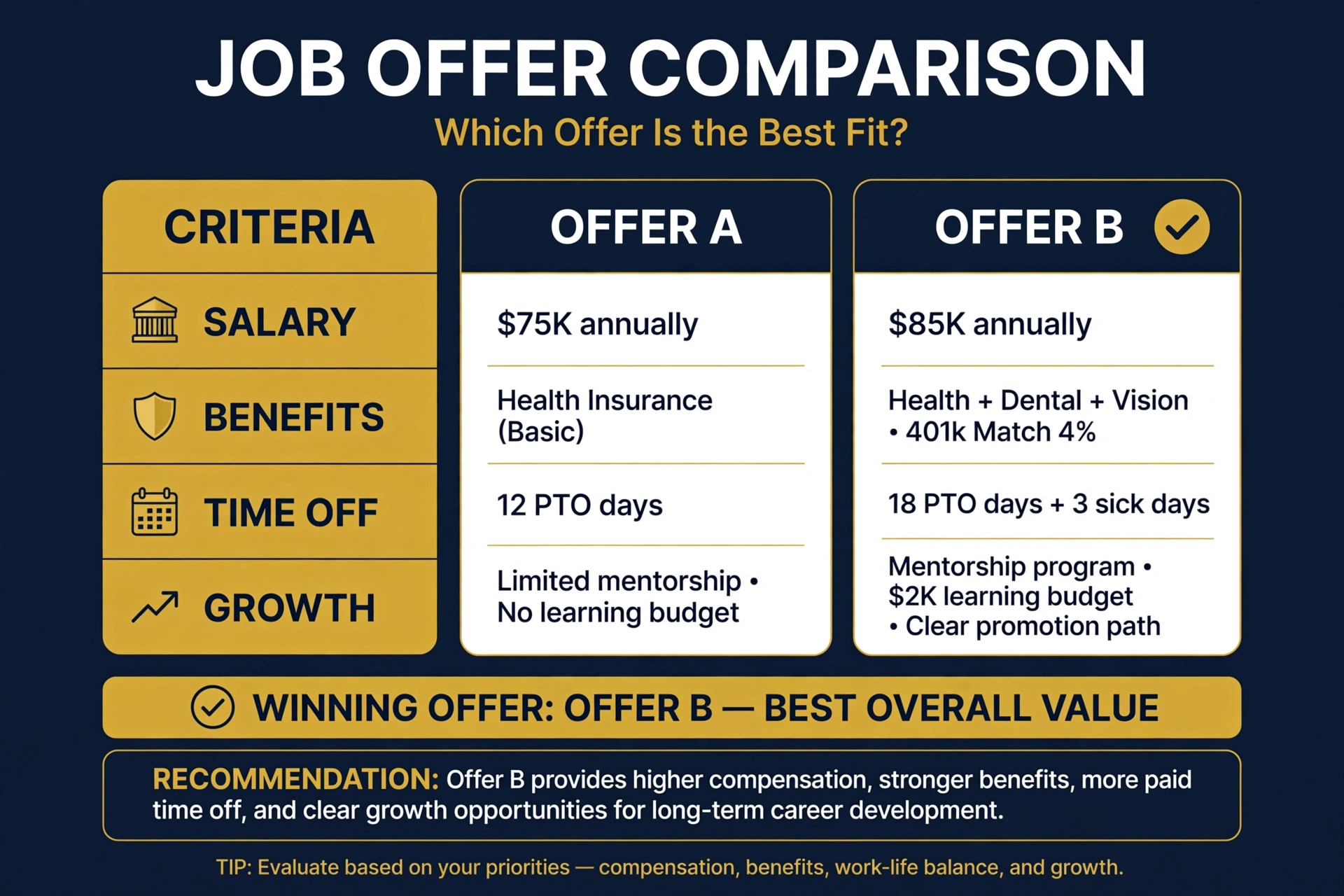
When you have more than one offer — or one offer and your current job — compare total compensation, not just salary. Total compensation means everything: base pay, plus the dollar value of benefits, plus time off, plus flexibility, plus growth.
Build a simple comparison table. List each offer down one side and each factor across the top: salary, health plan quality, retirement match, paid time off, remote flexibility, commute, training and growth, and how much you actually want the work. Score each honestly. The offer with the highest salary often stops looking like the winner once the rest of the row is filled in.
Two traps to avoid. First, the headline trap: choosing by salary alone while ignoring a weak benefits package or a brutal commute. Second, the relocation trap: a bigger number in a more expensive city can mean less money in your pocket after housing and daily costs. Always compare what life costs where the job is, not just what the job pays.
There is one more factor no table captures: trajectory. A role that teaches you valuable skills and puts you next to people you can learn from can be worth more over a career than a slightly better-paid dead end. You are not just choosing a paycheck. You are choosing what your career capital looks like two years from now.
Key terms
- Pay range
- the spread from the low to the high end of what employers pay for a role; pay moves with experience, location, industry, and company size.
- Anchor
- the first number spoken in a negotiation, which everything after is measured against.
- Negotiation script
- a practiced phrase you adapt to your own voice so you are not inventing language under pressure.
- Retirement match
- extra pay an employer adds to your retirement account based on what you contribute.
- Total compensation
- everything an offer is worth: base pay plus benefits, time off, flexibility, and growth.
- Counteroffer
- your response to an employer's offer, usually meeting partway after they move.
What's next
You can research pay, ask with confidence, and judge a whole offer. EM-103 "High-Paying Career Paths" zooms out to the biggest lever of all: which field you build your career in, and what each path costs to enter.
---
The quiz
Negotiate Your Worth — Quiz
3 questions · pass with 3 correct
1.Why research pay ranges before negotiating?
2.What is the 'pause' in a negotiation script?
3.Why compare offers by total compensation instead of salary alone?