
High-Paying Career Paths
School 02 — Earn More
Listen — 15-second overview
A quick spoken preview of this class
School 2 · Earn More · About 15 minutes
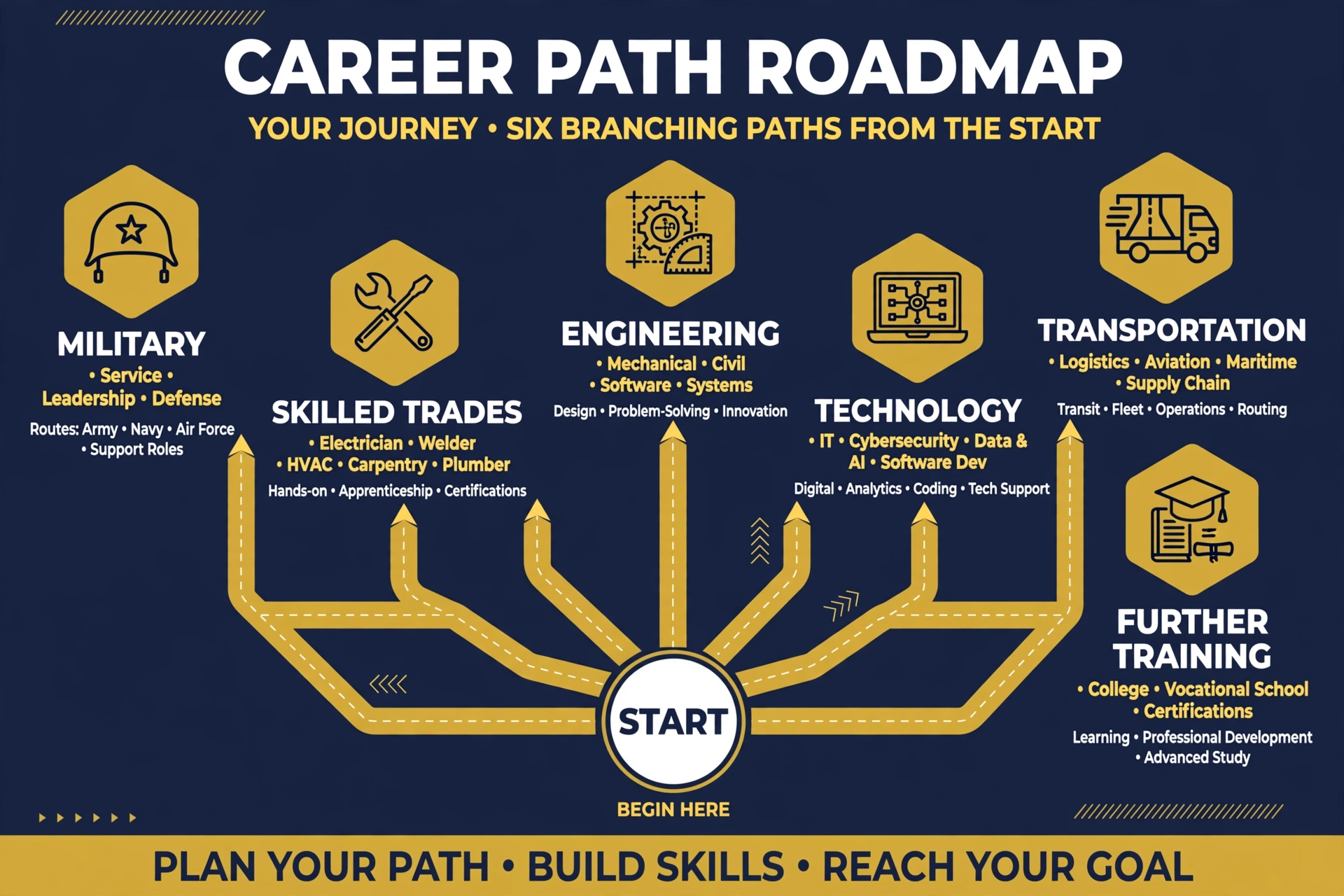
The field you choose shapes your earning power more than almost any other decision. Two people with the same talent and work ethic can end up in very different places financially, simply because one field pays more for skill than another. That does not mean chasing the highest-paying field blindly — the best path is the one you can finish, tolerate, and grow in. Every path below is described factually: what the work is like, what training it requires, and what that training costs in time and money. No path guarantees any outcome; training is an investment with real costs and uncertain returns. We will now teach you about the military, skilled trades, engineering, transportation, technology, and training economics.
The Military
Military service is a career path and a training program in one. Each branch trains you in a specialty — from electronics and mechanics to logistics, medicine, and communications — and that training is provided at no direct cost to you, in exchange for a multi-year service commitment. You earn pay and benefits while you learn, which makes this one of the few paths with no tuition bill.
The work is structured and demanding. You follow orders, meet physical standards, and may be stationed far from home or deployed. In return, service members typically receive housing and health coverage during service, plus education funding afterward that can pay for college or vocational training. Veterans also carry a credential civilian employers recognize: proof you can show up, follow through, and work under pressure.
There are two broad doors in. Enlisting means joining as a service member in a chosen specialty, usually straight out of school. The officer path requires a degree first and leads to leadership roles. Both demand the same honesty from you: this is a serious multi-year commitment, not a short experiment. Talk to veterans — not just recruiters — before deciding, because recruiters sell and veterans tell.
Skilled Trades
Skilled trades are hands-on licensed professions: electricians, plumbers, HVAC technicians, welders, carpenters. The work is physical, tangible, and hard to outsource — someone has to be in the building to wire it, pipe it, or fix it. Many tradespeople eventually run their own businesses, which adds an entrepreneurial upside to the path.
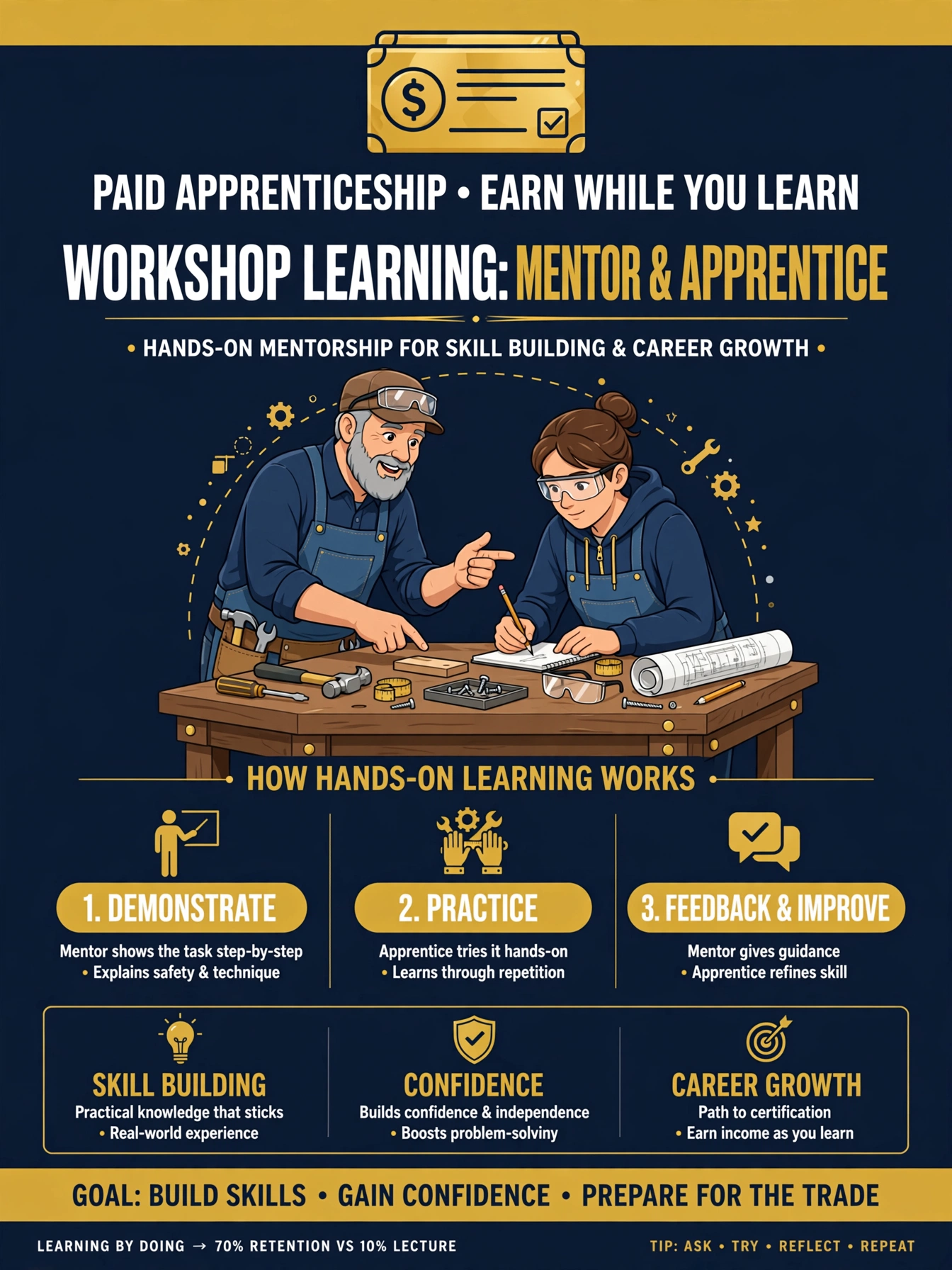
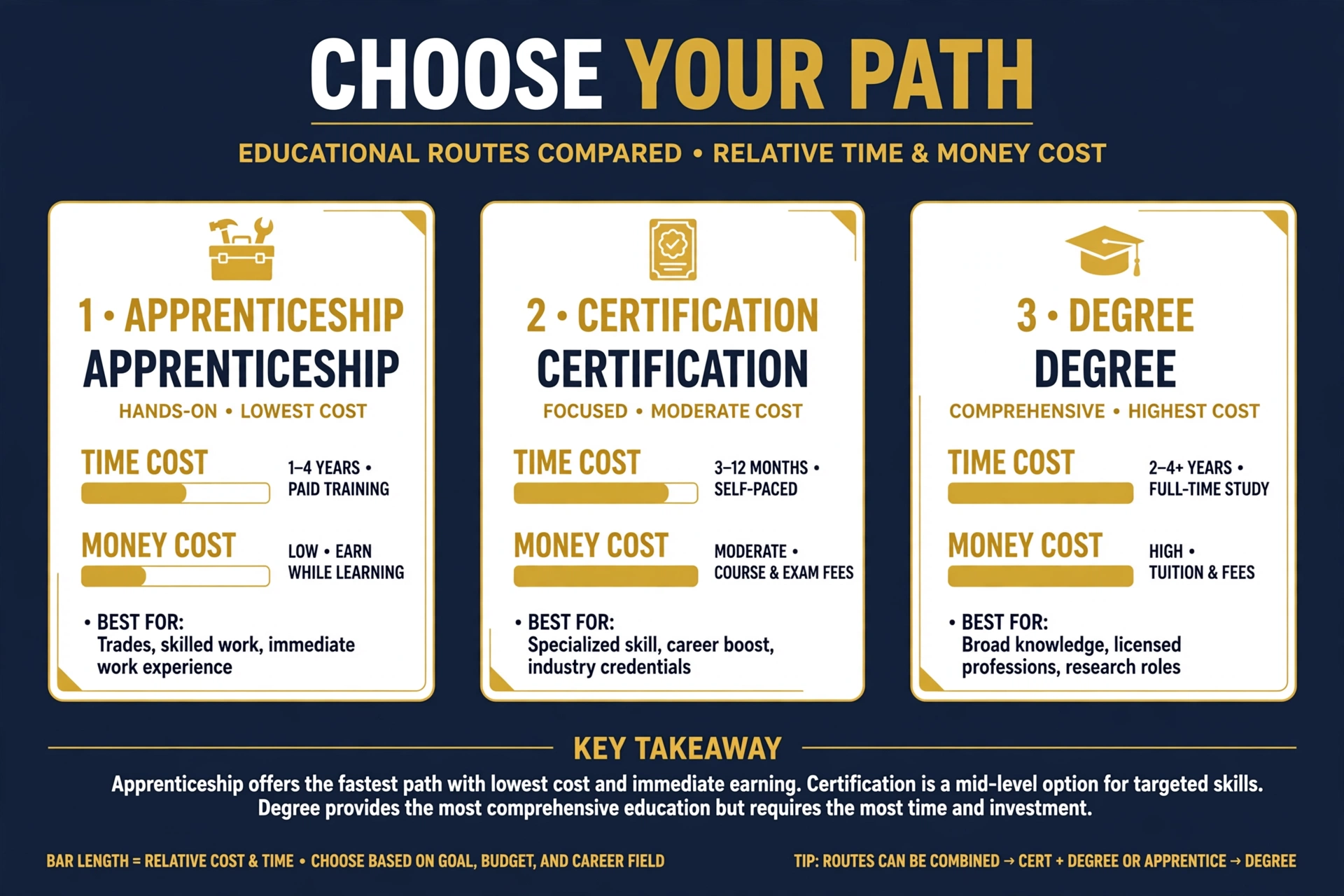
Training runs through apprenticeships. An apprenticeship is paid on-the-job training that lasts multiple years: you work under experienced tradespeople, earn a wage while you learn, and study the theory alongside. At the end, you typically sit for a licensing exam, and the license is what lets you work independently and charge full professional rates. Some people start through trade school first, which shortens the apprenticeship but adds tuition cost.
The tradeoff is honest: years of lower apprentice wages and physically demanding work, in exchange for a licensed skill that stays in demand. Because apprentices earn while they learn, this path avoids the debt that comes with full-time schooling — but it demands patience, since the full payoff waits until you are licensed.
Engineering
Engineers design and build the systems the modern world runs on: bridges, software, power grids, medical devices, manufacturing lines. The work is problem-solving with math and science — less physical than the trades, more analytical, usually office or lab based with occasional field work depending on the specialty.
The standard door in is a bachelor's degree in an engineering discipline, which takes several years of full-time study and costs significant time and money. The coursework is math-heavy, which filters out many people early — be honest with yourself about whether that kind of study suits you before committing. Some specialties add further licensing for certain kinds of work, earned through exams after graduation.
What you get for that investment is a credential employers everywhere recognize and a skill set that transfers across industries — an engineer can move from energy to tech to manufacturing without starting over. But the cost is real: years of study, tuition, and income you are not earning while in school. Engineering rewards those who finish; the dropout economics are much worse than the graduate economics.
Transportation
Transportation careers move the country's goods: long-haul trucking is the biggest one, joined by delivery driving, bus operation, and related roles. The work is solitary and schedule-driven — long hours, much of them alone, with real time away from home on long-haul routes. People who value independence often thrive; people who need daily social contact often do not.
The training door is a commercial driver's license, the CDL. Earning it takes weeks to months of training, not years — through a trucking school, a company-sponsored program, or self-study plus a test, depending on your state. That short runway is the path's main attraction: you can go from decision to licensed driver far faster than through a degree or apprenticeship. Watch the fine print on company-sponsored training, which sometimes requires you to drive for that company for a set period afterward.
The honest tradeoffs: the work pays for time and responsibility rather than credentials, experienced drivers with clean records are the ones companies compete for, and the lifestyle cost — sleep schedules, road food, weeks away — is the real price of the paycheck. Some drivers eventually buy their own rig and run as owner-operators, which trades a wage for a small business with all of its risks and rewards.
Technology
Technology covers software development, IT support, cybersecurity, data work, and more. The work is screen-based problem-solving, usually in teams, with a culture of constant learning — tools and methods change fast, so the learning never really stops. Remote work is more common here than in most fields, which matters if location flexibility is part of what you want.
This field has the most doors in. The traditional route is a computer science degree. Faster routes include intensive training programs, industry certifications, and self-teaching — and uniquely, employers here hire heavily on proof: a portfolio of working projects can outweigh any credential. That makes technology one of the most accessible fields for a self-directed learner with no budget for school.
The catch matches the opportunity: because the field moves fast, your skills expire faster too. A trade license lasts decades with minor updates; a programming skill set needs refreshing every few years. And the same openness that lets beginners in also means heavy competition at the entry level — the portfolio that gets you hired has to be genuinely good, not just finished.
Training Economics
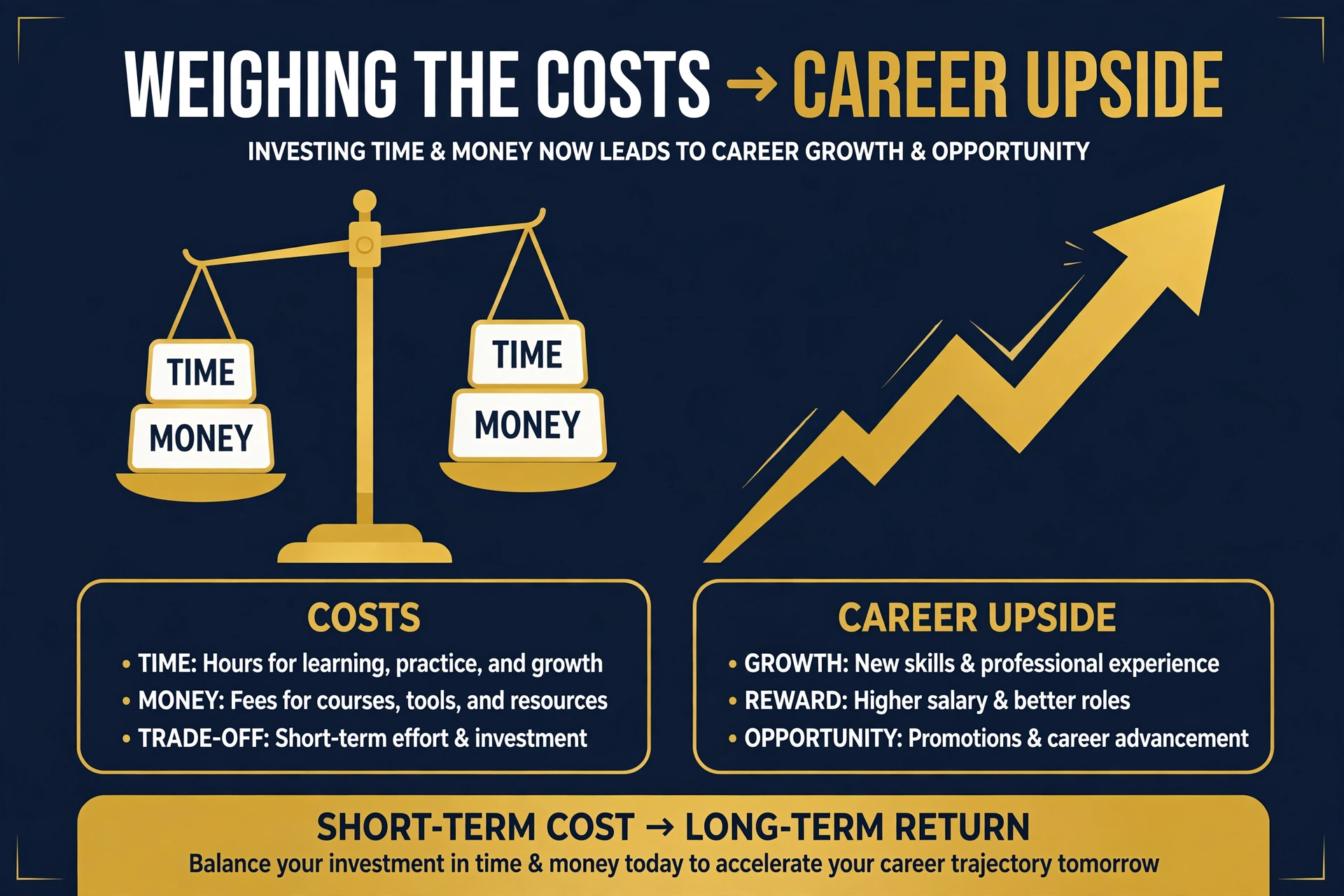
Training economics is the skill of weighing what a career path costs against what it can return. Every path charges admission in two currencies: time and money. Tuition is the money cost. But the bigger cost is usually time — months or years spent training are months or years you are not earning at full strength. Economists call this the opportunity cost, and beginners almost always underestimate it.
Run every path through the same three questions. First, what is the total cost — tuition plus living expenses plus the income you give up while training? Second, how long until the training pays for itself — how many working years at the new path's typical prospects does it take to earn back what you spent getting in? Third, what is the risk — what happens if you do not finish, or if demand for the field changes? A path you are likely to finish beats a "better" path you are likely to quit, because quitters pay the cost without collecting the return.
Notice how the paths differ on these questions. Apprenticeships and military service let you earn while you train, which keeps the total cost low. Short certifications cost little time but prove less. Degrees cost the most in both currencies but open the most doors. There is no universally right answer — only the right answer for your budget, your timeline, and your tolerance for risk. Research real costs, talk to people who finished the path, and never borrow heavily for training you are not sure you will complete.
Key terms
- Career path
- a field of work with its own training route, credentials, and typical prospects.
- Apprenticeship
- paid on-the-job training over multiple years, ending in a licensed trade.
- Certification
- proof you passed a standard test in a specific skill.
- License
- legal permission to do regulated work.
- CDL
- commercial driver's license, the credential required to drive large trucks professionally.
- Training economics
- weighing a path's total cost in time and money against its career upside and risk.
- Opportunity cost
- the income and time you give up while training instead of working.
- Owner-operator
- a driver who owns their truck and runs as a small business rather than working for a wage.
What's next
You have mapped the major paths and learned to price the training. EM-104 "Side-Hustle Validation" turns to the other engine of earning more: testing a small business idea cheaply before you bet real money on it.
---
The quiz
Choose Your Path — Quiz
4 questions · pass with 4 correct
1.What is training economics?
2.What is an apprenticeship?
3.Which training routes let you earn while you learn?
4.What should you do before committing to a training path?