
Small-Business Foundations
School 02 — Earn More
Listen — 15-second overview
A quick spoken preview of this class
School 2 · Earn More · About 15 minutes
A business is not a job with a logo on it. A business is a system that finds customers, delivers something they will pay for, and keeps some of the money as profit — over and over again, even on days you are not pushing it forward yourself. Many talented people sell their skills (EM-105 showed you how) but never build the foundation underneath, so their income stops the moment they stop working. The foundation has four parts: a clear business model, a reliable way to get customers, numbers that prove each sale makes money, and simple systems that keep everything running. We will now teach you about business model, customer acquisition, unit economics, and operating systems.
Business Model
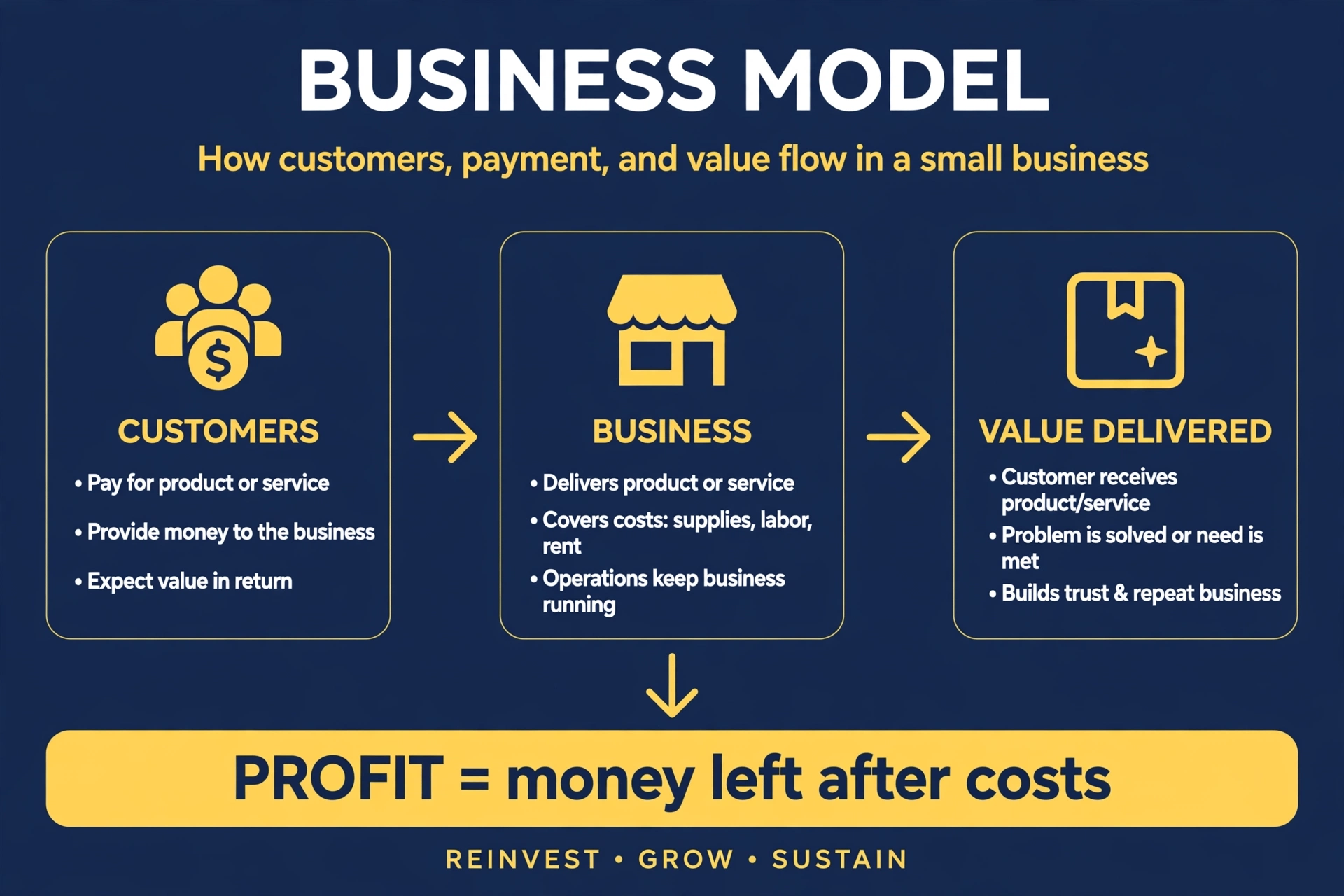
A business model is simply the answer to one question: how does this business make money? Who pays, what are they paying for, and how does the money flow in? A coffee shop's model is: people walking by pay for drinks, every day, in small amounts. A landscaping business's model is: homeowners pay for a monthly service, in larger recurring amounts. Same work ethic, very different models.
There are only a few shapes a model can take. Some businesses sell once (a house painter, a furniture maker). Some sell subscriptions or repeat service (a bookkeeper, a lawn care company). Some sell products over and over to many customers (a soap brand online). Repeat models are easier to grow because each new customer adds to a running total instead of starting from zero.
Before anything else, write your model down in one or two sentences: "I sell X to Y, and customers pay me Z each time." If you cannot write it that simply, the model is not clear yet. Every other decision — marketing, pricing, hiring — flows from this sentence, so it is worth getting right first.
Customer Acquisition
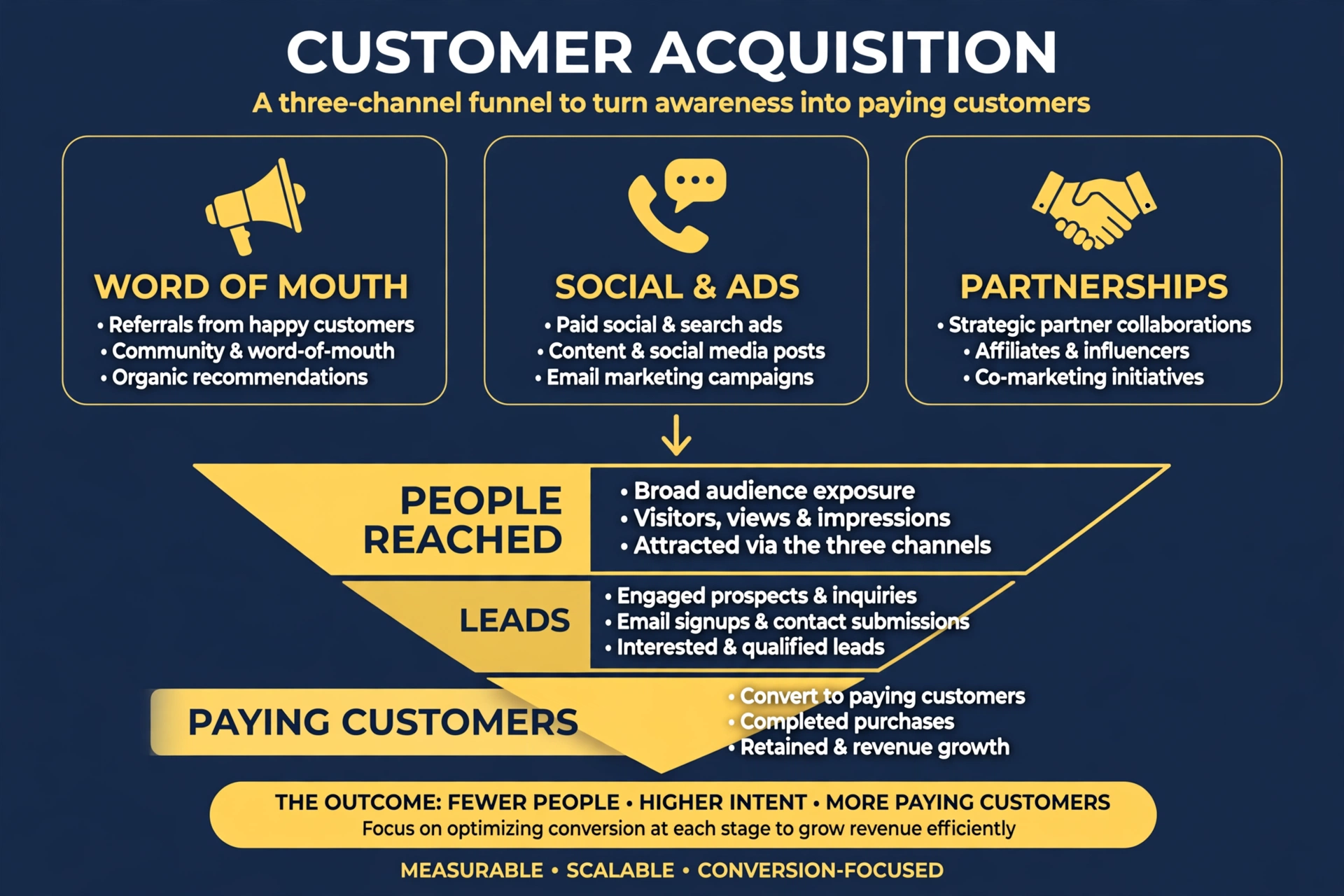
Customer acquisition is the process of finding people who will buy from you and turning them into paying customers. It is the engine of every business: without new customers coming in, even the best product quietly fades away. Beginners often focus on making the perfect product while ignoring acquisition — then wonder why nobody buys.
Start with one channel and do it well. A channel is just a place where customers can be found: word of mouth, local flyers, a social media page, a listing site, or partnerships with other businesses. Pick the channel where your customers already are. A house painter finds customers in neighborhoods, not on tech forums. Talk to people there, do good work, and ask every happy customer to tell a friend — referrals are the cheapest and most trusted channel there is.
Track what each customer costs you to get. If you spend money or time on a channel, notice how many customers it brings in and what they spend. A channel that brings in lots of customers who buy once and never return may be worse than a slower channel that brings loyal repeat buyers. We will dig into that math in the next section.
Unit Economics
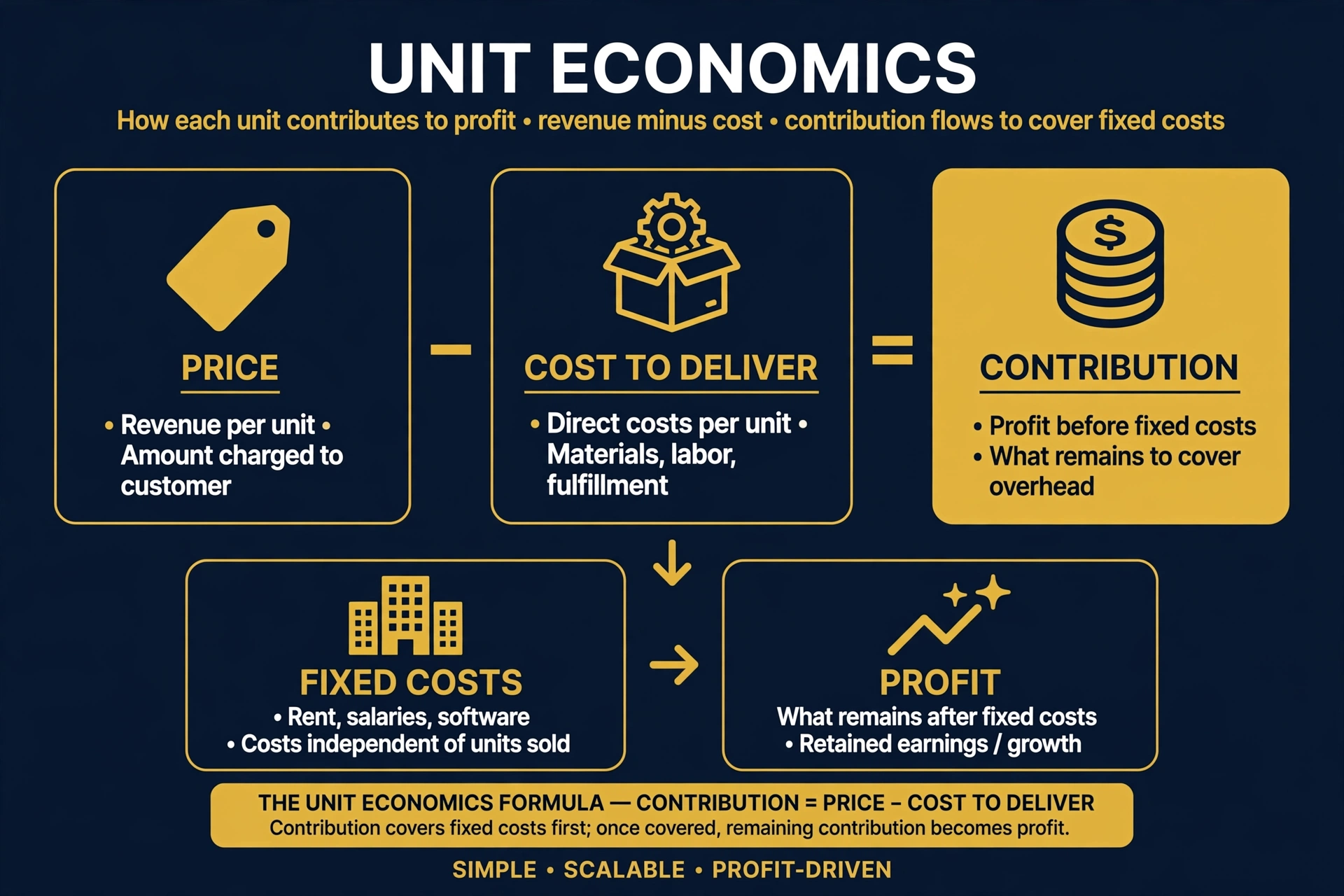
Unit economics is the math of one sale: does each unit you sell actually make money? A "unit" is whatever you sell — one haircut, one repaired fence, one subscription month. If one unit costs more to deliver than the customer pays, selling more only loses money faster. This sounds obvious, but many small businesses discover too late that their prices never covered their real costs.
The simple version: price minus the cost of delivering that one unit equals your contribution — the money each sale adds toward covering your fixed costs and eventually becoming profit. Fixed costs are things you pay whether or not you sell anything (rent, insurance, software). Variable costs are things tied to each sale (materials, shipping, an hour of a worker's time). Your contribution per sale must be positive, and the total of all contributions must exceed your fixed costs. That is the whole game.
Raise this number three ways: raise the price, lower the cost of delivery, or sell add-ons with the same sale. And check it regularly — costs creep up quietly (supplies, fees, taxes), and a business that was profitable last year can drift into losing money without anyone noticing.
Operating Systems
An operating system for a business has nothing to do with computers. It is the set of checklists, routines, and simple rules that let the business run the same good way every time — without you standing over it. A restaurant runs on systems: the opening checklist, the recipe cards, the cleaning schedule. Without them, quality depends on whoever showed up that day.
Write down anything you do more than twice. How do you greet a new customer? How do you send an invoice? How do you close up at the end of the day? Each written routine is a small piece of the business that no longer lives only in your head. This matters twice: first, it keeps quality steady; second, it is what makes delegation possible later — you cannot hand off work that was never written down.
Start small: one checklist per repeated task, kept somewhere you will actually see it. A business with systems is calmer, more reliable, and worth more — because it can run, and one day be sold or passed on, without depending entirely on you.
Key terms
- Business model
- the simple explanation of how a business makes money: who pays, for what, and how often.
- Customer acquisition
- the process of finding potential buyers and turning them into paying customers.
- Channel
- a place or method where a business finds its customers, such as referrals, social media, or local advertising.
- Unit economics
- the math of a single sale: whether one unit sold makes or loses money.
- Contribution
- the money left from one sale after the cost of delivering that sale, which goes toward fixed costs and profit.
- Fixed costs
- costs a business pays whether or not it sells anything, like rent, insurance, or software.
- Variable costs
- costs tied directly to each sale, like materials, shipping, or hourly labor for that job.
- Operating system
- the checklists, routines, and rules that let a business run consistently without the owner overseeing everything.
What's next
You know how a business is built to make money and keep running. But money handled sloppily leaks away — EM-107 "Business Money Basics" teaches you separate accounts, bookkeeping, cash flow, reserves, and the taxes every small business must handle.
The quiz
Small-Business Foundations — Quiz
3 questions · pass with 3 correct
1.What is a business model?
2.What is customer acquisition?
3.What does unit economics measure?
Recommended Tools
Hand-picked resources that fit this lesson — only ever one or two, and only when they're genuinely useful.
- Learn more
LendingTree
Compare small-business loan options if your business needs startup capital.
We may earn a commission if you sign up — at no extra cost to you.