
Business Money Basics
School 02 — Earn More
Listen — 15-second overview
A quick spoken preview of this class
School 2 · Earn More · About 15 minutes
A business can be busy, popular, and still go broke — because busyness is not the same as financial health. The difference between businesses that survive and ones that collapse is rarely talent; it is money management. Owners who mix business money with personal money, skip the books, or get surprised by tax bills learn this lesson the hard way. The basics are not complicated, but they are not optional either. We will now teach you about separate accounts, bookkeeping, cash flow, reserves, and estimated taxes.
Separate Accounts
The first rule of business money: the business's money is not your money, and your money is not the business's. Open a separate bank account for the business on day one — even before the first dollar comes in. Pay yourself from the business on a schedule (a set transfer each week or month), instead of dipping into the account whenever you feel like it.
Why does this matter so much? Two reasons. First, clarity: when business and personal money mix, you can never tell whether the business is actually making money or just eating your savings. Second, taxes and legal protection: clean records prove what the business earned and spent, and if the business is its own legal entity, mixing money can destroy that protection.
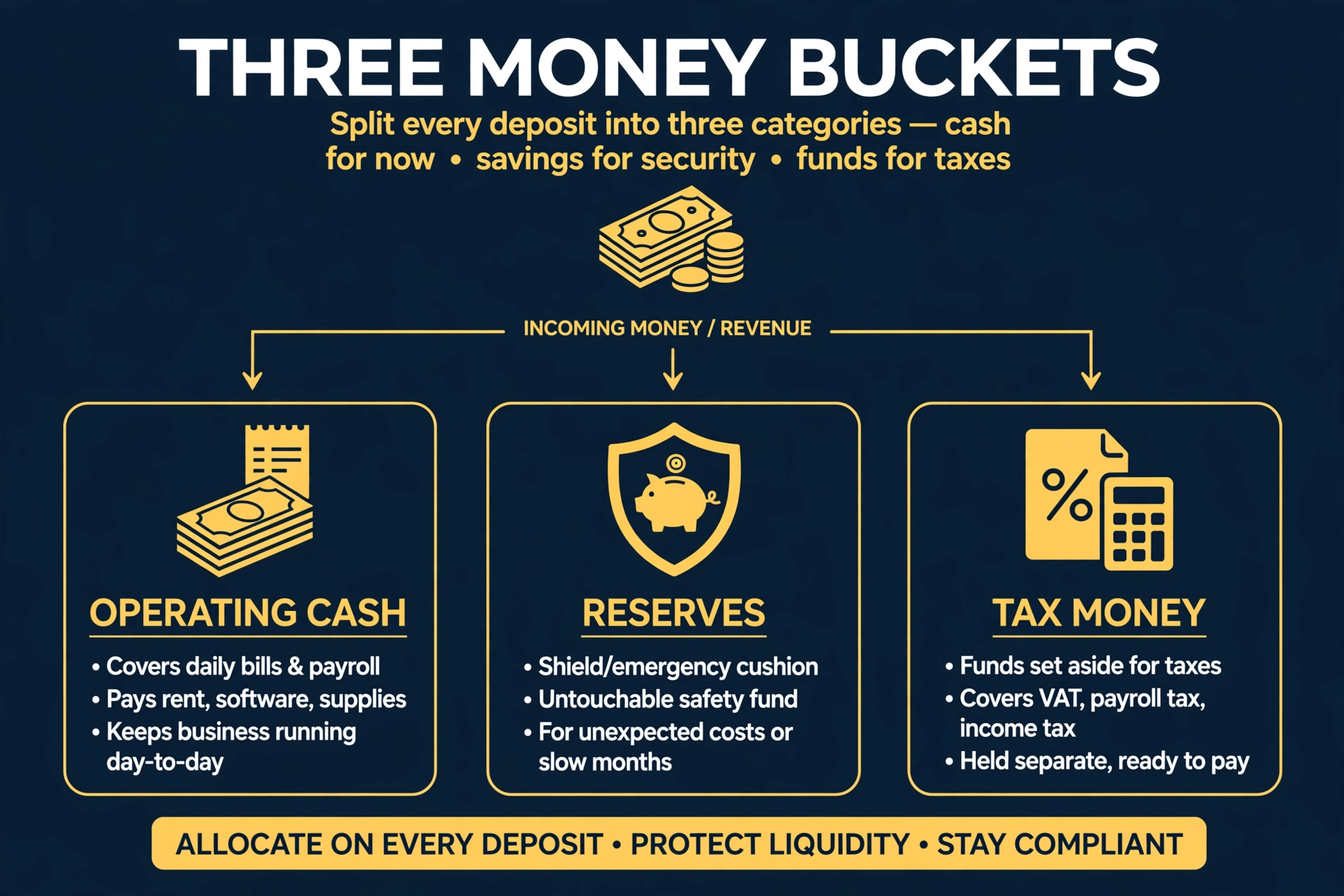
Keep it simple: one business checking account for daily money in and out, and one business savings account for taxes and reserves (covered below). Two business accounts plus your personal account — three total — is enough for most small businesses starting out.
Bookkeeping
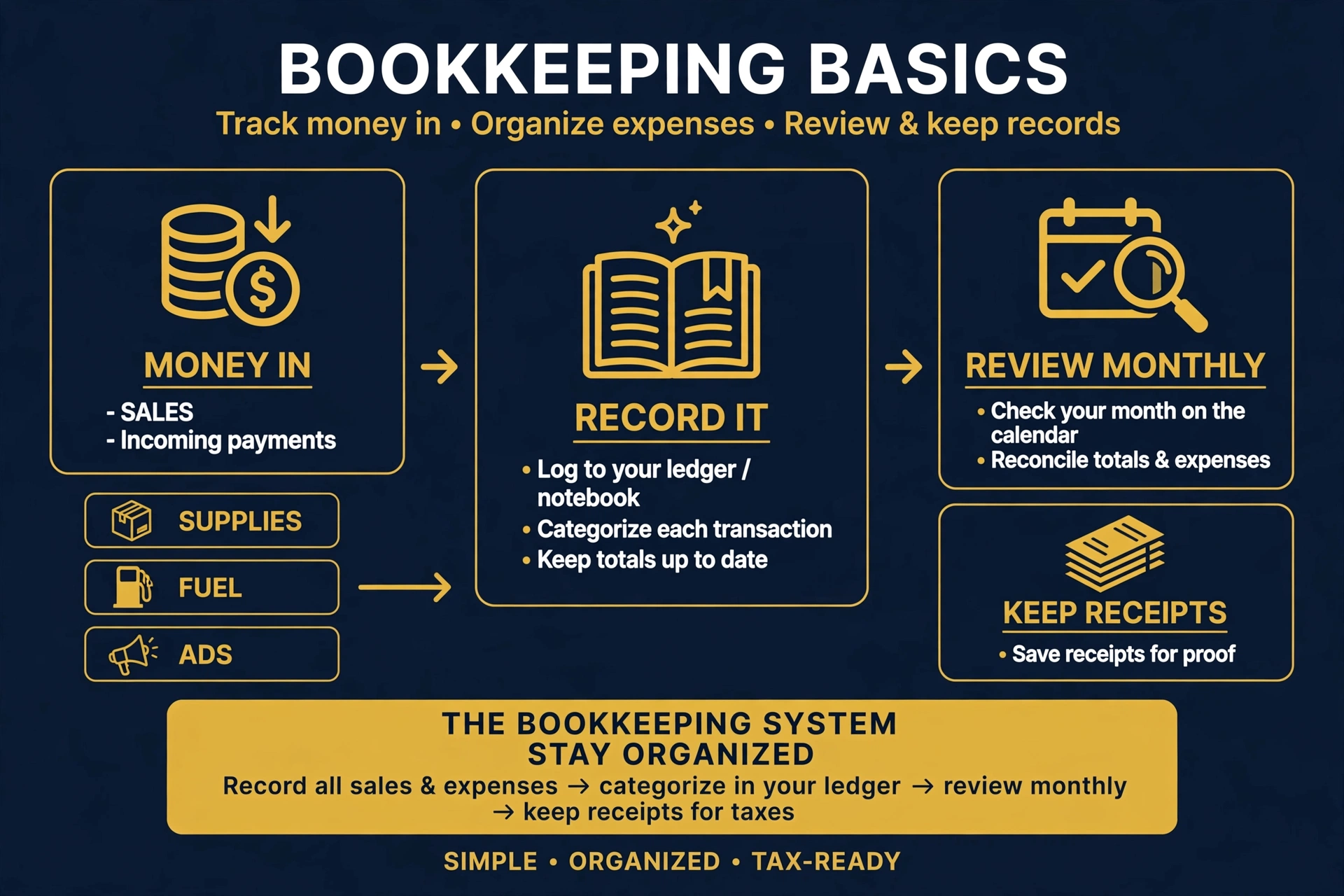
Bookkeeping is just writing down every dollar the business earns and spends, organized by category. That is the whole definition — it sounds boring, but it is the dashboard of your business. Without it, you are driving blind: you cannot tell which work is profitable, what you spent last month, or whether you can afford a new expense.
You do not need to become an accountant. For a small business, bookkeeping means: every sale gets recorded, every expense gets a receipt and a category (supplies, fuel, advertising, and so on), and you review the totals once a month. Simple accounting software or even a careful spreadsheet works at this stage — the tool matters less than the habit.
Do the books weekly, not yearly. Fifteen minutes a week beats a panicked weekend before tax season. And keep receipts — a photo of each receipt saved in one folder is enough. Clean books do three jobs at once: they tell you the truth about the business, they make tax time painless, and they are required if you ever apply for a loan or sell the business.
Cash Flow
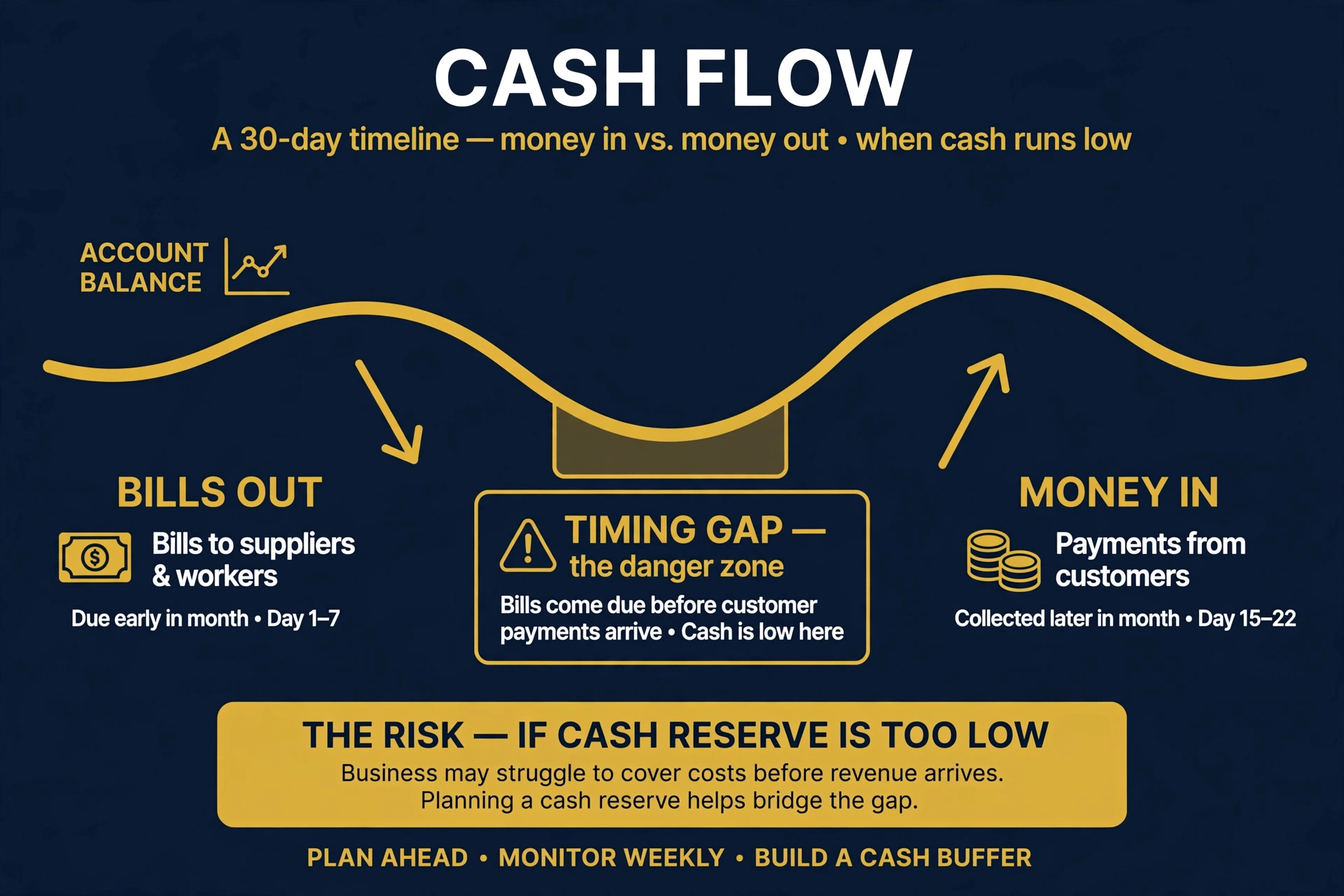
Cash flow is the movement of money in and out of the business over time — and it is different from profit. A business can be profitable on paper and still run out of cash: if customers pay you 60 days after the work is done, but your suppliers and workers must be paid this week, the business can starve while waiting for its own money. More small businesses die from cash flow problems than from lack of profit.
Watch the timing, not just the totals. Know when big money comes in and when big bills go out, and look ahead a few weeks. If a dry week is coming, you want to see it coming — that is when you chase late invoices, delay a purchase, or arrange short-term help before it becomes an emergency.
Three habits protect cash flow: invoice immediately (the day the work is done, not next month), follow up on late payments politely but firmly, and keep a simple forecast — even a one-page list of expected money in and money out for the next month. Cash is the oxygen of a business; profit is the food. You need both, but you die faster without oxygen.
Reserves
A reserve is money the business sets aside and does not touch — a cushion for the months when things go wrong. Equipment breaks. A big client pays late. Work slows down in the off season. A business with no reserve has no way to absorb these shocks except panic, debt, or shutting down.
Build the reserve slowly and automatically. Each time money comes in, move a small fixed percentage into the business savings account before you spend anything else — paying the reserve first is what makes it actually happen. Aim to grow it until it could cover a few months of the business's essential costs. You may not reach that for a while, and that is fine; any reserve beats none.
Treat the reserve as untouchable except for true emergencies — not for "a good deal on new equipment" or a slow month you saw coming. The whole point is that it is there when you truly need it. A business with a reserve makes calmer decisions, because it is never negotiating from desperation.
Estimated Taxes
Here is the surprise that catches almost every new business owner: nobody withholds taxes from your business income the way an employer does from a paycheck. You are responsible for setting tax money aside yourself — and the tax authority expects you to pay it in quarterly installments during the year, not in one lump sum at tax time. These are called estimated taxes.
The painful pattern goes like this: a great year of income, no money set aside, and then a tax bill arrives that the business cannot pay. Avoid it with one habit — every time money comes in, immediately move a portion into the tax savings account and do not spend it. It is not your money; it was never your money.
The exact percentage and rules depend on where you live and how your business is structured, so check with a tax professional or your local tax authority for your situation. The lesson itself is universal: set tax money aside first, pay quarterly, and never let a tax bill be a surprise. Surprises are for birthdays.
Key terms
- Separate accounts
- keeping business money in its own bank accounts, apart from personal money.
- Bookkeeping
- recording every dollar the business earns and spends, organized by category.
- Cash flow
- the movement of money in and out of the business over time; different from profit.
- Invoice
- a bill sent to a customer requesting payment for work done or goods delivered.
- Forecast
- a simple forward-looking list of money expected in and out over the coming weeks or months.
- Reserve
- money a business sets aside and does not touch, kept as a cushion for emergencies and slow periods.
- Estimated taxes
- tax payments a business owner makes in quarterly installments during the year, since no employer withholds them.
What's next
Your money is separated, tracked, and protected. Now the question becomes growth — EM-108 "Scale Without Losing Control" shows you how to design processes, delegate, automate, hire, and keep your margins strong as the business gets bigger.
The quiz
Business Money Basics — Quiz
3 questions · pass with 3 correct
1.Why should a business open a separate bank account from day one?
2.What is bookkeeping?
3.What is cash flow?