
Scale Without Losing Control
School 02 — Earn More
Listen — 15-second overview
A quick spoken preview of this class
School 2 · Earn More · About 15 minutes
Growth is the goal — until it breaks the business. A business that doubles its customers but keeps doing everything the old way usually ends up with exhausted owners, slipping quality, and thinner profits. Scaling well does not mean growing recklessly; it means building the business so that growth makes it stronger instead of messier. That takes deliberate design: clear processes, work handed off wisely, machines doing the repetitive parts, the right people in the right seats, and margins guarded like treasure. We will now teach you about process design, delegation, automation, hiring, and margin discipline.
Process Design
Process design means deciding, on purpose, exactly how the business's repeated work gets done — before growth forces the question. Every business has processes whether it designed them or not: the way orders are handled, how customers are answered, how a job moves from start to finish. Undesigned processes are just habits, and habits do not survive growth.
Map the few processes that matter most: how a new customer goes from first contact to paying, how the work gets delivered, and how money gets collected. Write each as simple steps in order. Then look for the weak points — the step where things get stuck, where mistakes happen, or where only you know how to do it. Fix those first, because growth multiplies every weakness along with every strength.
Review your processes regularly, not once. As the business grows, what worked for ten customers breaks at fifty. A short monthly review — what went wrong this month, and which process allowed it — keeps the business's plumbing healthy as the pressure rises.
Delegation
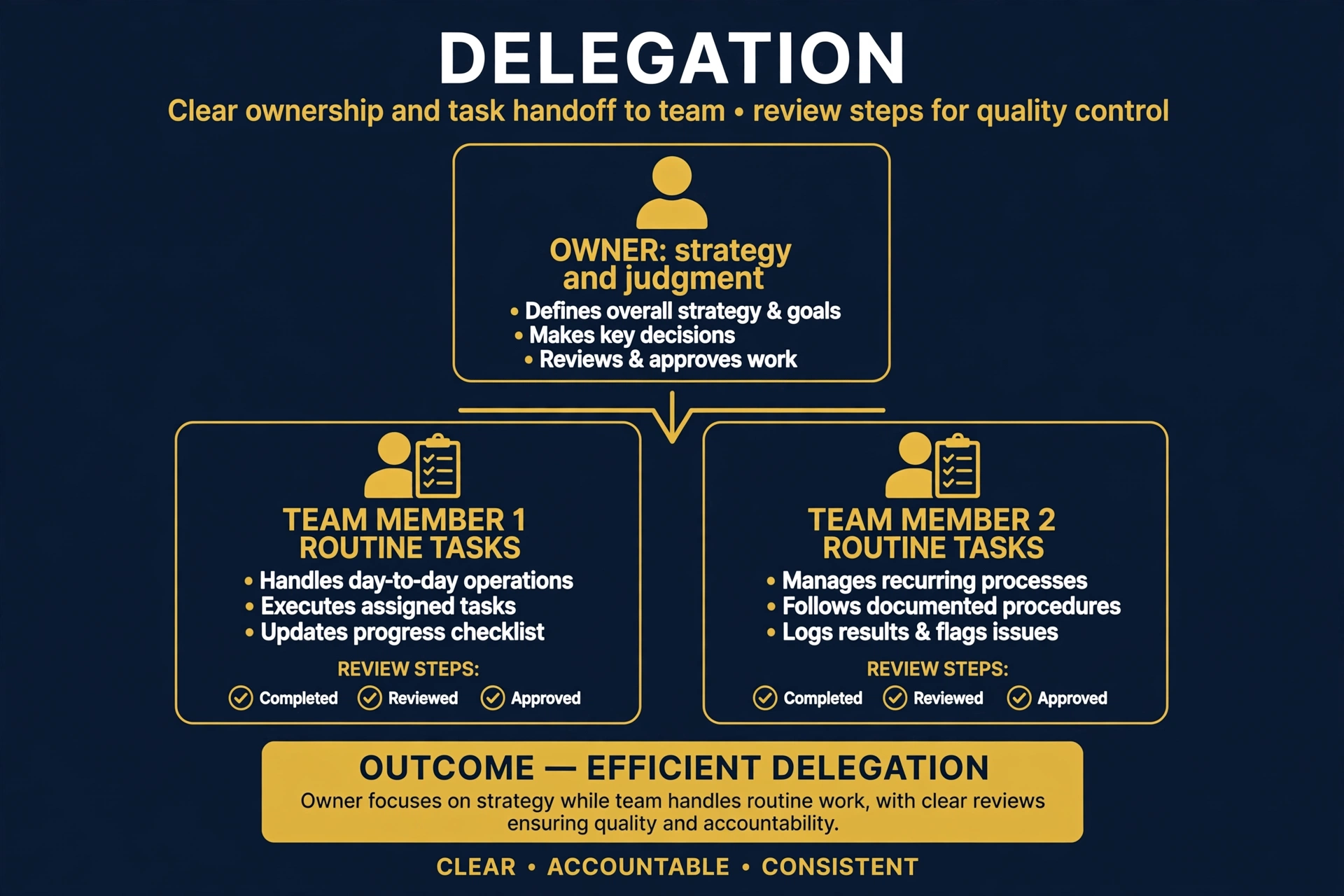
Delegation is handing work to someone else with clear instructions and letting them do it — and it is the hardest skill for most owners to learn. The trap is thinking "it is faster if I just do it myself." That is true today and false forever: every task you refuse to hand off becomes a ceiling on how big the business can get, because there is only one of you.
Delegate the routine, keep the judgment. Start with repeated, well-defined tasks — the ones you already turned into checklists back in EM-106. Hand over the outcome you want, the steps to follow, and how you will check the result. Then actually let go: hovering over someone's shoulder is not delegation, it is slower work with extra steps.
Expect mistakes, and plan for them. The first time someone does a task, they will do it worse than you — that is the tuition for your freedom. Build in a review step for new hand-offs, correct kindly, and keep a short written record of how the task should be done so the next person learns faster. Delegation done well buys back your time, which is the whole point of building a business instead of owning a job.
Automation
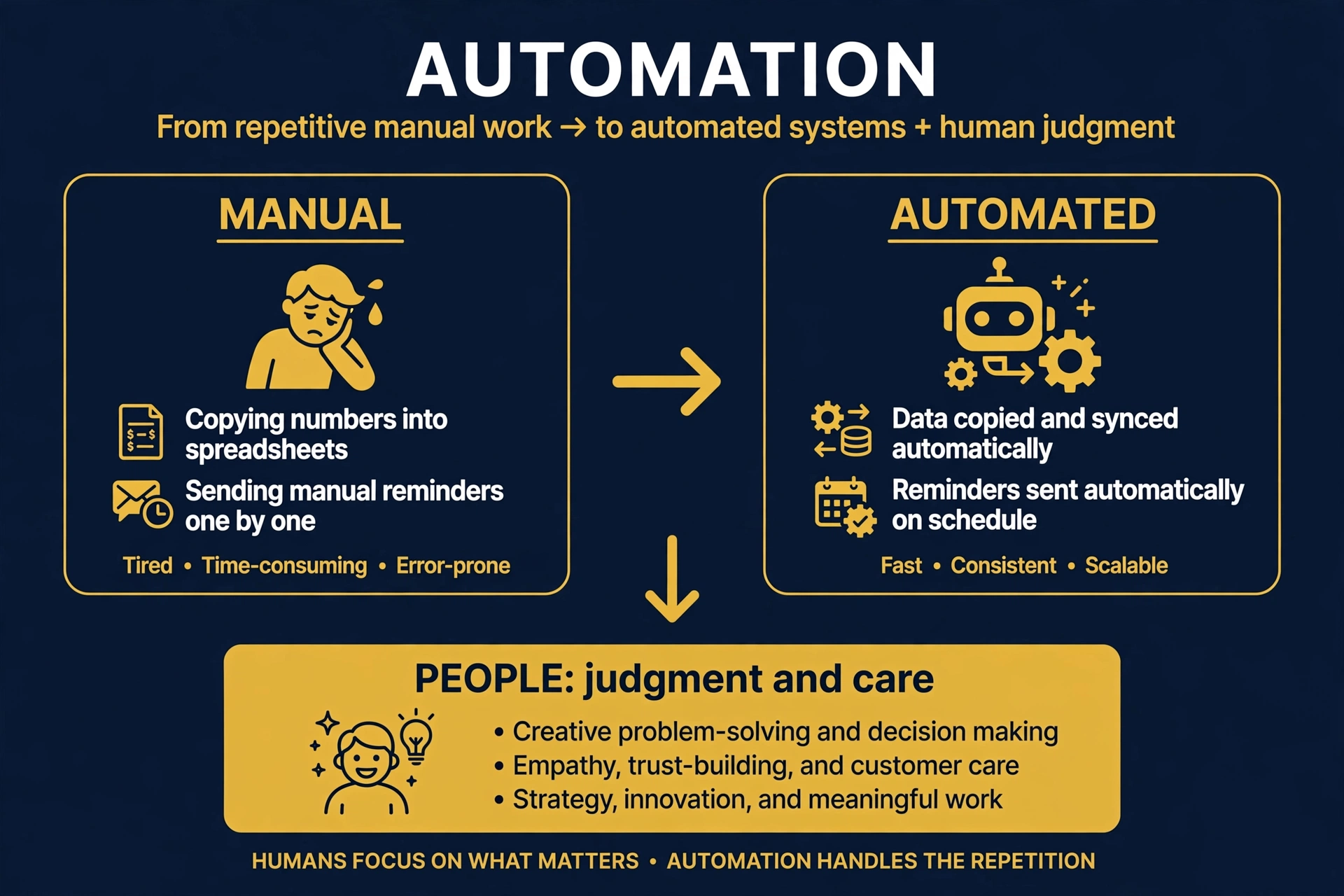
Automation means letting software or machines do repetitive work instead of people — sending appointment reminders, invoicing customers, posting the same update every week. Anything a computer can do the same way every time is a candidate. The rule is simple: automate the boring and repetitive so humans can do the work that needs judgment and care.
Start where the pain is. Look for the task you do over and over that adds no value by being done by hand: copying numbers between systems, reminding customers of appointments, sending the same email ten times a week. There is almost always an affordable tool for it. Set it up once, and it works while you sleep.
But automate good processes, not broken ones. Automation multiplies whatever it touches — a smooth process becomes effortless, and a broken process becomes a faster mess. Design the process first (see above), test it by hand until it works, and only then hand it to the machines. And keep watching: automated systems need occasional check-ups, because software changes and customers change.
Hiring
Hiring is how a business buys back the owner's time and adds skills it does not have — and it is also one of the most expensive mistakes a small business can make when done badly. A bad hire costs far more than their pay: lost customers, redone work, and your time spent managing problems. So hire slowly and deliberately, especially the first few times.
Hire for the work you actually need, not the title that sounds impressive. Write down the three to five real tasks this person will do every week, and hire someone who has done those tasks well before. Skills can be checked with a small paid trial task — far more honest than an interview alone. Attitude and reliability matter as much as skill: you can teach a process, but you cannot teach someone to care.
Start small: part-time help, a contractor for one job, or an assistant for a few hours a week. You do not need a full-time employee on day one. And remember the math from EM-106 — every hire must pay for themselves through the extra work they enable or the time they free up for higher-value work. If the numbers do not work, the hire does not work.
Margin Discipline
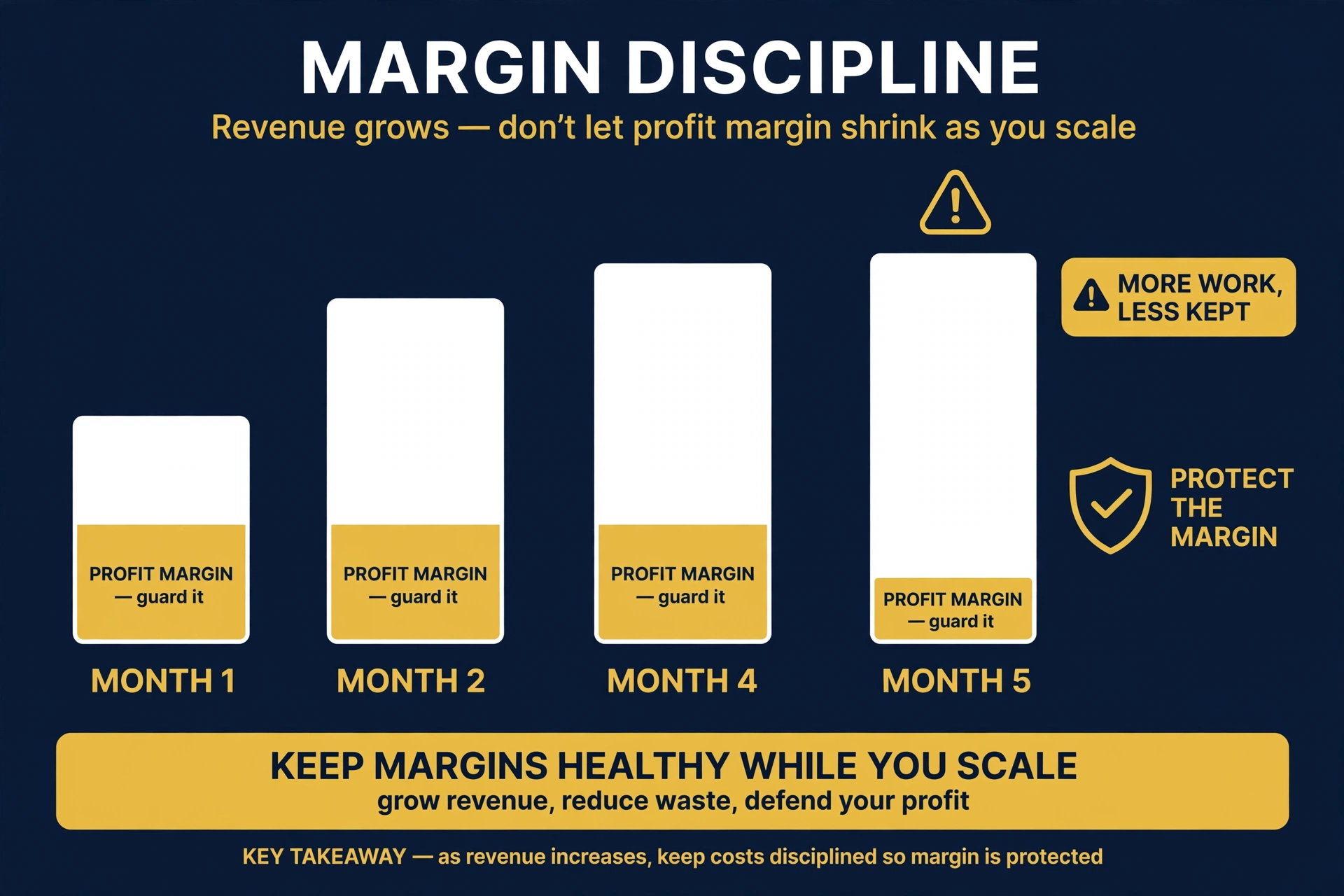
Margin discipline is the habit of protecting your profit margin as the business grows — because growth has a quiet way of eating it. More customers mean more staff, more tools, more complexity, and each layer adds cost. Many businesses grow their revenue impressively while their profit shrinks, and the owner works harder for less. That is growth in reverse.
Watch the margin, not just the revenue. Revenue is the total money coming in; margin is what stays after costs. A business doing twice the sales at half the margin is running twice as hard to stand still. Review your numbers monthly: are costs growing faster than revenue? Is each new customer as profitable as the earlier ones? If not, find out why before adding more.
Say no to growth that does not pay. Not every customer, product, or opportunity is worth taking — some cost more in time and trouble than they return. The disciplined owner drops the unprofitable work and doubles down on what pays. Scaling well is not about getting bigger; it is about getting bigger while keeping more of every dollar.
Key terms
- Scaling
- growing a business's revenue and customers without letting quality, control, or profit break down.
- Process design
- deliberately deciding and writing down the steps for the business's repeated work.
- Delegation
- handing work to someone else with clear instructions and letting them do it.
- Automation
- using software or machines to do repetitive work instead of people.
- Hire
- bringing someone on to do work for the business, part-time, contract, or full-time.
- Revenue
- the total money coming into the business from sales, before costs are subtracted.
- Margin
- what stays from revenue after costs; the profit kept from each dollar sold.
- Margin discipline
- the habit of protecting profit margins as the business grows.
What's next
You have completed the Earn More school — from finding your first way to earn (EM-101) all the way to growing a business without breaking it. Next up is a new school: IF-101 "Market Basics" begins your Investing Foundations journey, where your earned money starts working for you.
The quiz
Scale Without Losing Control — Quiz
3 questions · pass with 3 correct
1.What is process design?
2.What is delegation?
3.What does margin discipline mean as a business grows?