
Risk, Return, and Time
School 03 — Investing Foundations
Listen — 15-second overview
A quick spoken preview of this class
School 3 · Investing Foundations · About 15 minutes
Every investment lives on the same playing field: how much it might earn, how rough the ride could be, and how long you stay in the game. Return is what you get for putting money to work. Risk is what you might lose, or how bumpy the path could get. And time changes both — it turns small gains into big ones through compounding, erodes your money's buying power through inflation, and gives you room to recover from falls. We will now teach you about compounding, inflation, volatility, drawdowns, time horizon, and liquidity.
Compounding
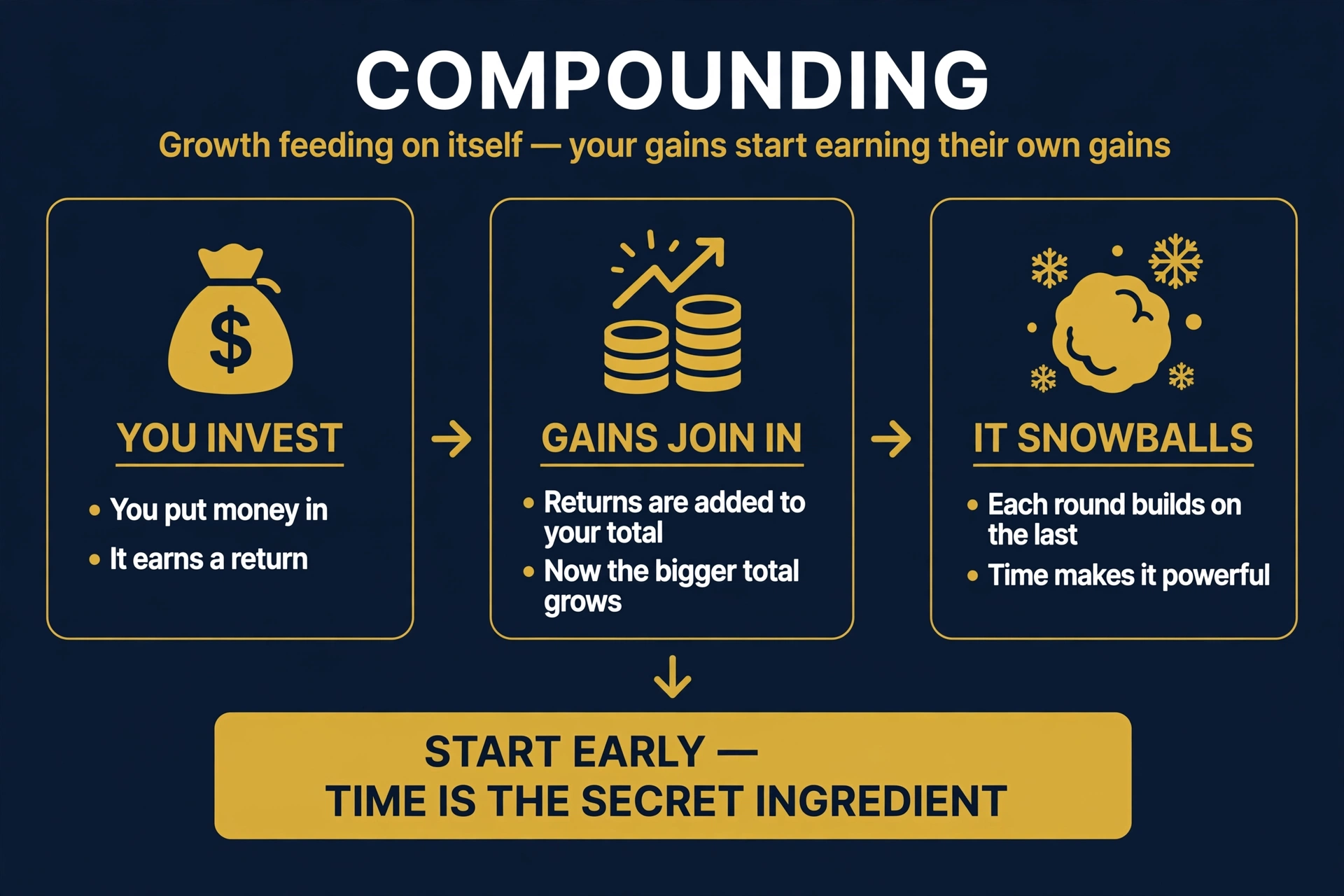
Compounding is growth feeding on itself. When your investment earns a return, that return gets added to the total — and the next round of growth is calculated on the new, bigger total. Your gains start earning their own gains, and the process repeats, round after round.
Think of a snowball rolling downhill. At the top it picks up a little snow with each roll, but as it gets bigger, the same rolling adds more snow with each turn. Time is the hill. The longer the snowball rolls, the more dramatic the effect — which is why starting early matters more than starting with a large amount.
The same math works against you with debt. Interest on a credit card balance compounds too, which is how a small balance can quietly grow into a large one if you only make minimum payments. Compounding is a tool: it rewards patience and punishes delay.
Inflation
Inflation is the slow shrinking of what your money can buy. Prices for everyday things tend to rise over time, so a dollar saved today will likely buy less in ten years than it buys now. Inflation is why cash sitting under a mattress quietly loses value — it is not stolen, it just buys less.
This matters because investing is a race against inflation, not just a race toward gains. A return that barely matches rising prices means your wealth is really just standing still. The goal of investing is growth that leaves you with more real buying power than you started with.
Inflation also explains why people accept risk at all. Safe, zero-growth savings feel comfortable, but they guarantee that inflation eats a little of your wealth every year. Investors take on risk because they want their money to grow faster than prices rise.
Volatility
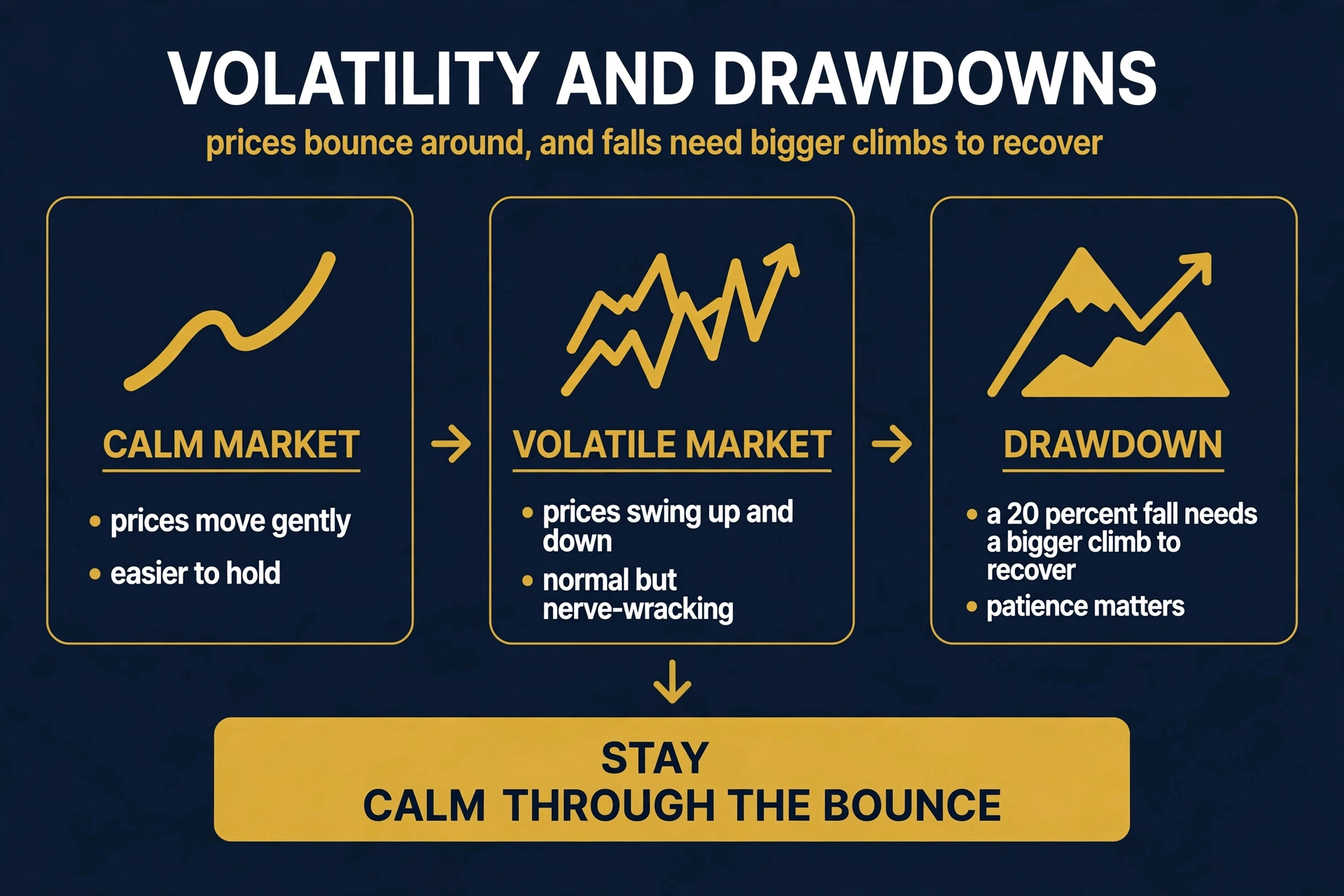
Volatility is how much prices bounce up and down. A calm investment moves in small steps; a volatile one swings widely, rising and falling sharply even when nothing fundamental has changed. Volatility is normal in markets — it is the price of admission for higher long-term returns.
Here is the key idea beginners often miss: volatility is not the same as loss. A stock that falls ten percent and then climbs back has been volatile, but anyone who held through it lost nothing. Volatility only turns into a real loss when you sell at a low price — or are forced to.
Different investments have different natural levels of bounce. Government savings accounts barely move. Stocks swing far more. Knowing this ahead of time matters: if big swings will make you panic and sell, a volatile investment is the wrong fit for you, no matter what its long-term record looks like.
Drawdowns
A drawdown is a fall from a previous high point. If an investment was worth 100 and is now worth 80, it is in a 20 percent drawdown. Every investment that has ever existed has spent time in a drawdown — they are as normal as the bounces that cause them.
What makes drawdowns worth understanding is that recovery takes more than the fall. From 80, a 20 percent gain only gets you to 96 — you need a bigger climb than the drop to get back to even. This is the hidden tax of falling: every deep hole takes an outsized climb to escape.
The defense against drawdowns is time, which is why this concept sits inside this lesson. A drawdown that takes years to heal is a disaster for money you need next month, but a mere footnote for money you will not touch for a decade. Your time horizon decides whether a drawdown is a catastrophe or an inconvenience.
Time Horizon
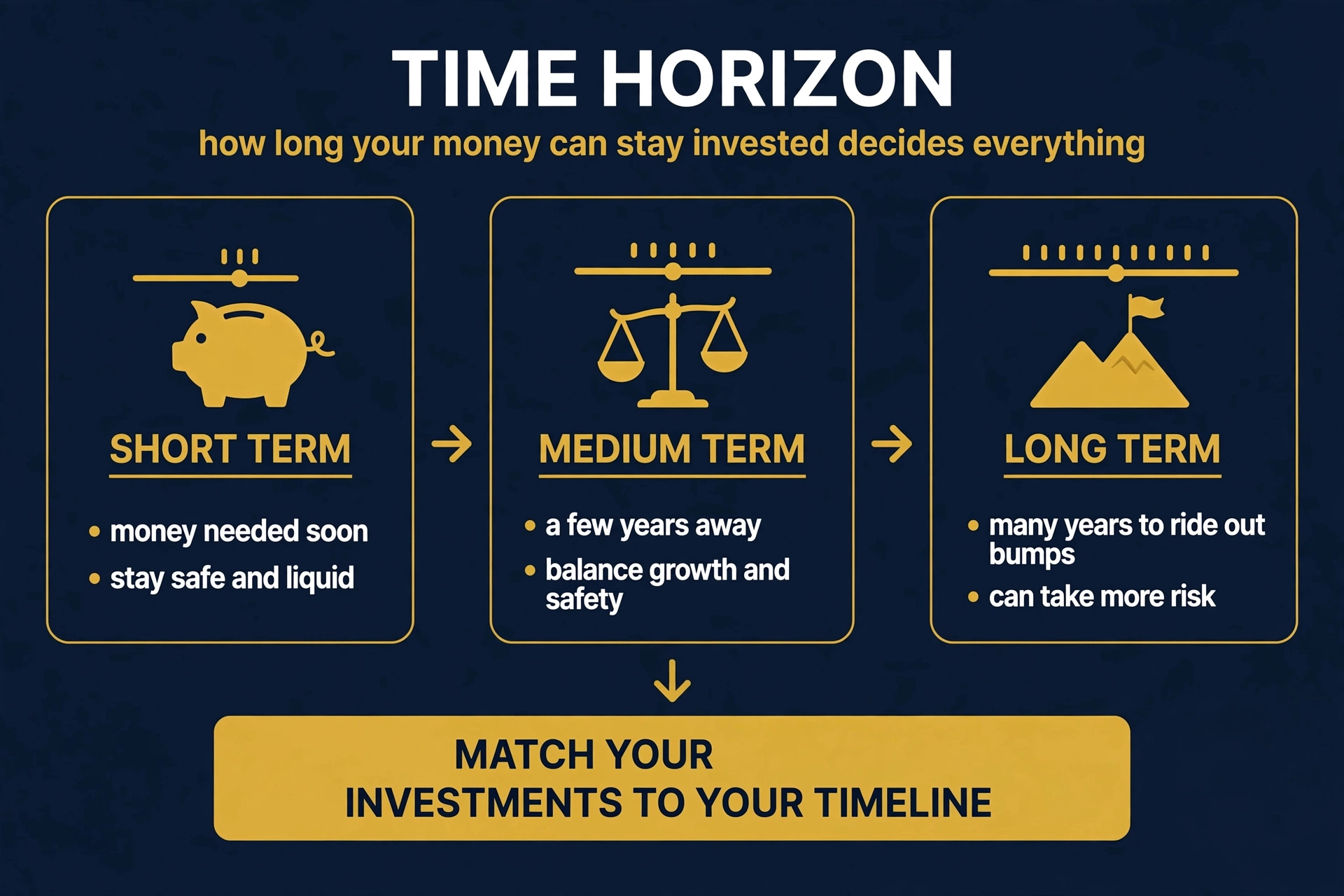
Your time horizon is how long your money will stay invested before you need it. It is one of the most important facts about your financial life, because nearly every decision — how much risk to take, which investments to pick — flows from it.
The rule is simple: money needed soon should be safe, and money needed far away can afford to take risks. Savings for a car you will buy next year should not ride the stock market's waves. Savings for retirement decades away can, because a long horizon gives you time to ride out the drawdowns along the way.
Time also works like a shock absorber. Over short periods, markets are noisy and unpredictable. Over long periods, the noise tends to smooth out and the underlying growth has room to compound. That is why a long time horizon is the investor's greatest advantage — it turns volatility from a threat into something you can simply wait through.
Liquidity
Liquidity is how quickly and cheaply you can turn an investment back into cash. Cash in a bank account is perfectly liquid — it is already cash. A stock is fairly liquid too, because you can usually sell it in seconds, though possibly at a price you do not love. A house is illiquid: selling takes months and costs a lot in fees.
Why does this matter? Life happens. Emergencies, job changes, and opportunities all arrive on their own schedule, and an investment you cannot sell when you need to is an investment that cannot serve you. This is why financial plans start with liquid emergency savings — money that is there instantly — before money moves into less liquid, higher-growth investments.
There is a trade-off: less liquid investments sometimes pay more, precisely because investors demand compensation for tying up their money. Real estate and private investments can offer strong returns, but they lock your money in. Always know before you invest: how fast can I get this money back, and what will it cost me?
Key terms
- Return
- what you earn for putting money to work, through growth or income.
- Risk
- what you might lose, or how rough and unpredictable the path could be.
- Compounding
- growth feeding on itself, as each round of returns is added to the total and earns its own returns.
- Inflation
- the gradual rise of prices that shrinks what each unit of money can buy.
- Volatility
- how much and how quickly an investment's price bounces up and down.
- Drawdown
- a fall from a previous high point, measured as the percentage decline from the peak.
- Time horizon
- how long your money will stay invested before you need to use it.
- Liquidity
- how quickly and cheaply an investment can be turned back into cash.
What's next
You now understand the forces every investment lives under: risk, return, compounding, inflation, volatility, and time. Ready to meet the most popular way people put this knowledge to work? IF-104 "Stocks" shows you how owning a tiny slice of a real company works.
The quiz
Risk, Return, and Time — Quiz
3 questions · pass with 3 correct
1.What is compounding?
2.Which statement best describes inflation?
3.You need the money in six months for a car. What does a short time horizon suggest?
Recommended Tools
Hand-picked resources that fit this lesson — only ever one or two, and only when they're genuinely useful.
- Learn more
M1 Finance
Build a diversified long-term portfolio that rebalances itself.
- Learn more
Acorns
Start small and let compounding do the heavy lifting.
We may earn a commission if you sign up — at no extra cost to you.