
Stocks
School 03 — Investing Foundations
Listen — 15-second overview
A quick spoken preview of this class
School 3 · Investing Foundations · About 15 minutes
A stock is a tiny piece of ownership in a real company. When you buy a share, you are not buying a lottery ticket or a line on a chart — you are buying a slice of an actual business, with real products, real customers, and real profits (or losses). That ownership is what makes stocks one of the most powerful wealth-building tools ever created: as companies grow and earn over time, their owners share in the results. We will now teach you about ownership, shares, dividends, market capitalization, and common versus preferred stock.
Ownership
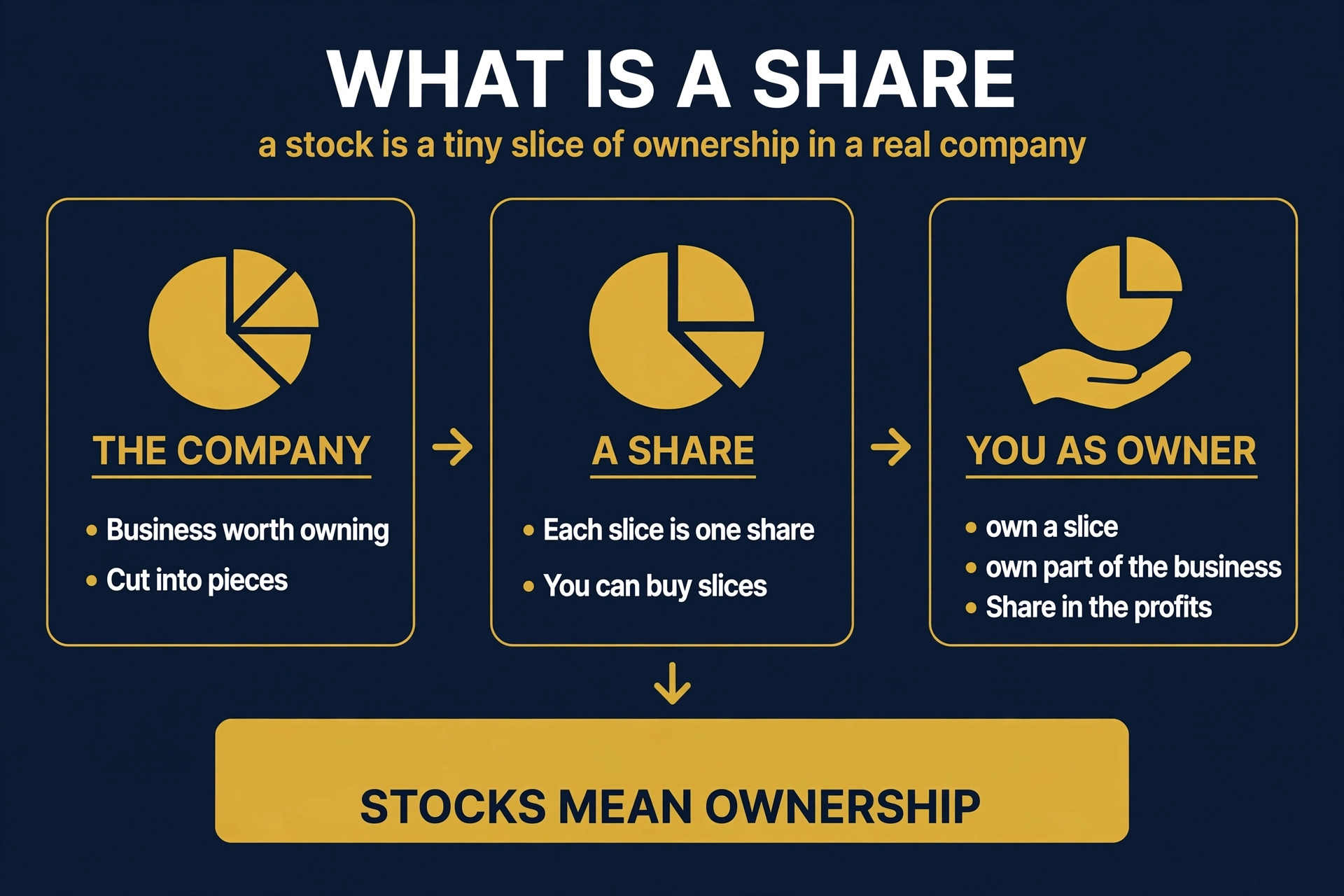
Buying stock makes you a part-owner of a company — a shareholder. Own a slice of a coffee chain, and you own a tiny piece of every store, every espresso machine, every bag of beans. Your slice is small, but it is real, and it comes with real rights.
Those rights are what separate stock from mere speculation. As an owner, you generally get a vote on big company decisions, like who sits on the board of directors. You get a share of the profits when the company chooses to pay them out. And if the company grows more valuable, your slice grows more valuable with it.
Ownership also means shared risk. If the company struggles, your slice can shrink in value. Companies can even fail completely, in which case owners are the last to be paid from whatever is left — after lenders, workers, and suppliers. Owning stock means standing in line behind all of those people. That is the deal: real ownership brings real upside and real downside.
Shares
A share is one unit of ownership. Companies divide themselves into shares so that ownership can be bought and sold in small pieces — you do not need to buy a whole company, just one or more of its slices. The stock price you see quoted is simply the price of a single slice right now.
Prices move because buyers and sellers constantly change their minds about what a slice is worth. When more people want to buy than sell, the price rises; when more want to sell than buy, it falls. Earnings reports, new products, economic news, and even rumors all shift those opinions, which is why prices bounce around the way IF-103 described.
One practical note for beginners: you do not need a fortune to start. Many brokers let you buy fractional shares — pieces of a single share — so you can begin with small amounts and still own a real slice of big companies. The number of shares you own matters far less than the habit of owning them.
Dividends
A dividend is a payment a company makes to its shareholders from its profits — your slice of the earnings, paid out in cash. Not every company pays dividends. Younger, fast-growing companies often keep every dollar to reinvest in growth, while older, established companies tend to share profits regularly with their owners.
Dividends arrive on a schedule, often quarterly, and they go straight to shareholders. Many investors choose to reinvest them automatically, using each dividend payment to buy more shares — which buys into the compounding you learned about in IF-103, since those new shares can earn their own future dividends.
Here is the important nuance: a dividend is not free money. When a company pays out cash, its value drops by roughly the amount paid, and the stock price adjusts down accordingly. The real benefit of a dividend is not the payout day itself — it is the steady share of profits over years, and the compounding that reinvested dividends create.
Market Capitalization
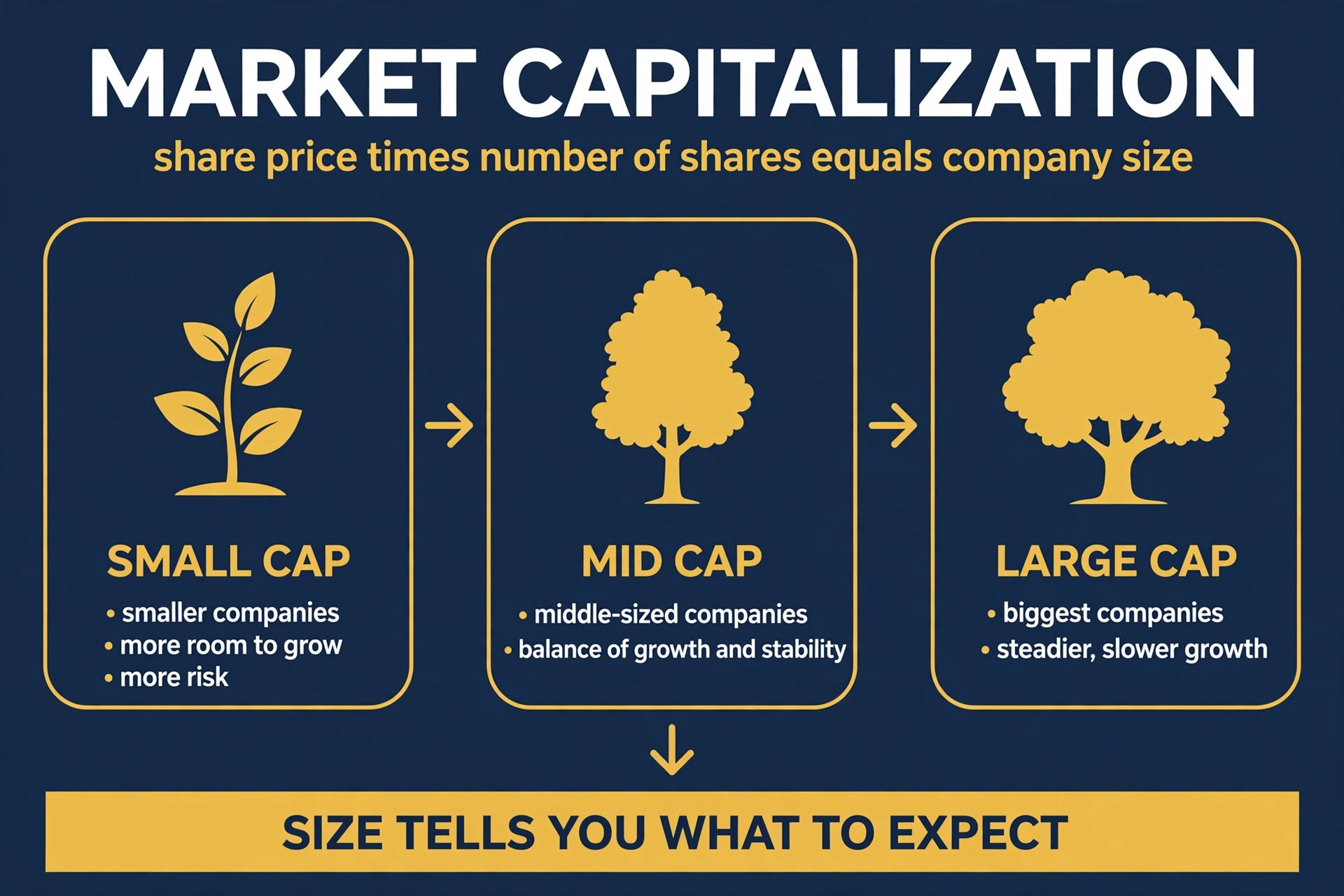
Market capitalization — market cap for short — is the total value the market puts on a company. It is simply the share price multiplied by the number of shares. If a company has a million shares at fifty dollars each, its market cap is fifty million dollars: the price tag for the entire business.
Market cap is how investors talk about company size. Smaller companies (low market cap) tend to be younger and riskier — they can grow fast, but they can also stumble hard. Larger companies (high market cap) are usually established giants: steadier, but with slower growth ahead of them. Size is not quality, but it tells you what kind of ride to expect.
This also explains why a stock's price alone tells you almost nothing. A hundred-dollar share of a company with few shares can be a smaller business than a ten-dollar share of a company with billions of shares. Always multiply: price times shares is what the company is actually worth.
Common vs. Preferred
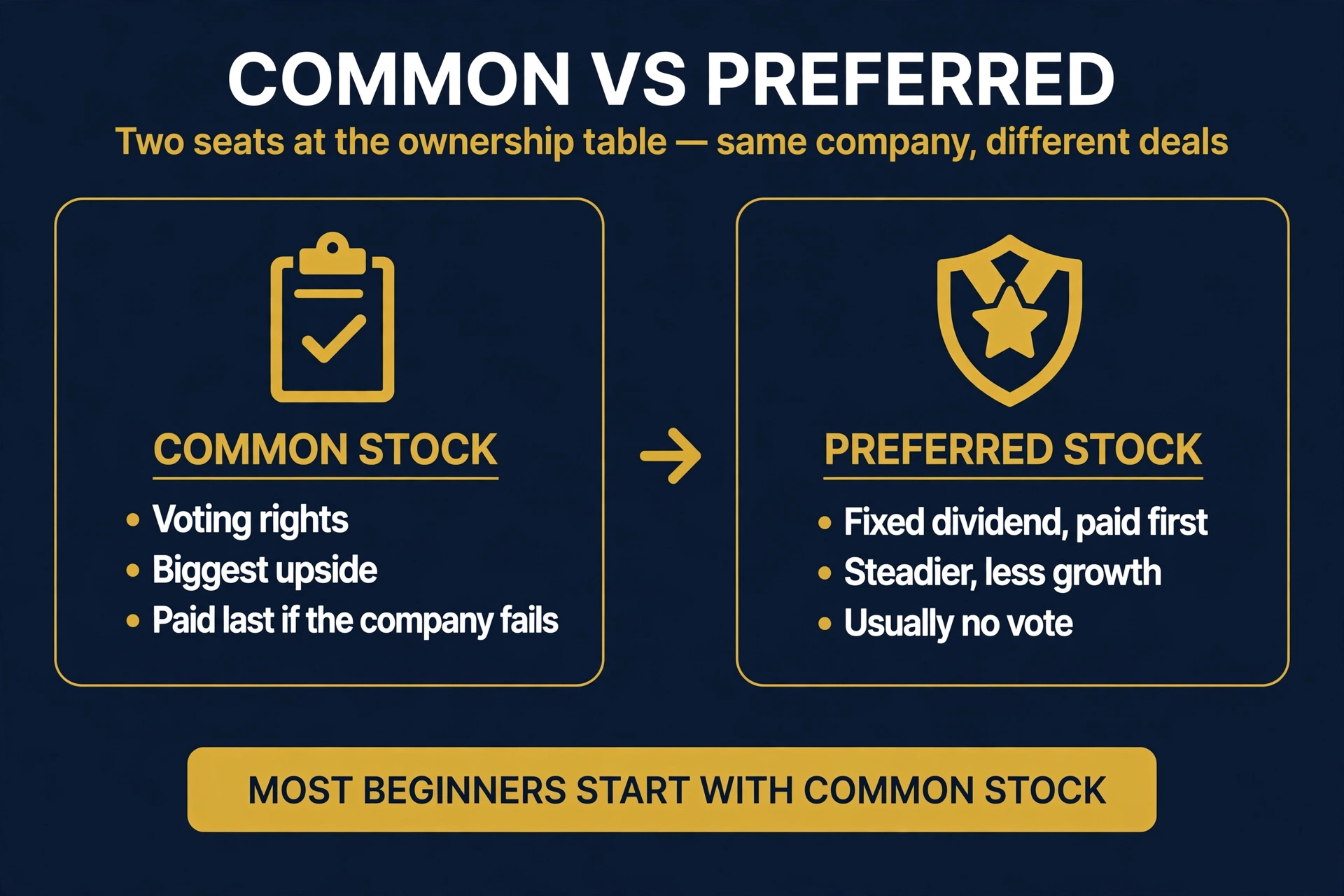
Most stocks you hear about are common stock — the standard slice of ownership. Common shareholders get voting rights and a share of profits through dividends and growth, but they stand last in line if the company fails. Common stock is what everyday investors buy, and it is where most of the long-term growth comes from.
Preferred stock is a hybrid: part stock, part bond. Preferred shareholders usually get a fixed, regular dividend that is paid before common shareholders get anything — but they typically give up voting rights in exchange. It is steadier and more income-focused than common stock, with less room for big growth.
Think of it as a trade. Common stock offers the biggest upside but the least protection: you eat last, but you can eat the most. Preferred stock offers priority treatment — paid first, more predictable — but caps what you can gain. Beginners will almost always start with common stock, but it is worth knowing the other seat at the table exists.
Key terms
- Stock
- a unit of ownership in a company, representing a claim on its assets and earnings.
- Share
- one unit of a company's stock; the price of one share is the stock price.
- Shareholder
- a person or institution that owns shares of a company's stock.
- Dividend
- a payment of company profits to shareholders, usually in cash and often quarterly.
- Market capitalization
- the total market value of a company: share price multiplied by the number of shares.
- Common stock
- the standard form of stock, with voting rights and the biggest upside, but last in line if the company fails.
- Preferred stock
- a steadier form of stock that pays a fixed dividend before common stock, usually without voting rights.
What's next
You now know what stocks are, how shares and dividends work, and how companies are sized. Next, IF-105 "Bonds" introduces the calmer side of investing — lending your money to governments and companies in exchange for steady, predictable payments.
The quiz
Stocks — Quiz
3 questions · pass with 3 correct
1.What does buying a share of stock actually mean?
2.What is a dividend?
3.How is market capitalization calculated?
Ready to Start
Hand-picked resources that fit this lesson — only ever one or two, and only when they're genuinely useful.
- Learn more
Public.com
Buy fractional shares of the companies you already know.
- Learn more
eToro
See how other investors build their stock portfolios.
We may earn a commission if you sign up — at no extra cost to you.