
Bonds
School 03 — Investing Foundations
Listen — 15-second overview
A quick spoken preview of this class
School 3 · Investing Foundations · About 15 minutes
If stocks are buying a piece of a business, bonds are lending your money to someone who promises to pay it back with interest. Governments borrow to build roads and fund budgets; companies borrow to build factories and expand. Bonds are the quieter half of investing — less dramatic than stocks, more predictable, and for many investors the steady foundation everything else is built on. We will now teach you about issuers, coupons, maturity, yield, duration, and the two big risks every bond investor must understand.
The Issuer: Who Is Borrowing Your Money?
A bond starts with someone who needs money. That borrower — called the issuer — sells a bond to investors, collects the cash now, and promises two things in return: regular interest payments, and the full original amount back on a set date.
There are three main types of issuers, from safest to riskiest. Treasury bonds come from the U.S. government and are backed by its full faith and credit — they are considered the safest bonds in the world. Municipal bonds come from states, cities, and local agencies, often to fund schools, roads, and hospitals; their interest is frequently exempt from federal income tax, which can make them attractive. Corporate bonds come from companies and usually pay the highest interest, because a company can stumble in ways a government usually cannot.
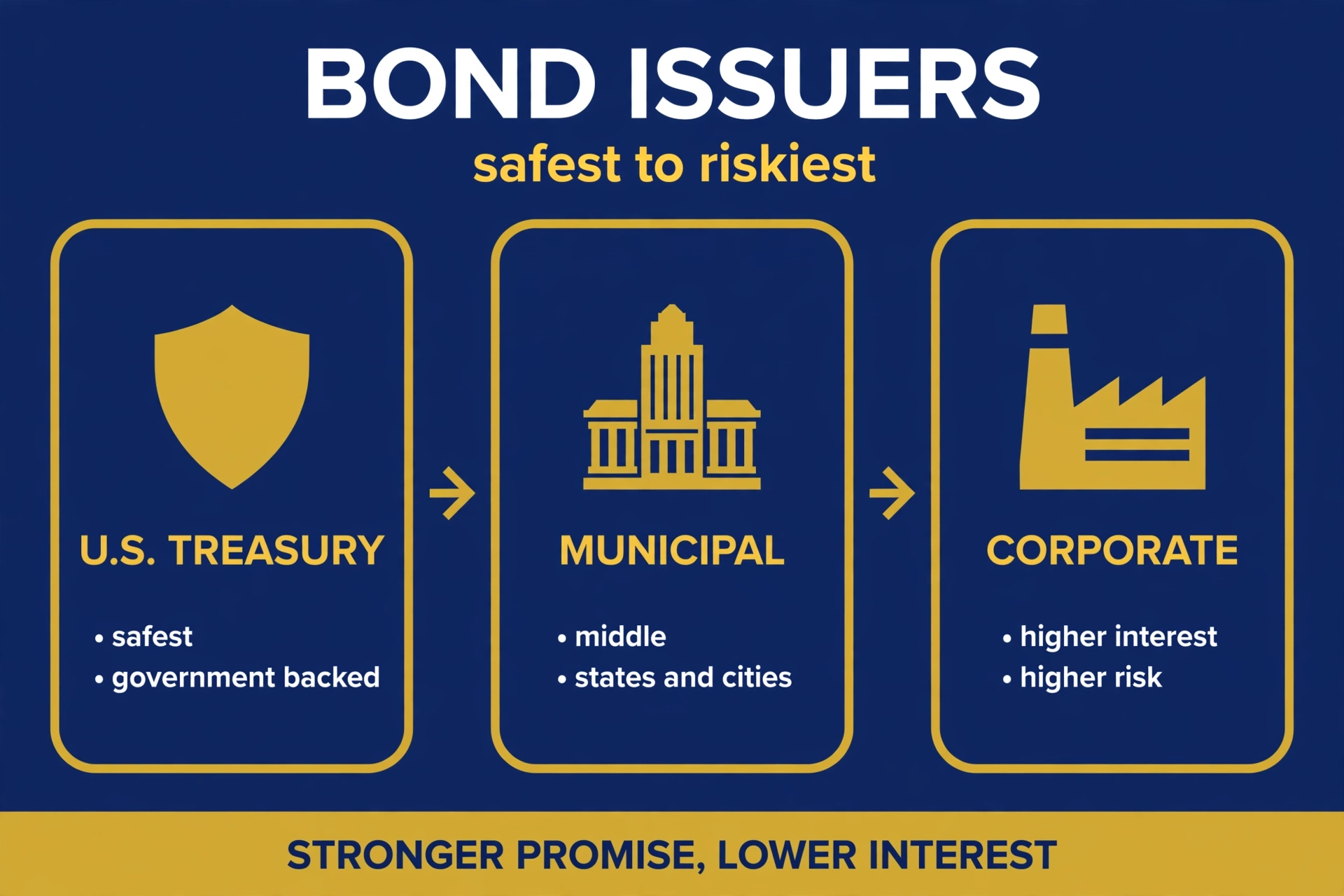
The issuer's reliability is everything, because a bond is only as strong as the promise behind it. Credit rating agencies like Moody's and Standard & Poor's grade issuers from AAA (safest) down through lower letters. Bonds rated BBB or higher are called investment grade; anything below is nicknamed "junk," and it pays much higher interest to compensate for the real chance of not being repaid.
Coupon and Maturity: The Terms of the Loan
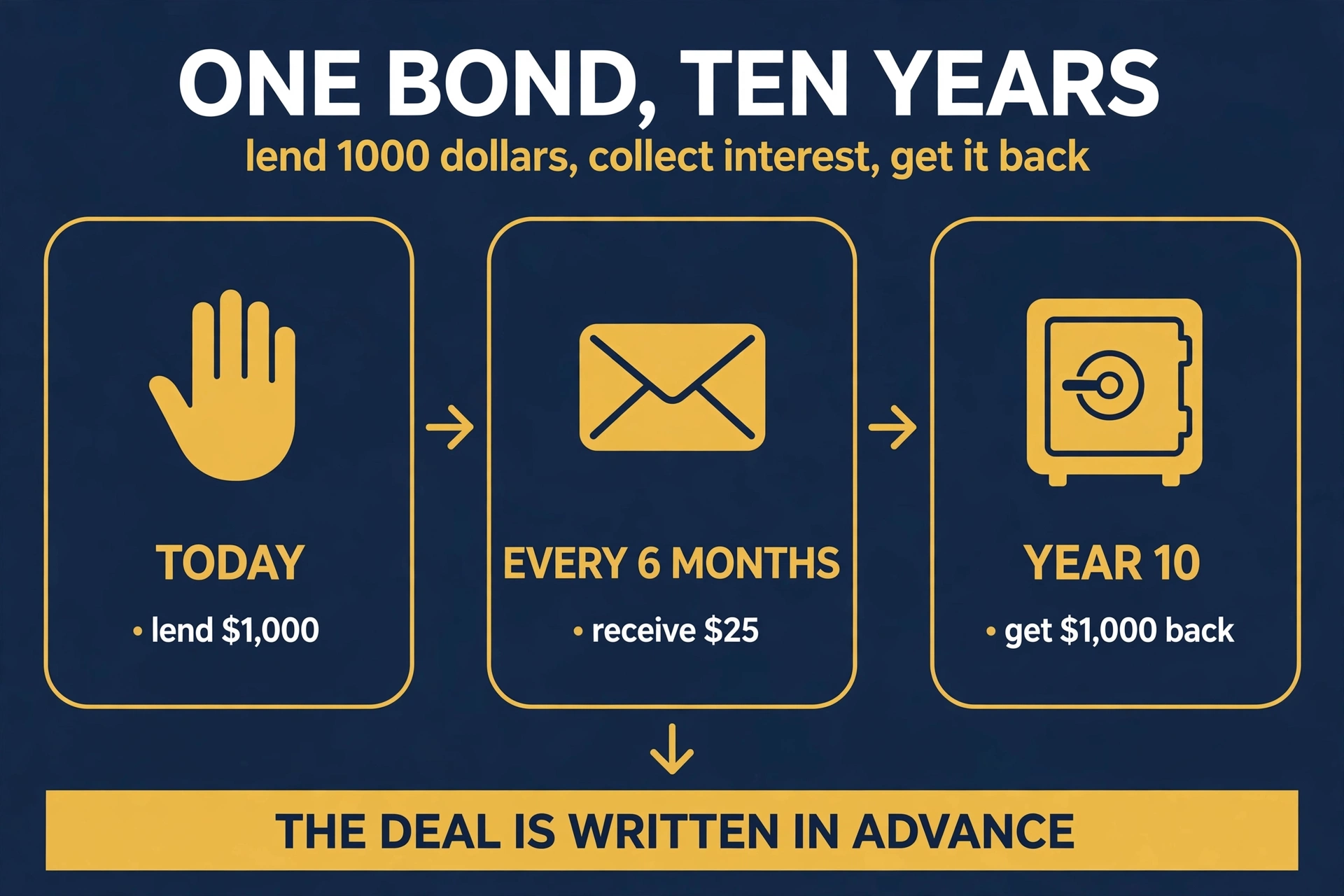
Every bond has two headline numbers. The coupon is the annual interest rate the bond pays, expressed as a percentage of the face value — the original amount lent, usually $1,000 per bond. A bond with a $1,000 face value and a 5% coupon pays $50 per year, typically as $25 every six months. That number never changes for the life of the bond, no matter what else happens in the economy.
The maturity date is when the issuer repays the face value and the bond ends. Maturities range from a few months to 30 years: short-term (under about 3 years), intermediate (roughly 3 to 10 years), and long-term (over 10 years). U.S. Treasury bills mature in a year or less and pay no coupon at all — they are sold at a discount, so the return comes from buying below face value and being repaid the full amount.
Here is the worked example. You buy a new 10-year corporate bond: face value $1,000, coupon 5%. For ten years you receive $50 per year, and at the end you get your $1,000 back. Total payments: $500 in interest plus the $1,000 principal, assuming the issuer never misses a payment. That is the whole appeal of bonds — the deal is written down in advance.
Yield: What You Actually Earn
The coupon tells you what the bond pays, but the yield tells you what you earn — and they are only the same if you buy at face value. In practice, bonds trade on the open market at prices above or below face value, and the price you pay changes your return.
The rule to memorize: bond prices and yields move in opposite directions. When interest rates rise, older bonds with lower coupons become less attractive, so their prices fall — which pushes their yield up. When rates fall, older bonds with higher coupons become more attractive, so their prices rise — which pushes their yield down.
Run the numbers. A $1,000 bond paying $50 a year has a 5% coupon. If rising rates knock its market price down to $900, the buyer still gets $50 a year — but $50 on a $900 purchase is about 5.6% yield. If falling rates push the price up to $1,100, that same $50 is only about 4.5% yield. The bond's payments never changed; only the price did, and the yield followed it.
The most useful yield number is yield to maturity — the total return you would earn if you held the bond until maturity, combining all the coupon payments plus any difference between what you paid and the face value you get back. When anyone quotes "a bond yielding 5.3%," they almost always mean yield to maturity.
Duration: Measuring the Sensitivity
Duration is the bond investor's speedometer. It measures, in years, how sensitive a bond's price is to interest-rate changes. The simple version: for every 1% that interest rates move, the bond's price moves by roughly the duration number, in the opposite direction.
A bond with a duration of 5 years loses about 5% of its price if rates rise 1%, and gains about 5% if rates fall 1%. A bond with a duration of 2 years barely flinches — roughly 2%. Long-term bonds have high duration, short-term bonds have low duration, which is exactly why the SEC's investor bulletin warns that longer maturities carry higher interest rate risk.
Duration is how professionals manage bond portfolios: they shorten duration when they expect rates to rise, and lengthen it when they expect rates to fall. For a beginner, the takeaway is simpler — if you cannot afford price swings, keep your maturities short. A 2-year bond and a 30-year bond pay interest all the same way; the difference is how violently their prices react while you hold them.
The Two Big Risks: Credit and Interest Rates
Every bond carries two main risks. Credit risk is the chance the issuer cannot pay — that it misses interest payments or fails to repay the principal. This is why Treasuries pay the lowest interest and junk bonds pay the highest: the interest rate is, in part, the price of worry. If you hold to maturity and the issuer pays as promised, you get every coupon and the full face value regardless of what the price did along the way.
Interest-rate risk is the chance that rates move against you before maturity. If rates rise and you need to sell, you will sell at a lower price. This risk grows with maturity — a 30-year bond's price can swing dramatically, while a 1-year bill barely moves. The two risks pull in different directions: the safest issuers still carry interest-rate risk if their bonds are long, and the riskiest issuers still have short bonds that are relatively stable.
There are smaller risks worth knowing: inflation quietly shrinks what fixed payments can buy, some bonds can be "called" early by the issuer when rates fall (call risk), and thinly traded bonds can be hard to sell quickly (liquidity risk). But credit and interest-rate risk are the pair that explain almost every surprise a bond investor ever faces.
Key terms
- Bond
- a loan an investor makes to a government or company, repaid with interest over time.
- Issuer
- the borrower who sells the bond and promises to make the payments.
- Coupon
- the annual interest rate a bond pays, as a percentage of its face value.
- Face value
- the original amount lent, repaid to the investor at maturity; usually $1,000.
- Maturity date
- the date the issuer repays the face value and the bond ends.
- Yield
- the actual return you earn, based on the price you paid; moves opposite to price.
- Yield to maturity
- the total return if the bond is held until maturity, including all payments and any price difference.
- Duration
- how sensitive a bond's price is to rate changes, measured in years; longer duration means bigger swings.
- Credit risk
- the chance the issuer fails to make its payments.
- Interest-rate risk
- the chance that rising rates push the bond's market price down before maturity.
- Investment grade
- bonds rated BBB or higher; considered safer, paying lower interest.
What's next
Bonds are one ingredient — but most investors do not buy bonds one at a time. IF-106 "Mutual Funds" shows you how a single purchase can own hundreds of bonds and stocks at once, and what that convenience really costs.
The quiz
Bonds — Quiz
3 questions · pass with 3 correct
1.What is a bond issuer?
2.What is a bond's coupon?
3.What happens to existing bond prices when interest rates rise?