
Mutual Funds
School 03 — Investing Foundations
Listen — 15-second overview
A quick spoken preview of this class
School 3 · Investing Foundations · About 15 minutes
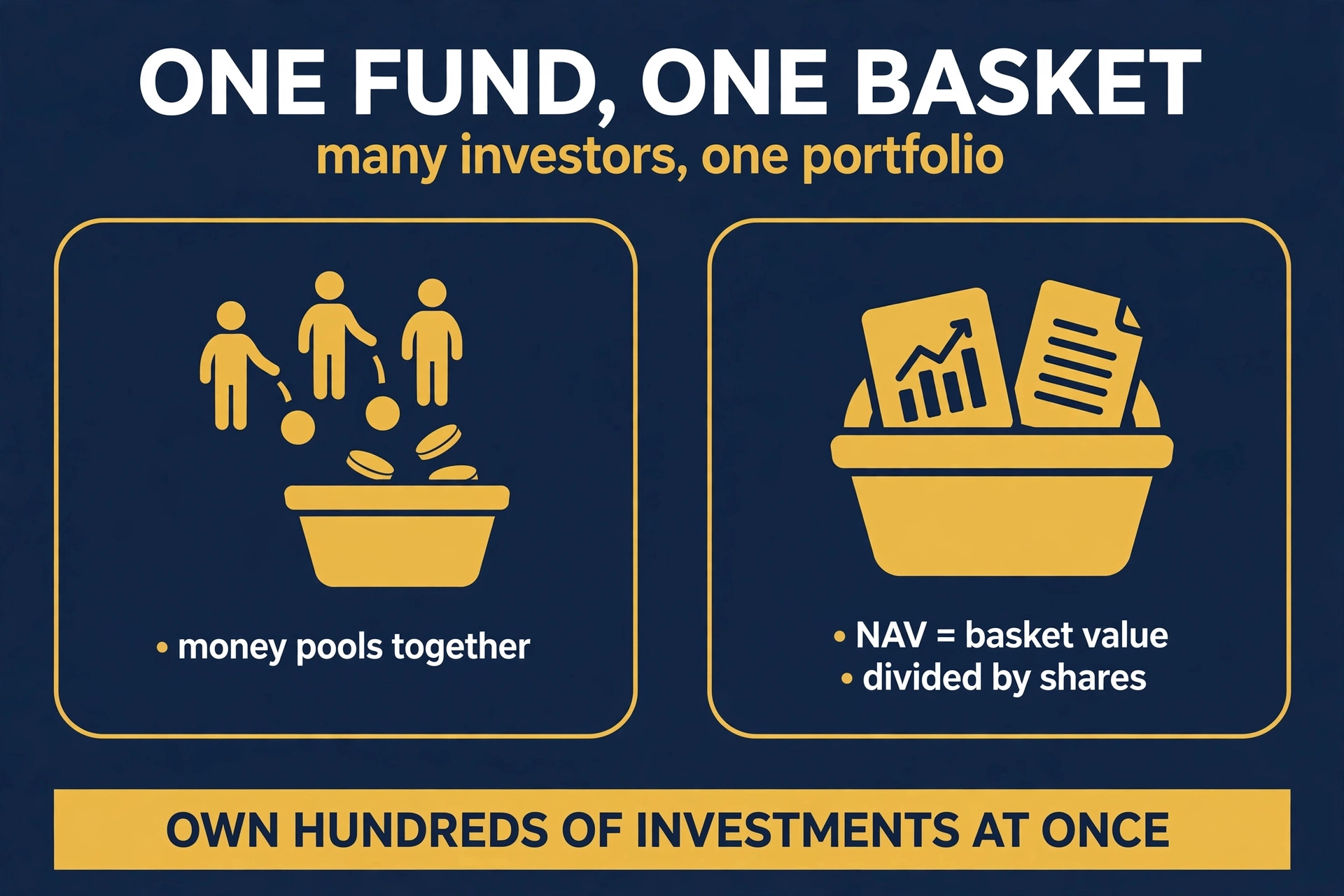
Buying stocks and bonds one at a time takes money, research, and patience most beginners do not have. A mutual fund solves that by pooling money from thousands of investors and buying a whole portfolio with it — so a single purchase of a few hundred dollars can own small slices of hundreds of companies. It is the easiest way to own a diversified portfolio, but the convenience comes with costs and quirks you should understand before buying. We will now teach you about NAV, active versus passive funds, share classes, loads, and distributions.
NAV: The Price of One Slice
A mutual fund owns a basket of investments — stocks, bonds, or both. Take everything the fund owns, subtract what it owes, and divide by the number of fund shares. That number is the net asset value, or NAV — the price of one share of the fund.
The worked example: a fund holds $200 million in stocks and bonds, owes $2 million in expenses, and has 10 million shares outstanding. NAV equals ($200,000,000 − $2,000,000) ÷ 10,000,000 = $19.80 per share. If the fund's holdings rise tomorrow, the NAV rises with them; if they fall, it falls.
One quirk to know: a mutual fund's NAV is calculated only once per day, after the market closes. When you place an order at noon, you do not get the noon price — you get whatever the NAV turns out to be at the end of the day. Unlike stocks, you cannot buy or sell a mutual fund mid-day at a live price.
Active vs. Passive: Two Ways to Run the Basket
Every mutual fund is run by a manager, but managers fall into two camps. Active funds try to beat the market: the manager researches companies, picks winners, trades in and out, and charges you for the effort — typically around 0.5% to 1.5% of your money per year. Passive funds simply copy an index like the S&P 500: no stock-picking, no expensive research team, and costs as low as 0.03% to 0.10% per year.
That cost gap matters enormously over time. On a $10,000 investment growing for 30 years, paying 1% a year in fees instead of 0.05% can cost you tens of thousands of dollars in lost growth — the difference between keeping your returns and donating them to the manager.
Study after study shows most active managers fail to beat their index after fees over long periods. That is why passive index funds have quietly taken over much of the industry. None of this means every active fund is bad — it means the burden of proof is on the expensive one, and for a beginner the cheap index fund is almost always the better starting point.
Share Classes and Loads: The Fee Maze
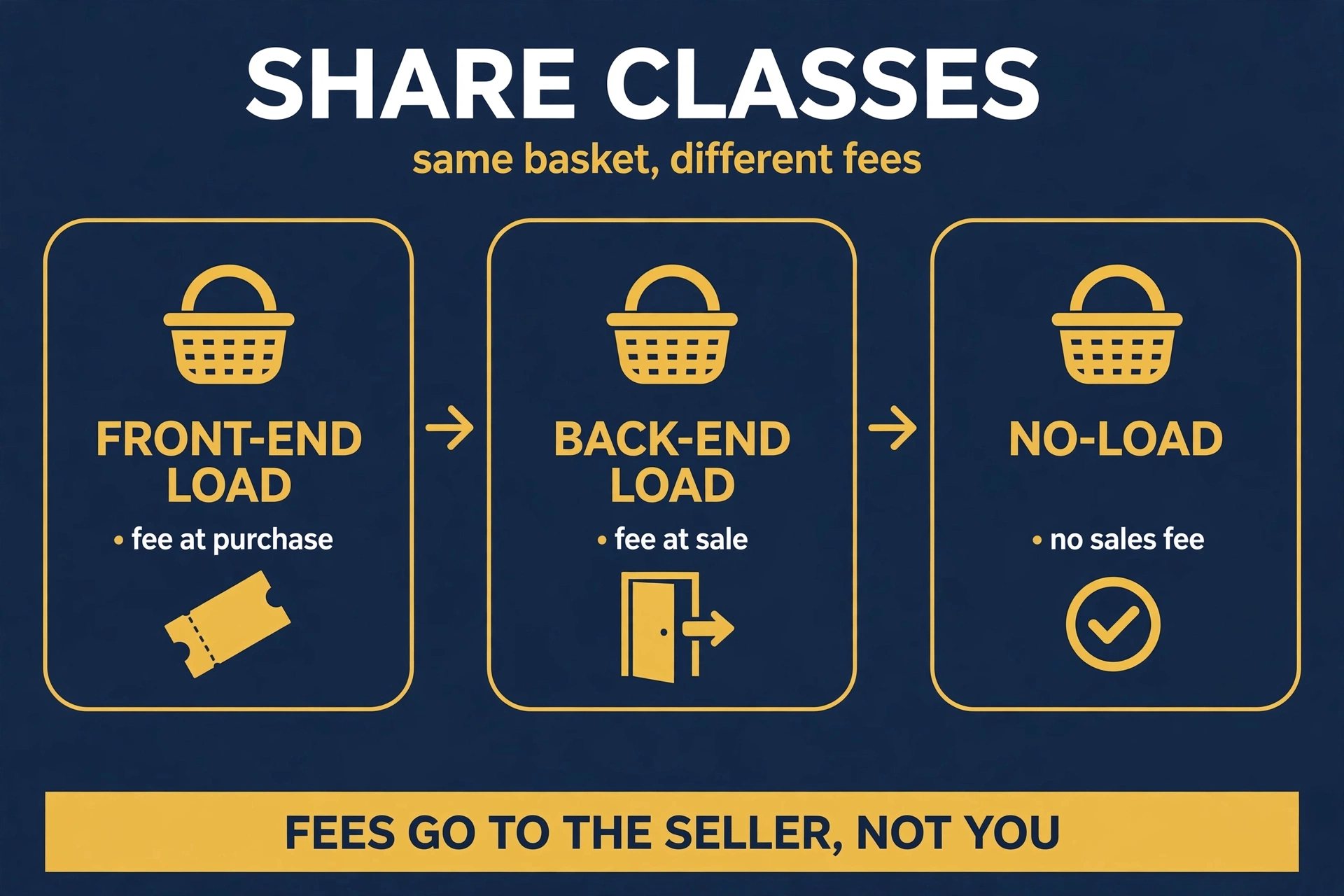
Here is where mutual funds get confusing on purpose. The same fund can be sold in several share classes — Class A, Class B, Class C — which hold identical investments but charge fees differently. It is like buying the same seat on a plane at different prices.
The fees come in two shapes. A load is a sales charge: a front-end load takes a cut when you buy (often around 5.75% — so only about $94.25 of every $100 actually gets invested), a back-end load takes a cut when you sell, and a no-load fund charges neither. The second shape is the annual expense ratio, quietly skimmed from the fund's returns every year.
Loads go to the broker or adviser who sold you the fund — they are a commission, not a service. That is why a broker might enthusiastically recommend a fund with a 5.75% front-end load: they just made 5.75% of your money. For a beginner buying on their own, no-load funds are almost always the right choice. If a fund charges you for the privilege of buying it, keep walking.
Distributions: The Fund's Tax Surprises
A mutual fund passes its income through to you in distributions. When the stocks inside pay dividends, the fund collects them and sends them to you, usually yearly. When the manager sells investments at a profit, those capital gains are distributed too — and here is the catch: you owe tax on distributions even if you never sold a share.
This creates a classic trap. Imagine you buy a fund in December for $10,000, and a week later it distributes $1,000 in gains the manager locked in earlier that year. You now owe tax on $1,000 you never really earned — the NAV simply drops by the amount distributed. Fund accountants call this "buying a distribution," and December buyers get burned by it every year.
Active funds distribute gains often, because they trade constantly. Index funds distribute rarely, because they barely trade — another quiet cost advantage. One simple defense: hold mutual funds inside tax-advantaged accounts like IRAs and 401(k)s (covered in School 4), where distributions do not create a tax bill at all.
Key terms
- Mutual fund
- a pooled investment that buys a portfolio of stocks and/or bonds with money from many investors.
- NAV (net asset value)
- the price of one fund share: total assets minus liabilities, divided by shares outstanding.
- Active fund
- a fund whose manager tries to beat the market by picking investments; higher fees.
- Passive fund (index fund)
- a fund that simply copies a market index; very low fees.
- Expense ratio
- the annual fee a fund charges, as a percentage of your investment, skimmed from returns.
- Share class
- different fee versions (A, B, C) of the same mutual fund.
- Load
- a sales charge on a fund: front-end (at purchase), back-end (at sale), or none (no-load).
- No-load fund
- a mutual fund with no sales charge to buy or sell.
- Distribution
- dividends and capital gains a fund passes through to shareholders, taxable even if you reinvested them.
What's next
Mutual funds are one wrapper for owning the market — but a newer wrapper trades all day long like a stock. IF-107 "ETFs and Index Funds" shows you exchange-traded funds: what intraday trading buys you, why premiums and discounts appear, and how index design shapes what you actually own.
The quiz
Mutual Funds — Quiz
3 questions · pass with 3 correct
1.How is a mutual fund's NAV (net asset value) calculated?
2.What is an actively managed mutual fund?
3.What is a mutual fund load?
Recommended Tools
Hand-picked resources that fit this lesson — only ever one or two, and only when they're genuinely useful.
- Learn more
M1 Finance
Own diversified fund portfolios that rebalance themselves.
- Learn more
Acorns
Invest automatically in diversified portfolios, starting with spare change.
We may earn a commission if you sign up — at no extra cost to you.