
ETFs and Index Funds
School 03 — Investing Foundations
Listen — 15-second overview
A quick spoken preview of this class
School 3 · Investing Foundations · About 15 minutes
An exchange-traded fund, or ETF, is a basket of investments — like a mutual fund — that trades on the stock exchange all day like a single stock. They have become the default tool for ordinary investors: cheap, flexible, and easy to buy in any brokerage account. But ETFs have their own mechanics worth understanding: intraday trading, small price gaps, tracking, and the quiet power of expense ratios and index design. We will now teach you how ETFs trade, why prices can drift from value, how to measure tracking and costs, and how indexes decide what you own.
Intraday Trading: A Fund That Acts Like a Stock
A mutual fund prices once a day; an ETF prices every second the market is open. You can buy at 10:00 AM, sell at 2:30 PM, set a limit order, or use a stop order — everything from IF-102 works with ETFs, because an ETF share is bought and sold on the exchange just like a stock share.
That flexibility has a real benefit and a real temptation. The benefit: you know your exact price before you commit, and you can trade around news the moment it breaks. The temptation: trading a long-term investment every day turns an investing tool into a gambling device. Studies of investor behavior keep finding the same thing — the more often people trade, the worse they do. The ETF gives you the freedom to trade constantly; wisdom is not using it.
There is also a tax edge hiding in the structure. When ETF managers rebalance, they usually swap holdings with large institutional partners instead of selling them outright — a process called in-kind redemption — so the fund rarely realizes capital gains. That is why ETFs famously distribute far fewer taxable capital gains than mutual funds do.
Premiums and Discounts: When Price Drifts From Value
An ETF has two numbers at any moment: its market price (what buyers and sellers agree on) and its intraday NAV — the live value of the basket it holds. Most of the time they match almost exactly, because big trading firms constantly buy the cheap side and sell the expensive side, pocketing the difference. That arbitrage is what keeps ETFs honest.
But the price can drift. When markets panic or a fund's holdings are hard to trade — say, an ETF holding foreign stocks while those markets are closed — the ETF can trade at a premium (price above NAV) or a discount (price below NAV). A 2% premium means you are paying $102 for $100 of assets.
For big, liquid ETFs tracking U.S. stocks, premiums and discounts are usually tiny — hundredths of a percent. They matter most in exotic or thinly traded ETFs. The beginner's rule is simple: stick to large, high-volume ETFs, and always glance at the premium or discount before buying. Paying a premium to own something is never a bargain.
Tracking: Does the Fund Do Its Job?
An index fund has exactly one job: copy its index. Tracking error measures how faithfully it does that — the gap between the fund's return and the index's return over time. A well-run S&P 500 ETF trails its index by roughly its expense ratio and almost nothing else.
Two things cause drift. The obvious one is fees: if the fund charges 0.03% a year, it trails by about 0.03%. The sneaky one is cash drag — the fund holds a little cash for redemptions, and cash earns nothing while the index rises. Some funds also sample the index (holding most of it) rather than owning every stock, which introduces tiny differences.
Tracking is how you judge quality between near-identical funds. Two S&P 500 ETFs at the same fee should behave identically; if one lags persistently, something is off. For beginners the practical lesson is narrower: once you pick the index you want, any of the big ETFs tracking it will do the job fine. Do not overthink the brand.
Expense Ratios: The Quiet Wealth Killer
The expense ratio is the annual fee, expressed as a percentage of your investment, skimmed straight from the fund's returns. A 0.03% expense ratio on $10,000 costs you $3 a year. A 1.00% ratio costs $100 a year — on the same $10,000, every year, whether the fund goes up or down.
The math compounds against you. Over 30 years, assume 8% market returns: $10,000 at a 0.03% expense ratio grows to roughly $100,600; at a 1.00% ratio it grows to roughly $76,100. Same market, same 30 years — about $24,500 of the difference is fees you paid and growth those fees would have earned. This is why IF-106 pushed passive funds: in investing, the highest-fee option is not the premium product, it is the one charging you for the privilege of underperforming.
Vanguard's S&P 500 ETF charges about 0.03% — three dollars per ten thousand, per year. When you see an index ETF charging ten or twenty times that for the same index, ask what the extra money buys. The answer is usually nothing.
Index Design: Who Decides What's in the Basket?
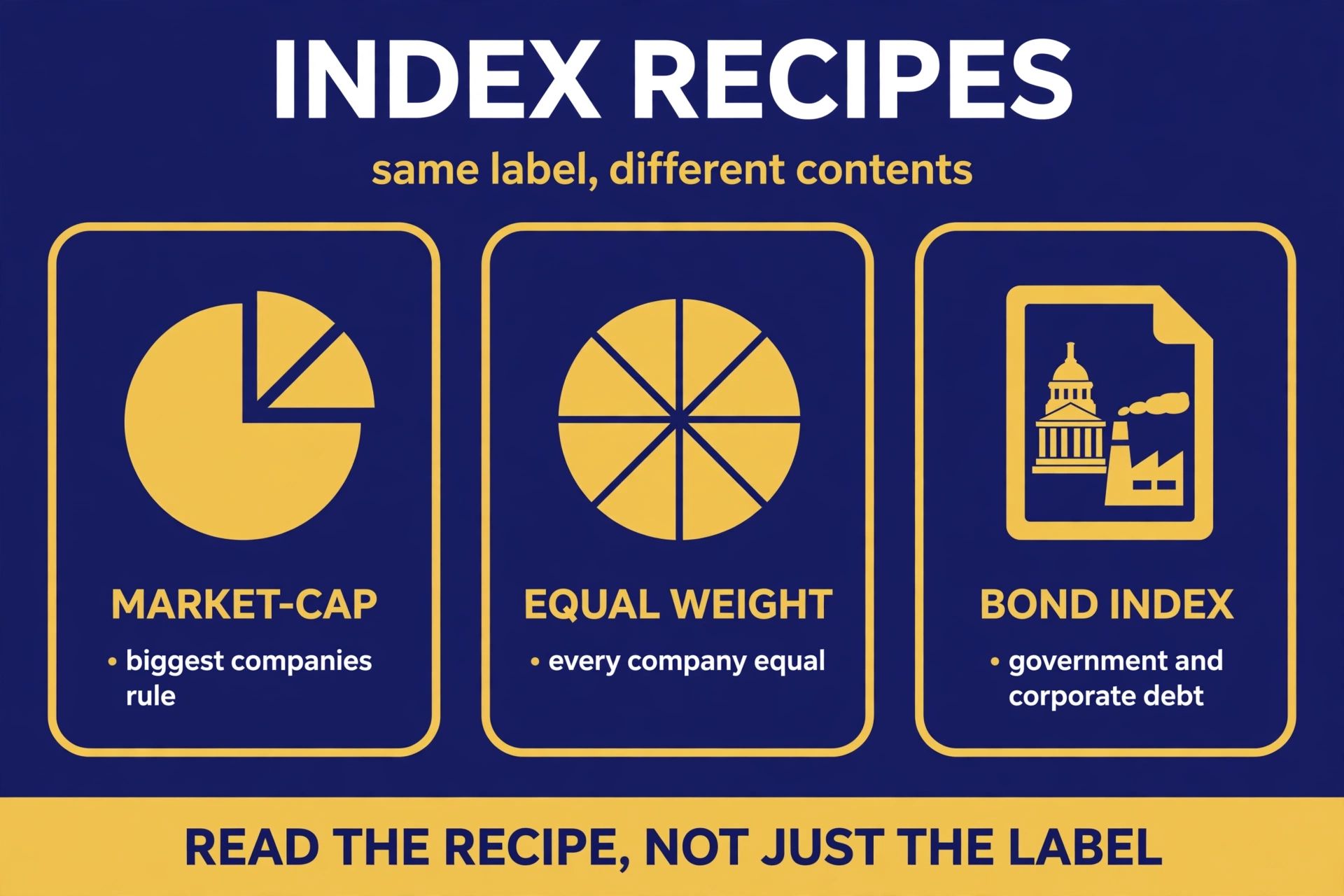
An index is just a recipe — a published list of rules for which investments to hold and how much of each. The S&P 500 holds 500 large U.S. companies, weighted by size. The total U.S. stock market index holds thousands, down to small companies. A bond index holds bonds. There is an index for nearly everything.
Design details change what you own. Market-cap weighting (the S&P 500 approach) means the biggest companies dominate — the top ten can be a third of the whole index. Equal weighting gives every company the same slice. Reconstitution is when the index updates its list — companies graduate in, fallen ones drop out, and every fund tracking it buys and sells to match.
None of this is hidden: index rules are public documents. But two investors can both say "I own an index fund" and own very different things — one holds 500 giants, another holds the entire market including small companies, another holds only bonds. The label "index fund" tells you the cost structure, not the contents. Always read the recipe.
Key terms
- ETF (exchange-traded fund)
- a basket of investments that trades on the stock exchange all day like a stock.
- Index fund
- a fund, mutual or ETF, that copies a market index instead of picking investments.
- Intraday NAV
- the live, second-by-second value of an ETF's holdings during the trading day.
- Premium
- when an ETF's market price sits above its NAV; you pay more than the basket is worth.
- Discount
- when an ETF's market price sits below its NAV.
- Tracking error
- how far a fund's return drifts from its index's return; the measure of copy quality.
- Expense ratio
- the annual fee skimmed from a fund's returns, as a percentage of your investment.
- Index
- a published set of rules defining which investments to hold and in what proportions.
- Market-cap weighting
- sizing holdings by company size, so the biggest companies get the biggest slices.
- Reconstitution
- the index's periodic update of its holdings list.
What's next
You can now own the traditional markets cheaply and simply — stocks, bonds, and the funds that bundle them. But a newer asset class claims to be money itself, reimagined. IF-108 "Crypto and Digital Assets" explains blockchain, wallets, and custody in plain English — and why this market's wild swings and scam density demand special caution.
The quiz
ETFs and Index Funds — Quiz
3 questions · pass with 3 correct
1.How does an ETF's trading differ from a mutual fund's?
2.What does tracking error measure?
3.Why does a fund's expense ratio matter so much?
Recommended Tools
Hand-picked resources that fit this lesson — only ever one or two, and only when they're genuinely useful.
- Learn more
M1 Finance
Build a portfolio of low-cost ETFs and let it rebalance automatically.
- Learn more
Acorns
Start small with automated, low-cost index investing.
We may earn a commission if you sign up — at no extra cost to you.