
Crypto / Digital Assets
School 03 — Investing Foundations
Listen — 15-second overview
A quick spoken preview of this class
School 3 · Investing Foundations · About 15 minutes
Bitcoin and its thousands of cousins are the first new asset class in a generation — and the most confusing. Prices swing wildly, headlines swing between "the future of money" and "worthless," and scammers have set up camp everywhere the excitement is. This class is not a pitch for or against crypto: it is a plain-English explanation of what the technology is, how people hold it, and the questions to ask before a single dollar goes in. We will now teach you blockchain basics, wallets and custody, volatility, scams, and how to think about portfolio size.
Blockchain Basics: A Ledger Nobody Owns
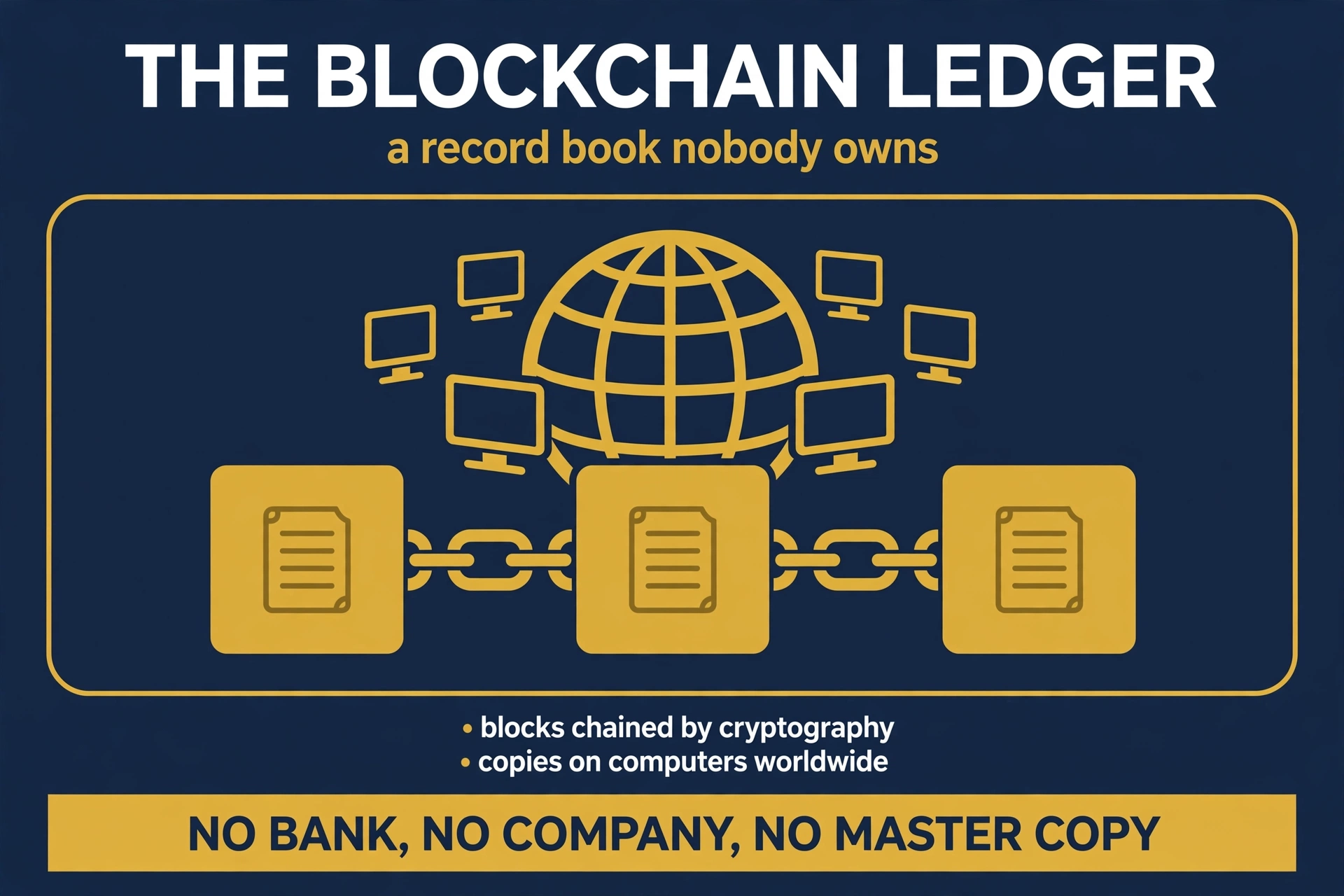
A blockchain is a shared record book. Every transaction — who sent what to whom — is written into a "block," each block is chained to the previous one with cryptography, and thousands of computers around the world keep identical copies. There is no bank, no company, no government in charge of the master copy, because there is no master copy: the network itself is the authority.
That design is the whole point. In the traditional system, you trust a bank to keep your balance right. In crypto, you trust math and the crowd of computers enforcing it. Bitcoin, the first blockchain (launched in 2009), applies this to money: a fixed supply of 21 million coins, no central issuer, and ownership tracked by the ledger rather than by an account at an institution.
Digital assets is the umbrella term: Bitcoin and similar coins, tokens built on other blockchains (many are just software projects with their own currencies), and stablecoins — tokens designed to stay pegged to a dollar, backed by reserves of cash and bonds. Stablecoins are the plumbing of crypto trading; the other coins are the speculation.
Wallets and Custody: Your Keys, Your Problem
Here is the sentence that matters most in this class: in crypto, whoever holds the private keys controls the coins. A private key is a secret code — lose it and your crypto is gone forever; let someone copy it and they can take your crypto forever. There is no password-reset button, no fraud department, no one to call.
A wallet is the software (or device) that stores your keys and lets you send and receive. A hot wallet lives on your phone or computer — convenient, but exposed to hackers. A cold wallet (usually a small hardware device) keeps keys offline — much safer, a bit clumsier. Big holders use cold wallets; beginners usually do not.
Custody is the question of who holds the keys. If you buy crypto on an exchange like a brokerage app, the exchange holds your keys — convenient, but you are trusting the company, and exchanges have been hacked and gone bankrupt. If you move coins to your own wallet, you hold the keys — total control, total responsibility. The old saying in crypto captures it: "not your keys, not your coins." Both choices have real risks; the mistake is not knowing which one you made.
Volatility: The Price of Admission
Crypto is the most volatile major asset class on Earth, and it is not close. Bitcoin has repeatedly fallen 50% or more from its highs — and then risen to new highs. Smaller coins routinely drop 80–90% and never come back. A stock investor having a bad year loses 20%; a crypto investor having a bad month can lose 50%.
Why so wild? The market is young, relatively small compared to stocks, trades around the clock with no circuit breakers, and is dominated by speculation rather than earnings or dividends to anchor prices. There is no company reporting quarterly profits to steady the story — price is pure supply, demand, and sentiment.
The practical consequence: money you might need soon has no business in crypto. If a 50% drop would change your plans — your rent, your emergency fund, your retirement timeline — the position is too big or the money was never yours to risk. Volatility is not a bug you wait out; it is the permanent weather of this asset class.
Scams: The Minefield
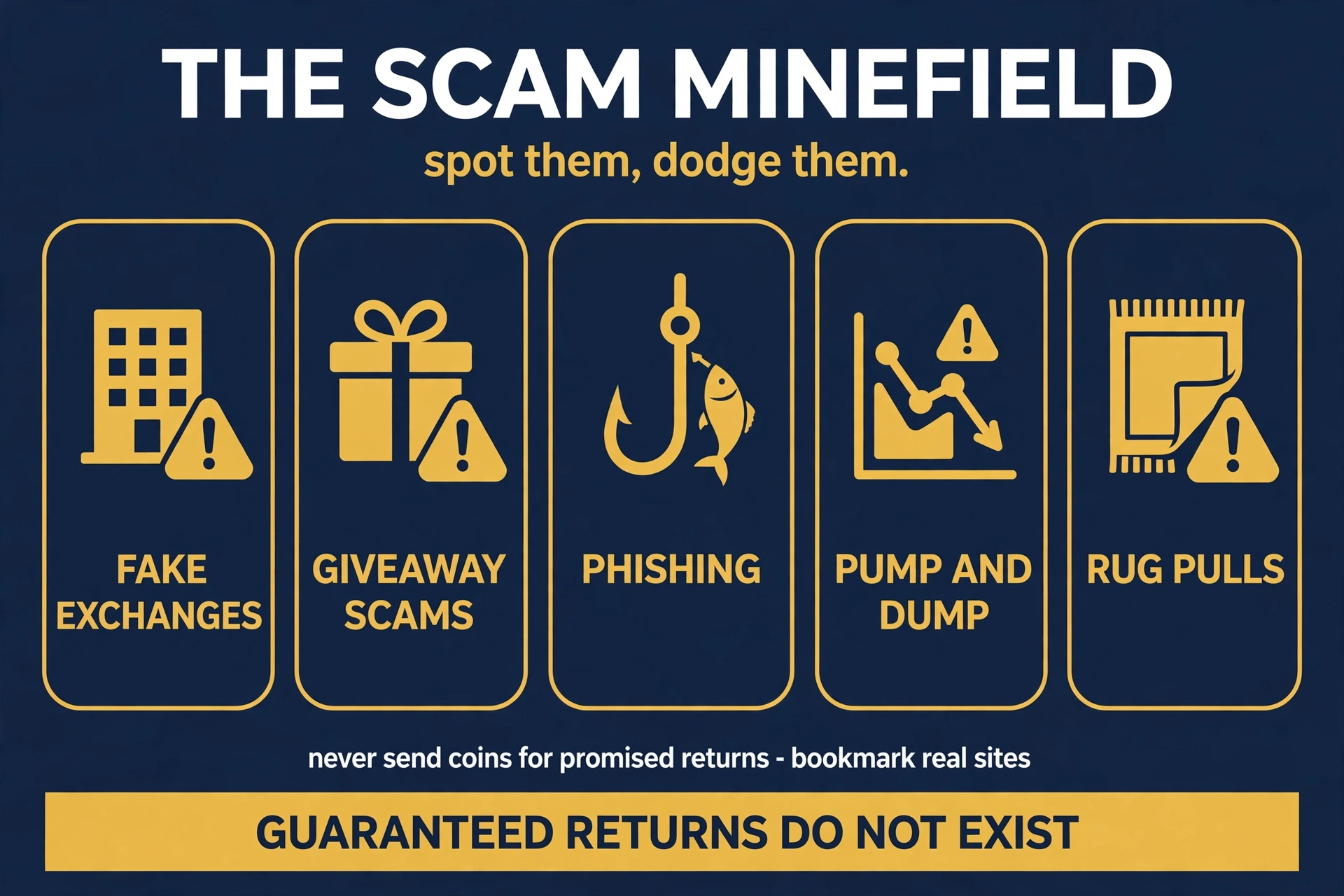
Wherever excitement meets complexity, scammers follow — and crypto is their favorite hunting ground. The classics, in plain English: fake exchanges and wallets that take your deposit and vanish; "double your Bitcoin" giveaways on social media impersonating celebrities; phishing — fake login pages and emails that steal your exchange password; pump-and-dump groups that hype a tiny coin, sell into the spike, and leave newcomers holding the crash; and rug pulls, where the creators of a new token drain its funds and disappear.
The defenses are boring and they work. Never send crypto to anyone promising returns — no legitimate investment asks you to send coins to a stranger's address. Bookmark real sites instead of clicking links in messages. Turn on every security option your exchange offers. Be deeply suspicious of anyone who contacts you first about an opportunity. And remember the iron rule of fraud: guaranteed returns do not exist, in crypto or anywhere else.
Portfolio-Sizing Questions
This is the part most crypto content skips: not whether to own any, but how much. Start with honest questions, not with a coin. Could you lose every dollar you put in and still be fine? Is this money you will not need for years? Have you already built the boring foundation — emergency fund, diversified stocks and bonds — before reaching for the exciting stuff?
Many thoughtful investors who include crypto cap it at a small slice — commonly 1% to 5% of a portfolio — precisely because the upside is real but the downside includes total loss. Size it so that if it goes to zero, you shrug; and if it multiplies, you are pleasantly surprised but not saved or ruined either way. That is not a recommendation to buy — it is a framework for deciding whether, and how much, this asset class belongs in a beginner's plan at all.
One more tax note, because it surprises people: in the U.S., the IRS treats crypto as property, not currency. Selling, trading one coin for another, or spending it can each trigger capital gains tax (covered in IF-110). Swapping Bitcoin for another token is a taxable sale of the Bitcoin — the tax code does not care that you never touched dollars.
Key terms
- Blockchain
- a shared, decentralized record book of transactions, copied across many computers with no central owner.
- Bitcoin
- the first blockchain-based digital currency (2009), with a fixed supply of 21 million coins.
- Token
- a digital asset built on an existing blockchain, often tied to a specific software project.
- Stablecoin
- a token designed to hold a steady value, usually pegged to the U.S. dollar.
- Private key
- the secret code that controls crypto; whoever holds it controls the coins.
- Wallet
- software or a device that stores your keys and lets you send and receive crypto.
- Hot wallet
- a wallet connected to the internet; convenient but exposed to hacking.
- Cold wallet
- a wallet kept offline (often a hardware device); much safer from hackers.
- Custody
- who holds the private keys: you, or an exchange or company holding them for you.
- Volatility
- how violently prices swing; crypto's defining and permanent characteristic.
- Rug pull
- a scam where a token's creators drain its funds and disappear.
What's next
You have now met every major asset class — stocks, bonds, funds, and crypto. Owning them is only half the battle; the other half is deciding how they fit together. IF-109 "Diversification and Allocation" shows you why spreading money across assets works, what correlation means, and how to build a target mix you can actually stick with.
The quiz
Crypto and Digital Assets — Quiz
3 questions · pass with 3 correct
1.What is a blockchain?
2.In crypto, who controls the coins?
3.What is the safest way to think about crypto position size?
Recommended Tools
Hand-picked resources that fit this lesson — only ever one or two, and only when they're genuinely useful.
- Learn more
Public.com
Explore crypto in small, fixed amounts alongside your stocks.
- Learn more
eToro
See how other investors size their crypto positions before you commit.
We may earn a commission if you sign up — at no extra cost to you.