
Diversification and Allocation
School 03 — Investing Foundations
Listen — 15-second overview
A quick spoken preview of this class
School 3 · Investing Foundations · About 15 minutes
"Don't put all your eggs in one basket" is the oldest investing advice there is — and it is also the most ignored. Diversification is the deliberate version of that folk wisdom: spreading money across different investments so that no single failure can sink you. But doing it well requires understanding asset classes, how they move together, and the difference between the risk you can afford and the risk you can stomach. We will now teach you about asset classes, correlation, concentration, risk capacity, and building a target allocation.
Asset Classes: The Baskets
An asset class is a category of investments that behaves similarly. The big ones: stocks (ownership in companies — highest long-term growth, highest drama), bonds (loans to governments and companies — steadier, lower returns), cash (savings, money markets — safe, barely grows), real estate (property or funds that own it — income plus growth, hard to sell quickly), and alternatives (commodities, crypto, and anything that does not fit the other boxes).
History gives each class a personality. Over very long periods, stocks have returned roughly 10% a year on average in the U.S. — but with regular drops of 20%, 30%, even 50%. Bonds have returned roughly 4–5% with far gentler swings. Cash has barely beaten inflation. These are averages across decades, not promises for any given year — but they explain why the classes exist: growth, stability, and safety each live in a different basket.
Geography and size add more baskets. U.S. stocks behave differently from international stocks; large companies behave differently from small ones. A portfolio holding only big U.S. tech stocks is less diversified than its owner thinks — everything in it can fall for the same reason on the same day.
Correlation: Do They Fall Together?
Diversification only works if your baskets do not all fall at once — and that is what correlation measures. Two investments with high correlation move together; with low correlation they move independently; with negative correlation one rises when the other falls.
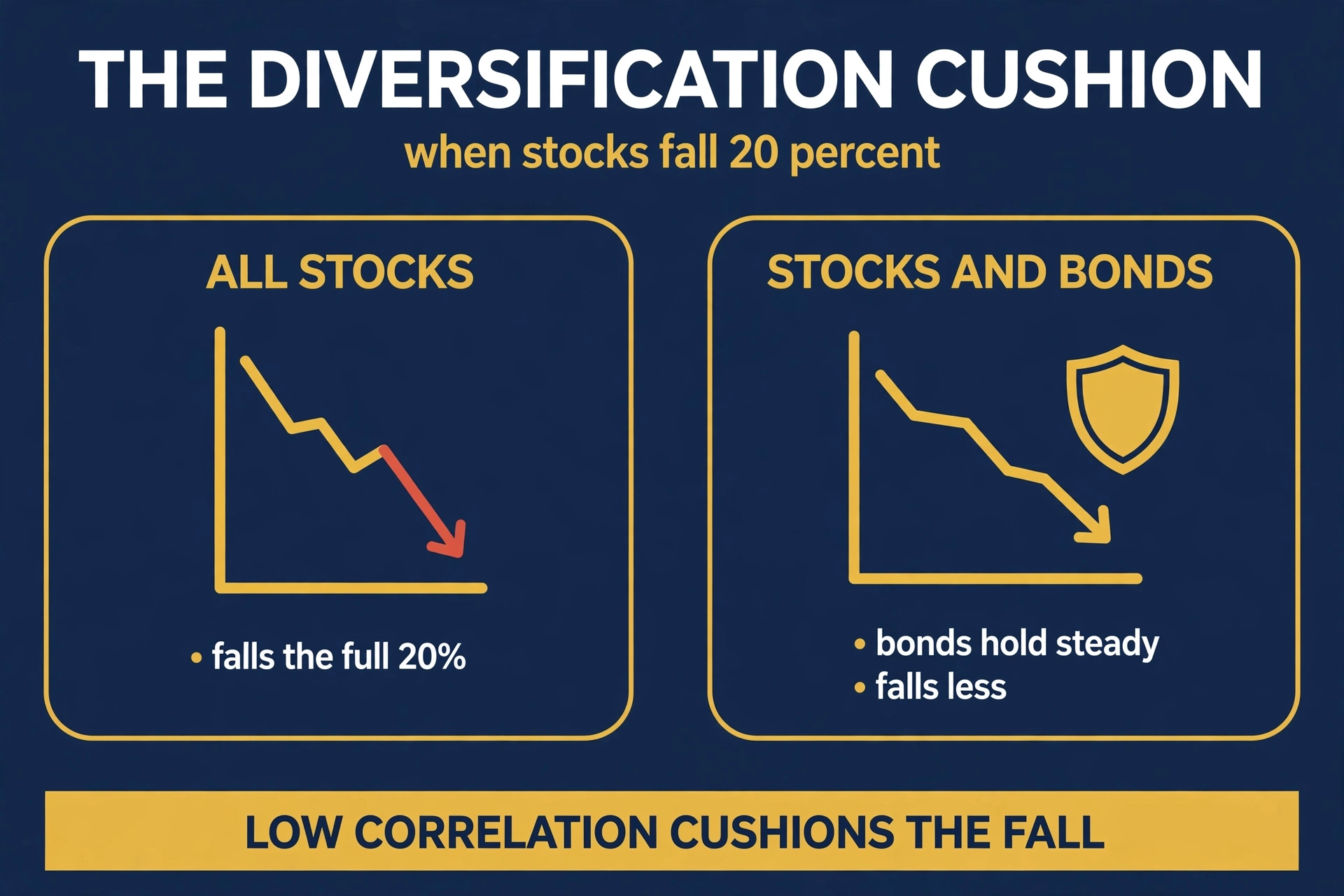
The worked example. In a calm market, you own $10,000 in stocks and $10,000 in bonds. Stocks drop 20% (now $8,000) while bonds stay flat (still $10,000). Your portfolio is $18,000 instead of $16,000 — the bonds cushioned half the blow. That cushion is low correlation doing its job.
But correlation is sneaky: in a true panic, correlations spike and almost everything falls together — 2008 taught investors that stocks, real estate, and many "diversifiers" can all plunge at once. The honest lesson: diversification softens normal storms and does not prevent hurricanes. It is still the best free protection available — it just is not a force field.
Concentration: The Opposite of Diversification
Concentration is betting big on one thing: all your money in your employer's stock, in one "hot" sector, or in a single coin. Sometimes it makes fortunes — every legendary investor has a concentration story. What the stories skip: for every winner, countless concentrated portfolios were wiped out by one bankruptcy, one scandal, one bad quarter.
The employer's-stock trap deserves special attention. It feels loyal and smart — you know the company! But your salary already depends on it. If the company stumbles, you can lose your job and your savings in the same month. Financial advisers treat heavy employer-stock ownership as one of the most dangerous positions an ordinary investor can hold.
Concentration has a place, deliberately and in small doses: a few percent in a company you deeply understand is a calculated bet, not a portfolio. The danger is concentration by accident — never deciding, just drifting, until one holding quietly becomes half your net worth. Check your portfolio's biggest position today; if one investment is more than about 10% of it, you are concentrated whether you meant to be or not.
Risk Capacity vs. Risk Tolerance: Can vs. Can You Stand It
Two different questions govern how much risk to take. Risk capacity is objective: how much can you afford to lose? A 25-year-old with decades of paychecks ahead and no dependents has enormous capacity. A 60-year-old retiring next year, living off savings, has very little. Time horizon and financial cushion decide capacity — math, not feelings.
Risk tolerance is emotional: how much can you stand to lose without panicking? Some people watch a 20% drop and buy more; others lose sleep over 5% and sell at the worst moment. Neither reaction is a character flaw — but the second person should not own an aggressive portfolio, because the portfolio they abandon mid-crash is worse than the conservative one they keep.
Your allocation must respect the lower of the two. High capacity with low tolerance means a calmer portfolio you will actually hold. Low capacity with high tolerance means you cannot afford your own bravery. Beginners almost always overestimate their tolerance — everyone is brave in a bull market. Assume yours is lower than you think.
Target Allocation: Your Mix, On Paper
A target allocation is your plan written as percentages: for example, 70% stocks, 25% bonds, 5% cash. It is the single most important investing decision you will make — more important than which specific fund you pick, because the mix drives most of your results and most of your risk.
Build it from what you just learned. Long time horizon and high capacity? More stocks. Short horizon or low tolerance? More bonds and cash. A common starting framework is the "age rule" and its variants — but treat rules of thumb as conversation starters, not answers. The right allocation is the one that matches your capacity, respects your tolerance, and lets you sleep.
Then write it down and keep it somewhere you will see it. An allocation that lives only in your head will be renegotiated every time the market scares you — which is exactly when you most need the plan you made when you were calm. IF-111 will show you how to maintain it; for now, the job is simply to choose a mix on purpose instead of drifting into one by accident.
Key terms
- Diversification
- spreading money across different investments so no single failure can sink the portfolio.
- Asset class
- a category of investments that behaves similarly: stocks, bonds, cash, real estate, alternatives.
- Correlation
- how closely two investments move together; low correlation is what makes diversification work.
- Concentration
- holding a large portion of wealth in one investment; the opposite of diversification.
- Risk capacity
- the objective amount of risk you can afford, set by time horizon and financial cushion.
- Risk tolerance
- the emotional amount of risk you can endure without panicking and selling.
- Target allocation
- your planned mix of asset classes, written as percentages.
- Time horizon
- how long until you need the money; the biggest driver of risk capacity.
What's next
You know how to spread risk — but there is a quieter enemy eating your returns from the inside: costs and taxes. IF-110 "Fees, Taxes, and Real Returns" shows you exactly how expense ratios, trading costs, and the tax code shrink your gains, and what "after-tax return" really means.
The quiz
Diversification and Allocation — Quiz
3 questions · pass with 3 correct
1.What is diversification?
2.What does correlation measure?
3.What is concentration risk?
Recommended Tools
Hand-picked resources that fit this lesson — only ever one or two, and only when they're genuinely useful.
- Learn more
M1 Finance
Set your target allocation once and let automatic rebalancing keep it on track.
We may earn a commission if you sign up — at no extra cost to you.