
Fees, Taxes, and Real Returns
School 03 — Investing Foundations
Listen — 15-second overview
A quick spoken preview of this class
School 3 · Investing Foundations · About 15 minutes
Two investors can earn the exact same market return and keep very different amounts of money. The difference is what happens between the market and their pocket: fees skimmed by middlemen, and taxes claimed by the government. Most beginners obsess over picking winners while ignoring these two — yet for ordinary investors, minimizing fees and managing taxes is the closest thing to a guaranteed edge that exists. We will now teach you about expense ratios, spreads and commissions, turnover, capital gains, and how to think in after-tax returns.
Expense Ratios: The Fee You Barely Notice
From IF-106 and IF-107 you know the expense ratio: the annual percentage a fund skims from your returns. The reason it deserves its own section is that it is the single most predictable drag on your wealth — charged every year, in good markets and bad, whether the manager earned it or not.
Run the numbers again, because they are worth memorizing. $10,000 invested for 30 years at 8% market returns: with a 0.03% expense ratio you keep about $100,600; with a 1.00% ratio you keep about $76,100. The high-fee version costs you roughly $24,500 — and you received nothing extra for it. Morningstar's research has repeatedly found that low fees predict future fund success better than the manager's star rating does.
The practical rule: for index funds and ETFs, treat anything above about 0.20% a year as expensive and anything near 0.03–0.05% as excellent. For active funds, ask what the fee buys — and remember that the fee is certain while the outperformance is not. Fees are the one part of investing you control completely, so control them ruthlessly.
Spreads and Commissions: The Cost of Trading
Every trade has a toll. The bid-ask spread is the tiny gap between what buyers offer and sellers ask — you buy at the ask and sell at the bid, so the gap is an invisible cost on every round trip. On a heavily traded stock the spread is pennies; on a thinly traded one it can be a meaningful percentage of the price.
Commissions — the fee your broker charged per trade — have mostly fallen to zero at major U.S. brokers, which sounds like trading is now free. It is not. The spread still exists on every trade, and frequent trading multiplies it. Buy and sell a stock with a 0.1% spread fifty times a year and you have quietly donated about 5% of your position to the market's middlemen.
This is the hidden engine behind a famous finding: the more investors trade, the worse they do. Each trade feels free, but the spread plus the market's short-term randomness grinds accounts down. The cheapest trade is the one you do not make — which is why long holding periods are not just a tax strategy but a cost strategy too.
Turnover: The Tax Bill Inside Your Fund
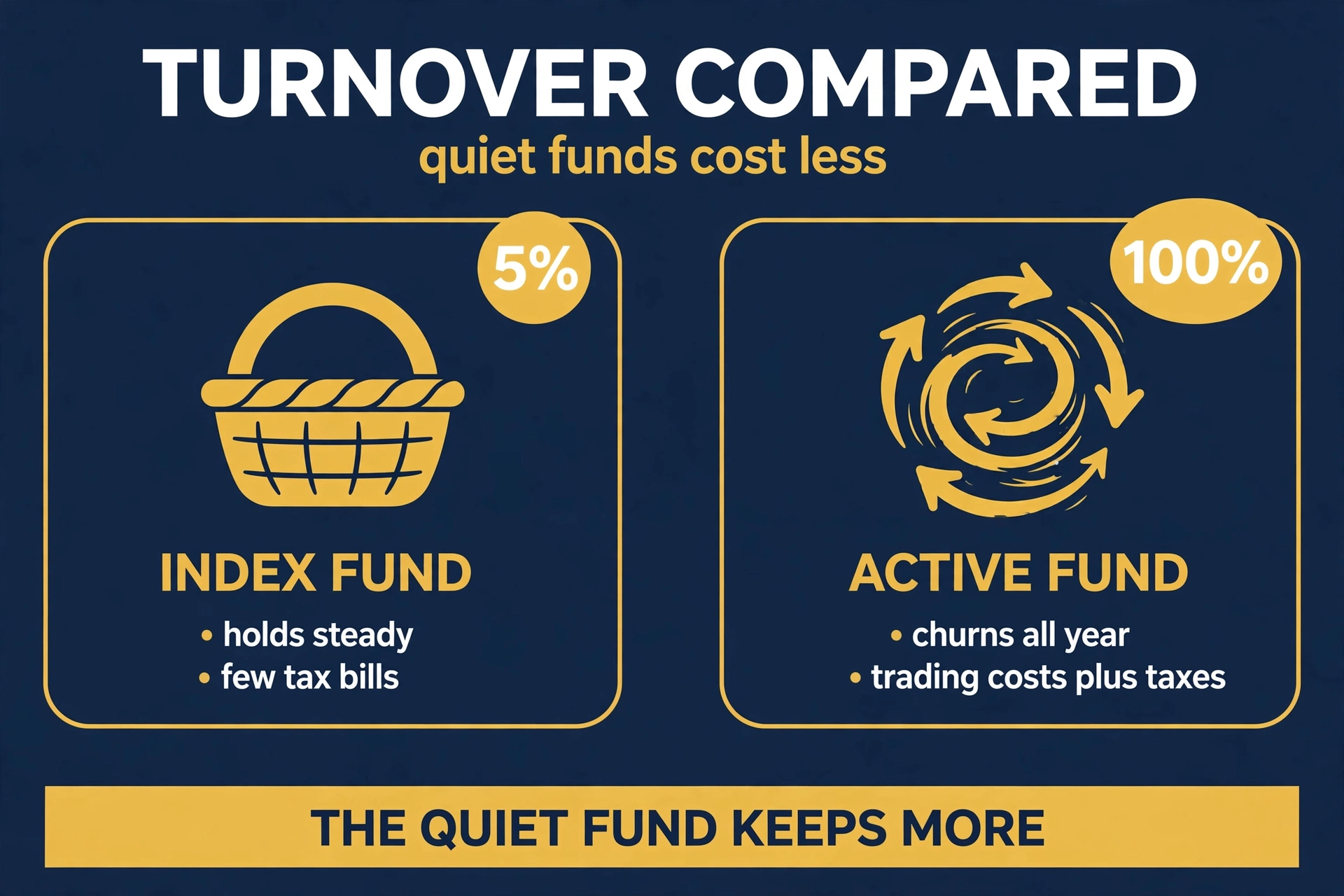
Turnover measures how much of a fund's portfolio the manager replaces each year. A 100% turnover means the fund effectively sold and rebought everything once that year; a 5% turnover means it barely touched anything.
High turnover hurts twice. First, trading costs: every sale and purchase inside the fund pays spreads and commissions, billed to you through the fund's expenses. Second — and bigger — taxes: every profitable sale inside the fund can generate a capital-gains distribution, and as IF-106 taught you, you owe tax on those distributions even if you never sold a share.
Index funds typically run turnover in the single digits — another reason they are so tax-efficient. An active fund with 100%+ turnover in a taxable account is a machine for generating tax bills. When comparing funds, turnover is the number that tells you how quietly or loudly the fund will cost you beyond its expense ratio.
Capital Gains: Short-Term vs. Long-Term
When you sell an investment for more than you paid, the profit is a capital gain — and the tax depends on how long you held it. Hold more than one year and it is a long-term gain, taxed at preferential rates of 0%, 15%, or 20% depending on your taxable income (for 2026, a single filer pays 0% up to about $49,450 of taxable income, 15% up to about $545,500, and 20% above that). Hold one year or less and it is a short-term gain, taxed as ordinary income — the same rates as your paycheck, up to 37%.
The worked example: you make a $10,000 profit. Held 13 months as a single filer in the 15% bracket, you owe $1,500 and keep $8,500. Held 11 months in the 22% ordinary bracket, you owe $2,200 and keep $7,800. Two extra months of patience saved $700 — the government literally pays you to be patient.
Losses have a silver lining: tax-loss harvesting means selling losers to offset winners, and up to $3,000 of net losses a year can offset ordinary income, with the rest carrying forward. Dividends, meanwhile, are taxed in the year you receive them — qualified dividends from most U.S. stocks get the same friendly long-term rates. The one-year line is the most valuable date on an investor's calendar.
After-Tax Return: What You Actually Keep
The only return that matters is the after-tax return — what stays in your pocket after fees and taxes. Two investments with identical headline returns are not identical investments if one is eaten by fees and the other is sheltered.
Compare: Fund A returns 8% with a 1% expense ratio in a taxable account where you realize gains yearly. Fund B returns 8% with a 0.05% ratio inside a retirement account where nothing is taxed until withdrawal. After 30 years on $10,000, the gap between them is not a rounding error — it is tens of thousands of dollars. Same market. Same 8%. Completely different outcomes.
This is also why asset location matters: tax-inefficient investments (bonds, high-turnover funds) belong in tax-sheltered accounts first, while tax-efficient ones (index ETFs you rarely sell) can sit in taxable accounts. School 4 will map the account types; the principle to carry forward is simple — always ask "after fees, after taxes, what do I keep?" before any investment decision.
Key terms
- Expense ratio
- the annual percentage a fund skims from returns; the most predictable drag on wealth.
- Bid-ask spread
- the gap between buying and selling prices; an invisible cost on every trade.
- Commission
- a broker's per-trade fee; mostly zero at major brokers today, but spreads remain.
- Turnover
- how much of a fund's portfolio is replaced each year; high turnover means more costs and tax distributions.
- Capital gain
- profit from selling an investment for more than you paid.
- Long-term capital gain
- profit on an asset held more than one year; taxed at 0%, 15%, or 20%.
- Short-term capital gain
- profit on an asset held one year or less; taxed as ordinary income.
- Tax-loss harvesting
- selling losers to offset taxable gains; up to $3,000 of net losses a year can offset ordinary income.
- After-tax return
- what you actually keep after fees and taxes; the only return that truly matters.
- Asset location
- placing tax-inefficient investments in sheltered accounts and efficient ones in taxable accounts.
What's next
You understand the markets, the vehicles, the risks, the costs, and the taxes. Now it is time to assemble the machine. IF-111 "Build and Maintain a Portfolio" puts it all together: how to start, how to keep contributing, and the simple maintenance rhythm that keeps your plan on track for decades.
The quiz
Fees, Taxes, and Real Returns — Quiz
3 questions · pass with 3 correct
1.What is a fund's expense ratio?
2.What is a capital gain?
3.What makes a capital gain long-term, and how is it taxed?
Recommended Tools
Hand-picked resources that fit this lesson — only ever one or two, and only when they're genuinely useful.
- Learn more
Acorns
Low-cost automated investing that keeps fees from eating your return.
We may earn a commission if you sign up — at no extra cost to you.