
Build and Maintain a Portfolio
School 03 — Investing Foundations
Listen — 15-second overview
A quick spoken preview of this class
School 3 · Investing Foundations · About 15 minutes
Everything in School 3 has been preparation for this: taking the target allocation you designed in IF-109 and turning it into a working portfolio that runs for decades with minimal effort. The good news is that maintaining a portfolio is mostly plumbing — a few setup decisions, one contribution habit, and a short annual checklist. Investors fail at this stage not from complexity but from neglect or meddling. We will now teach you dollar-cost averaging versus lump sums, rebalancing, a contribution policy, and a review rhythm.
Starting: Dollar-Cost Averaging vs. Lump Sum
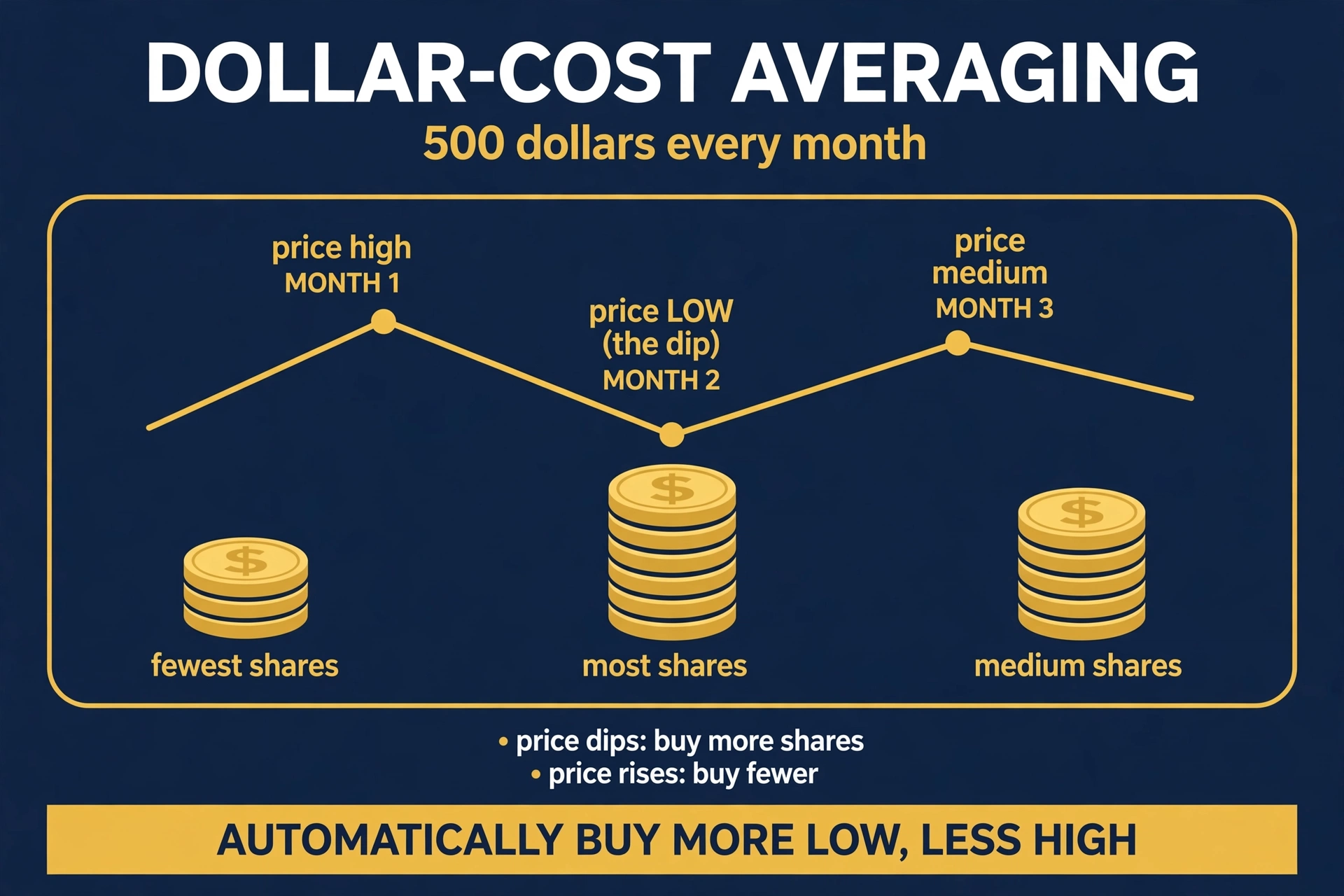
You have money ready to invest. Two ways in. Dollar-cost averaging means investing a fixed amount on a schedule — say $500 on the first of every month. Lump-sum investing means putting it all in at once.
The math favors the lump sum: because markets rise more often than they fall, money invested earlier usually earns more. Studies of this question keep finding the lump sum wins roughly two-thirds of the time. But math is not psychology — if the market drops 20% the month after you invest everything, many beginners panic and sell, turning a paper loss into a permanent one. Dollar-cost averaging buys emotional insurance: when prices fall, your fixed $500 buys more shares; when they rise, it buys fewer. You automatically buy more low and less high, without deciding anything.
The practical answer for most beginners: if the money is a windfall or savings you have been sitting on, consider splitting it — invest a chunk now and schedule the rest over 6 to 12 months. If it is new money from each paycheck, you are dollar-cost averaging already just by contributing regularly. Either way, the worst choice is the money sitting in cash for years waiting for "the right moment."
Rebalancing: Selling High, Buying Low, On Purpose
Over time your allocation drifts. Start at 70% stocks and 30% bonds; after a great year for stocks you might be at 80/20 — riskier than you planned, without ever making a decision. Rebalancing is resetting the mix back to your target: sell some of what grew, buy some of what lagged.
The worked example: your $10,000 portfolio is now $8,000 in stocks and $2,000 in bonds — an 80/20 split against your 70/30 target. Rebalance by selling $1,000 of stocks and buying $1,000 of bonds. You are back at $7,000/$3,000. Notice what just happened: you sold stocks after they rose and bought bonds after they lagged — the "buy low, sell high" everyone talks about, executed mechanically, with no forecasting required.
Rebalance on a schedule, not on feelings: once or twice a year is plenty, or whenever the mix drifts more than about 5 percentage points from target. In taxable accounts, prefer rebalancing with new contributions — aim fresh money at whatever is below target — so you sell less and owe less tax. Many brokerages and funds like M1 Finance can rebalance automatically, which removes the last excuse.
Contribution Policy: The Habit That Matters Most
Here is an uncomfortable truth: for your first decade of investing, how much you contribute matters far more than your returns. $500 a month for ten years at 0% return is $60,000; brilliant stock-picking on $50 a month will never catch up. The contribution habit is the engine; returns are the tailwind.
So make it a policy, not a mood. Pick a percentage of each paycheck — 10%, 15%, 20%, whatever your budget from School 1 allows — and automate it: money moves to investments the day you are paid, before you can spend it. Treat it like a bill that happens to be paid to your future self. When you get a raise, split it: half to lifestyle, half to the contribution rate. Lifestyle inflation is the silent killer of contribution policies.
Name your number and write it next to your target allocation. "15% of every paycheck, 70/30 stocks and bonds, rebalanced every January." That one sentence is a complete investing plan — and it beats the plan of almost everyone who has a more complicated one they do not follow.
Review Rhythm: A Short Annual Checklist
A portfolio needs attention the way a garden does: regular, brief, and scheduled — not constant hovering. Once a year, sit down for thirty minutes and run this checklist:
- Am I still on target? Check the allocation; rebalance if it drifted.
- Did life change? A new job, a baby, a house purchase, or a nearer retirement date can change your risk capacity — update the target allocation if so.
- Are fees still low? Glance at expense ratios; make sure nothing crept up.
- Is the emergency fund intact? Investing assumes the safety net from School 1 is still there.
- Am I contributing enough? Raise the rate if income grew.
That is the whole maintenance manual. Between reviews, the best action is usually no action: ignore the headlines, skip the daily price checks, and let compounding work. The investors who tinker the least tend to keep the most — IF-110 showed you why every trade has a cost. Your job is to fund the machine and check it yearly; the market's job is the rest.
Key terms
- Dollar-cost averaging
- investing a fixed amount on a regular schedule, automatically buying more shares when prices are low.
- Lump-sum investing
- investing the full amount at once; usually wins mathematically, harder emotionally.
- Rebalancing
- resetting the portfolio back to its target allocation by selling what grew and buying what lagged.
- Contribution policy
- a fixed rule for how much of each paycheck goes to investments, automated.
- Target allocation
- your planned mix of asset classes, in percentages (from IF-109).
- Review rhythm
- a short, scheduled annual checklist: allocation, life changes, fees, emergency fund, contribution rate.
What's next
School 3 is complete. You can picture the markets, reach them through accounts and orders, weigh risk against time, and you now know every major asset class — stocks, bonds, funds, ETFs, and crypto — plus how diversification, fees, taxes, and portfolio maintenance fit together. School 4, "Retirement and Long-Term Planning," puts this foundation to work: the account types that shelter your money from taxes, and how to aim it all at the life you want.
The quiz
Build and Maintain a Portfolio — Quiz
3 questions · pass with 3 correct
1.What is dollar-cost averaging?
2.What does rebalancing a portfolio mean?
3.What matters most in your first decade of investing?
Ready to Start
Hand-picked resources that fit this lesson — only ever one or two, and only when they're genuinely useful.
- Learn more
M1 Finance
Open an account and automate contributions to your target portfolio.
- Learn more
Acorns
Start investing automatically with round-ups and recurring contributions.
We may earn a commission if you sign up — at no extra cost to you.