
Credit Without Confusion
School 01 — Money Foundations
Listen — 15-second overview
A quick spoken preview of this class
School 1 · Money Foundations · About 15 minutes
Credit means borrowing money you promise to pay back. You will meet it the moment you sign a credit card agreement, finance a car, or apply for a loan. Credit is a tool that can build your future, or a trap that taxes it — the difference is understanding. This lesson gives you that understanding in plain language, before any lender ever asks for your signature. We will now teach you about credit reports, credit scores, the five FICO factors, credit utilization, credit card interest, and responsible borrowing.
Credit Reports
Your credit report is the history. It is a record of your borrowing life: the accounts you have, the balances on them, and whether you pay on time. Everything lenders know about you as a borrower starts with this record.
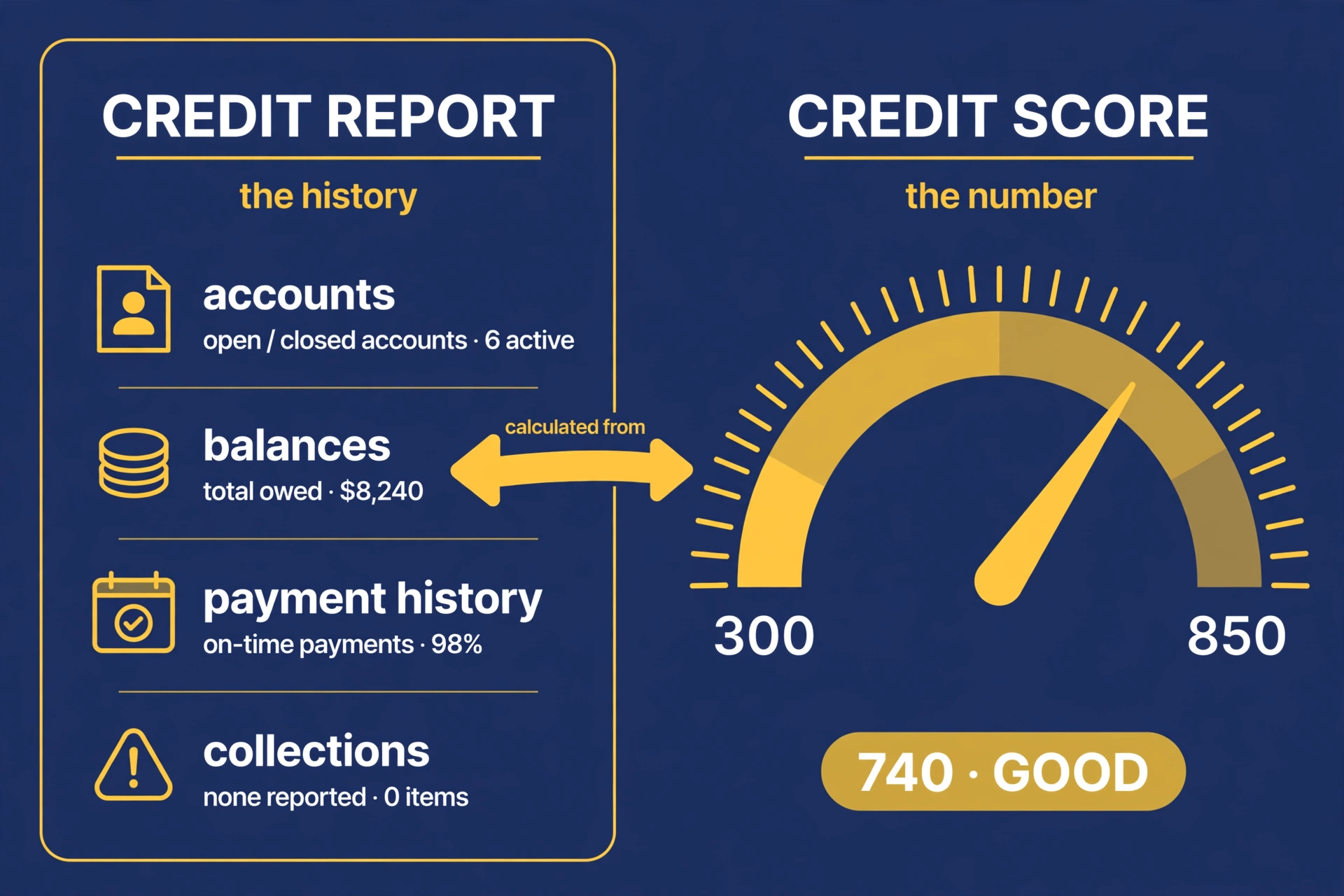
Three companies collect and keep these records. They are called credit bureaus, and their names are Equifax, Experian, and TransUnion. Each one keeps its own file on you, so your three reports can look a little different from each other.
You have the right to check your own reports for free at AnnualCreditReport.com. That is the official source — watch out for copycat sites with similar names that try to charge you. When you check your own credit, it never hurts your score. That is called a soft inquiry. When a lender checks your credit because you applied for a card or loan, that is called a hard inquiry, and it can cause a small, temporary dip in your score.
Credit Scores
Your credit score is the number built from the report. If the report is your report card, the score is your GPA — one simple grade that sums up the whole history. Lenders use it to judge how risky it feels to lend to you.
The most widely used score is the FICO Score, used by the vast majority of top U.S. lenders. FICO scores run from 300 to 850, and higher is always better. Lenders group scores into bands of attitude: Exceptional, Very Good, Good, Fair, and Poor. These are rough labels for how welcome you are as a borrower, not promises — every lender sets its own rules.
The Five FICO Factors
Your score is not random. It comes from five pieces of your report, and the pieces are weighted. That means some pieces count more than others — these weights are what define the score.
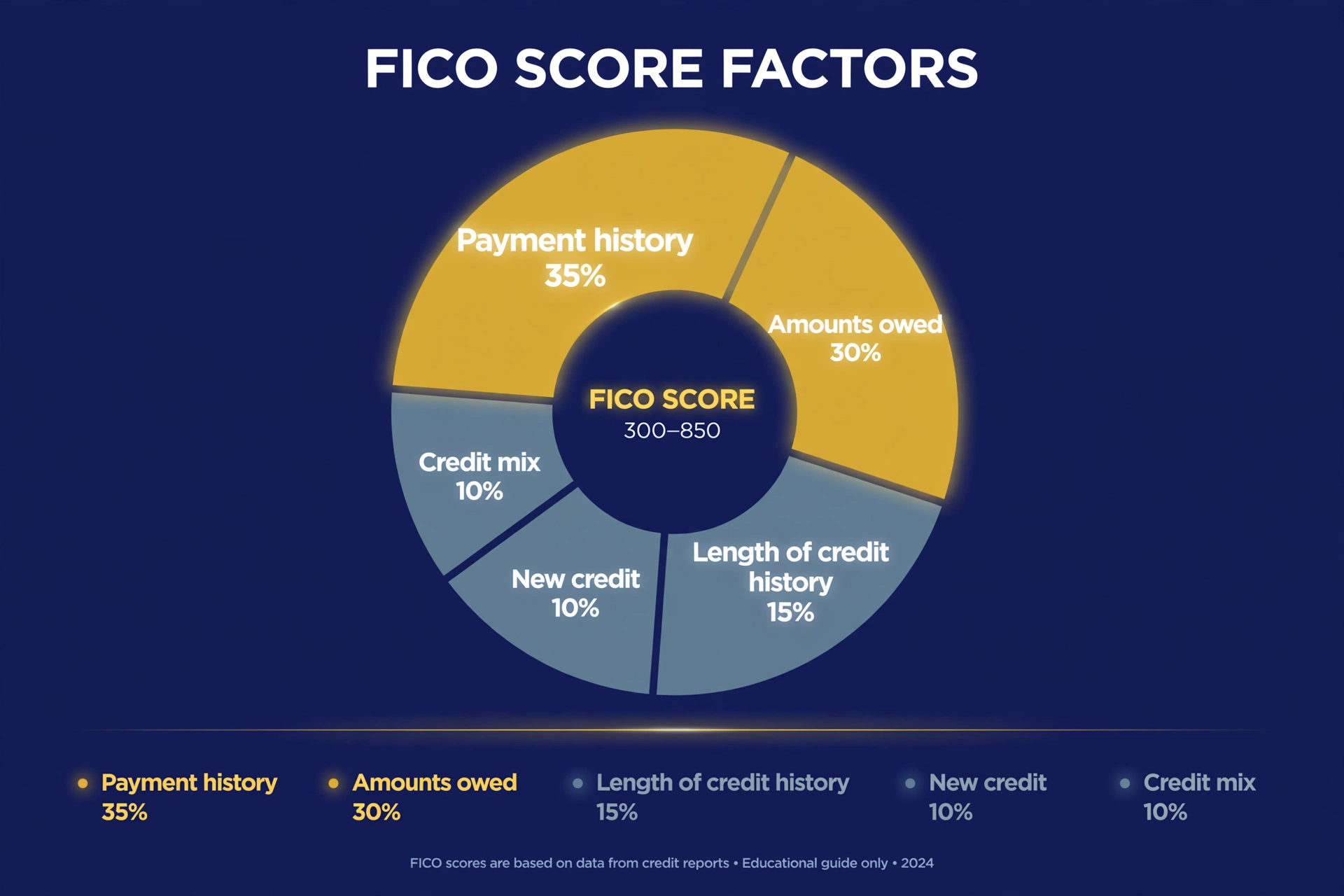
Here are the five factors. Payment history, 35%. Do you pay on time, every time? This is the single biggest piece of your score. Amounts owed, 30%. How much of your available credit you are using. Length of credit history, 15%. How long your accounts have been open — longer is better. New credit, 10%. Recent applications and newly opened accounts. Credit mix, 10%. Handling different types of credit responsibly, like cards plus a loan.
Notice the first two: payment history and amounts owed together make up 65% of the score. For beginners, those two are the whole game. One more habit to build now: if your reports contain errors, you can dispute them with the bureau that shows them. Nobody fixes your report for you — checking it and correcting mistakes is your job.
Credit Utilization
Credit utilization is the share of your available credit that you are currently using. If your total available credit is a whole pie, utilization is how big a slice you have taken.
The widely used guideline is to keep it under 30%, and lower is better. People with the very best scores tend to use only a small fraction of what they could borrow. There is no cliff at any one number — it works on a sliding scale.
Here is the friendly part: utilization has no memory. It is recalculated each month from the balance your lender reports. A month where you used a lot of credit stops hurting you once the next month's lower balance shows up. The simplest ways to keep it low are to pay your card in full each month, avoid spending up to your limits, and never close your oldest card just to simplify things.
Credit Card Interest
Credit card interest is the price of borrowing. The price is quoted as an APR, the annual percentage rate — the yearly cost of carrying a balance. In reality, interest builds up every single day you carry a balance, and each day's interest gets added on and starts earning its own interest. That is why a carried balance grows faster than people expect.
There is one protection: the grace period. When you pay your previous balance in full, the card gives you an interest-free window — at least 21 days — to pay new purchases without any interest. But the moment you carry any balance, that window disappears. Interest starts immediately on new purchases and keeps going until the balance is cleared again. Pay in full and on time, and a credit card costs you nothing in interest. Carry a balance, and it becomes one of the most expensive ways to borrow that exists.
Responsible Borrowing
These are the rules that protect your credit over time. Borrow only what you can repay — a credit card is not extra income, it is a short-term loan you must settle. Pay on time, every time, because payment history is the biggest piece of your score. Pay in full when you can, so you pay no interest and keep your utilization low.
Never borrow money to invest — borrowed money multiplies losses just as fast as gains, and the interest accrues either way. Read the terms before you sign anything: know the rate, the fees, and what happens if you pay late. Apply for credit sparingly, because each application is a hard inquiry. Keep your oldest accounts open, since account age and available credit both help you. And check your reports regularly at AnnualCreditReport.com, disputing anything that is wrong.
One last warning, and it is important: minimum payments are a trap by design. Paying only the minimum on a large balance means most of your payment goes to interest, and the debt can drag on for years. You will learn how to escape that trap in MF-105.
Key terms
- Credit report
- the detailed history of your borrowing: accounts, balances, and payment history.
- Credit score
- a single number built from your credit report, summarizing your borrowing history.
- Credit bureau
- a company that collects credit information: Equifax, Experian, or TransUnion.
- FICO Score
- the most widely used U.S. credit-scoring model, range 300–850.
- Utilization ratio
- the share of your available credit that you are currently using.
- APR
- annual percentage rate; the yearly cost of borrowing.
- Grace period
- the interest-free window, at least 21 days, you get when you paid the previous balance in full.
- Soft inquiry
- checking your own credit; it never hurts your score.
- Hard inquiry
- a lender checking your credit because you applied; causes a small, temporary dip.
- Secured card
- a credit card backed by a cash deposit you provide, often used to build credit.
What's next
You now know how credit is measured and priced — the report, the score, and what borrowing actually costs. Next, MF-105 "Debt Exit Strategies" turns that knowledge into a plan for getting out of debt for good.
---
The quiz
Credit Without Confusion — Quiz
4 questions · pass with 4 correct
1.What is the difference between a credit report and a credit score?
2.Which two factors make up 65% of your FICO Score, and what are their weights?
3.What is the credit utilization ratio, and what is the widely used guideline for it?
4.What is the grace period on a credit card?
Recommended Tools
Hand-picked resources that fit this lesson — only ever one or two, and only when they're genuinely useful.
- Learn more
Credit Karma
Check your credit scores and reports for free, anytime.
- Learn more
Experian
See your FICO score and get alerts when it changes.
We may earn a commission if you sign up — at no extra cost to you.