
Debt Exit Strategies
School 01 — Money Foundations
Listen — 15-second overview
A quick spoken preview of this class
School 1 · Money Foundations · About 15 minutes
Getting out of debt means owing less and less each month until you owe nothing at all. That sounds simple, but debt grows on its own through interest, so willpower alone is not enough. A system beats willpower because it attacks your debts in the right order every single month, automatically. With a plan, every payment you make hits the debt that matters most. We will now teach you about the debt inventory, the avalanche method, the snowball method, how the two compare, refinancing, low-interest debt versus investing, and staying out of debt.
The Debt Inventory
A debt inventory is the full list of every debt you owe, all in one place. For each debt you write down the balance (what you owe right now), the rate (the APR you are paying), the minimum payment (what you must pay each month), and the type (revolving like a credit card, or installment like a loan).
This list is the foundation of everything else in this lesson. You cannot plan an escape from debts you have not written down. No payoff plan survives a forgotten debt, so take the time to list them all — every card, every loan, every balance.
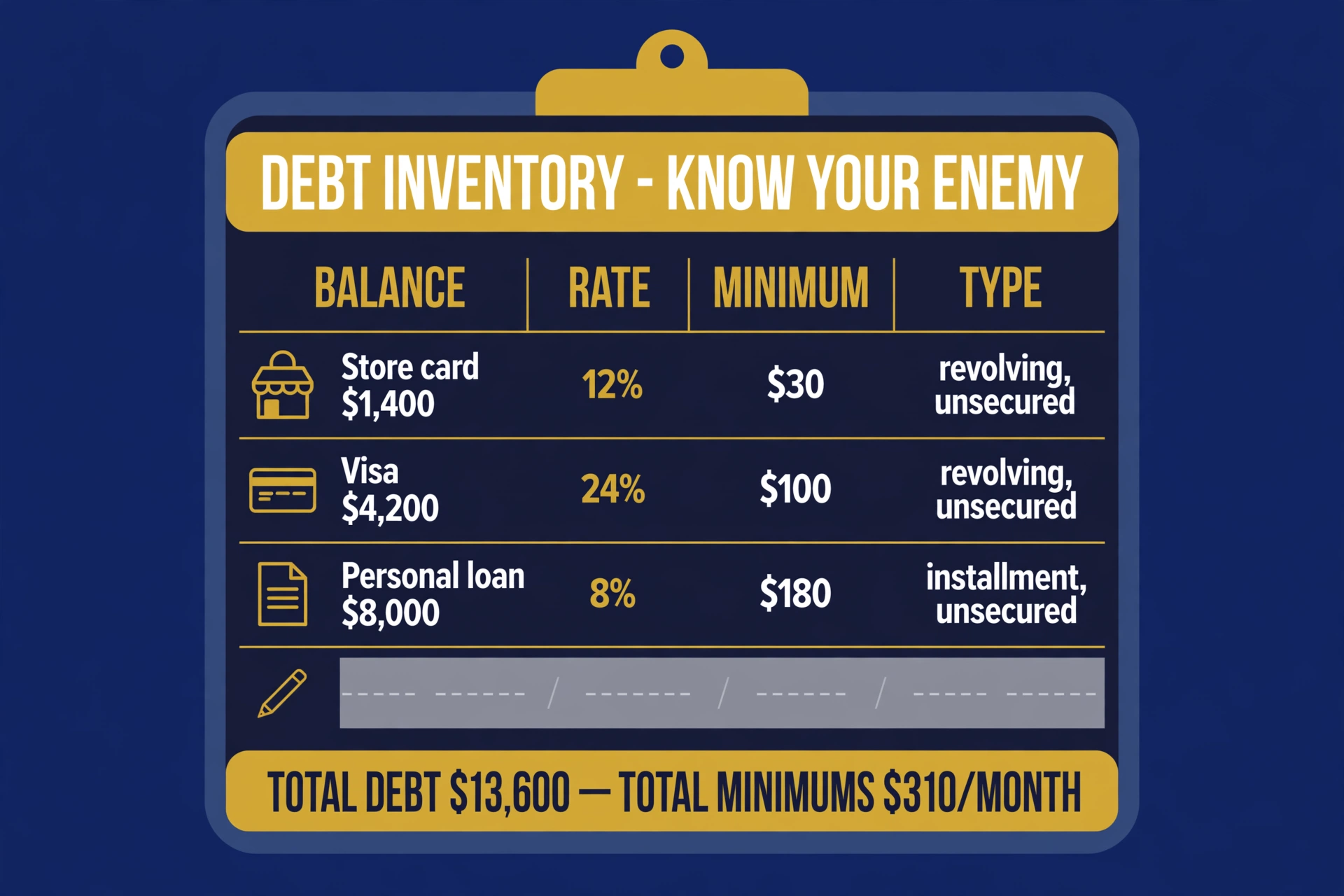
Once the list is complete, you finally know exactly where you stand. That is the moment a vague money worry turns into a concrete problem with a beginning, a middle, and an end.
The Avalanche Method
The avalanche method aims all your extra money at the debt with the highest interest rate first. You keep paying the minimums on every other debt so nothing falls behind, and every extra dollar goes to the one expensive target.
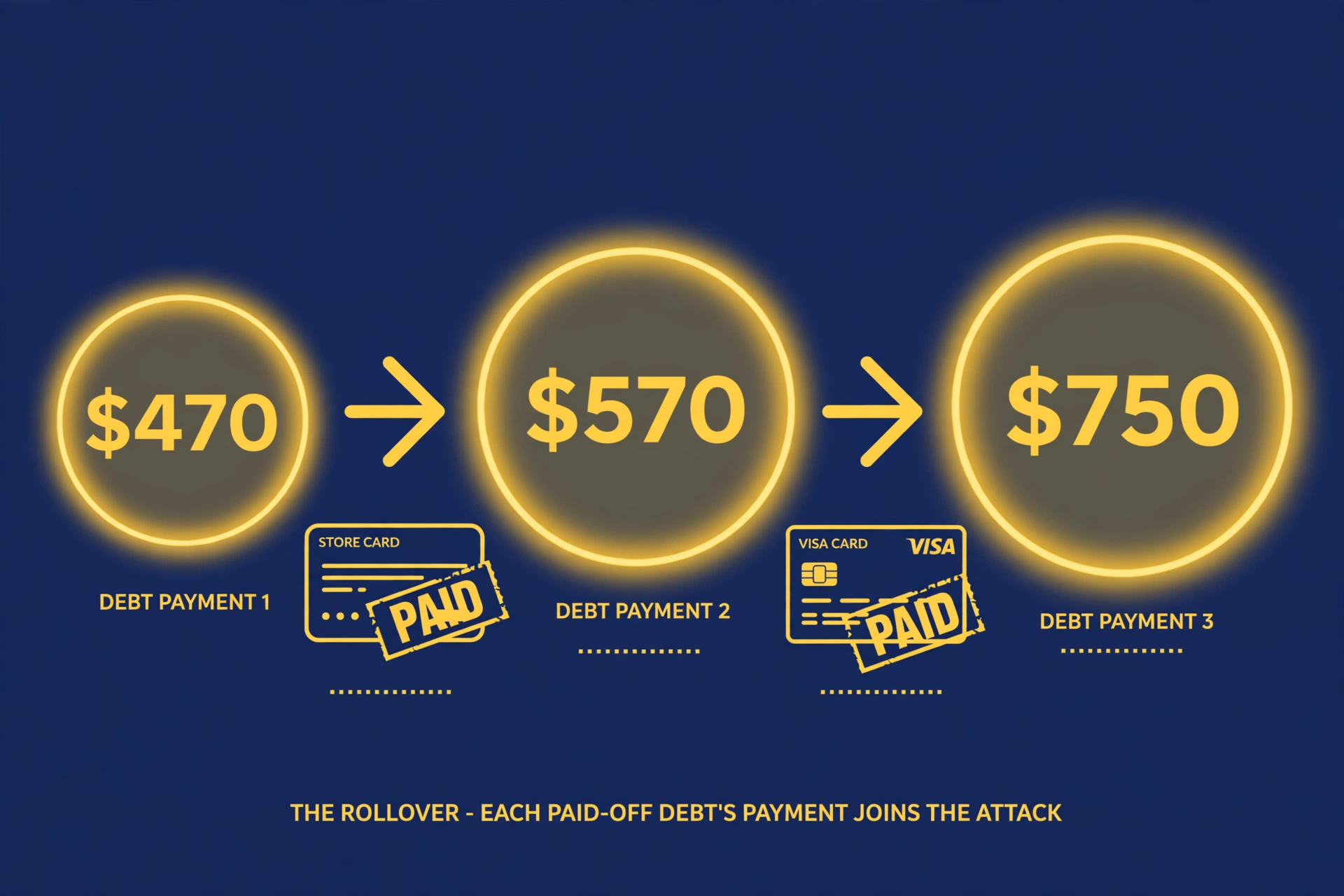
When that highest-rate debt is gone, you take its whole payment — the minimum plus all the extra — and roll it into attacking the next-highest-rate debt. The payment you throw at the target grows bigger with every kill, like an avalanche gathering size as it rolls down the hill.
The avalanche costs the least in total interest. That is because the highest-rate debt is the fastest-growing balance, so killing it first stops the most expensive growth. It is the method that wins on the math.
The Snowball Method
The snowball method aims all your extra money at the debt with the smallest balance first, no matter what the rates are. Just like the avalanche, you pay the minimums on everything else and throw every extra dollar at one target debt.
The difference is that you kill a debt completely much sooner. Each paid-off debt is a visible win, and debt payoff is a long grind where most people quit the plan, not the math. Those early wins keep you in the fight.
The snowball trades a little extra interest for momentum. If quick victories are what will keep you going month after month, this is the method built for you.
Avalanche vs. Snowball
The avalanche saves more interest, because it always attacks the fastest-growing balance first. The snowball gives you faster first wins, because the smallest balance dies soonest. Both are real advantages, and they point in different directions.
Here is the thing that matters most: either method beats paying only the minimums for years. Minimum-only payments stretch your debt out for ages while interest keeps piling up. Picking the method you will actually finish is more important than picking the method that saves a few extra dollars on paper.
So choose honestly. If you are disciplined and motivated by efficiency, the avalanche is your plan. If you need proof that the plan is working to stay with it, take the snowball. The best method is the one you stick with until the last debt is gone.
Refinancing
Refinancing means replacing a debt with a new loan on better terms. It is not a payoff method on its own — it is a way to make the debt you are already attacking cheaper to kill.
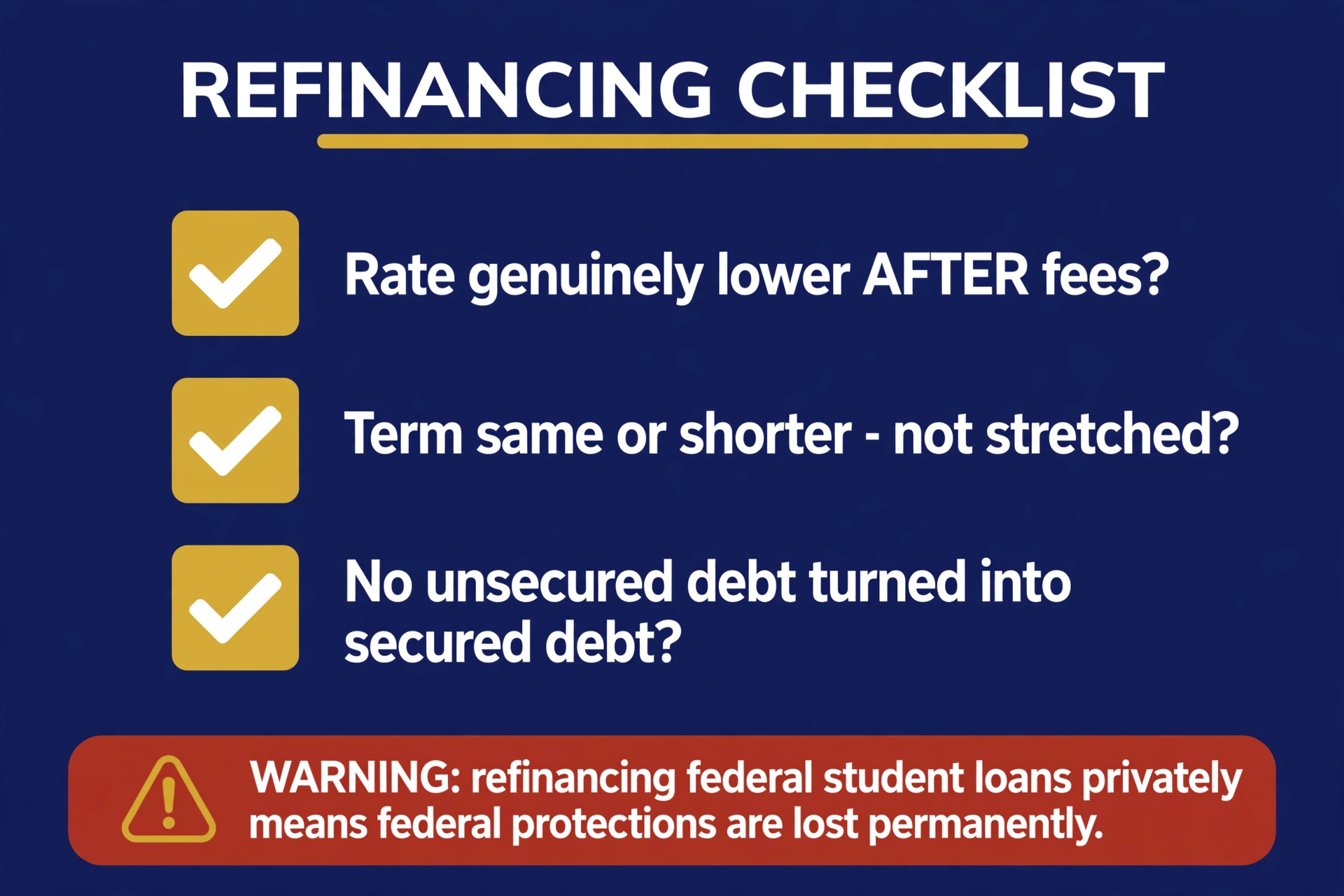
It only makes sense when three things are true. First, the new rate is genuinely lower after you count all the fees — origination fees and closing costs can wipe out a small rate improvement. Second, you do not stretch the term just to shrink the monthly payment, because a lower payment over more years can cost more in total. Third, you do not turn unsecured debt into secured debt — rolling credit-card balances into a loan backed by your home puts your house behind debt that was never attached to it.
One serious warning: refinancing federal student loans into a private loan gives up federal protections permanently — income-driven repayment plans, deferment options, and forgiveness programs are gone for good. That trade only goes one way, so be certain before you make it.
And the cardinal rule: refinancing only helps if you stop adding new debt. A balance transfer to a low-rate card that you then refill is not a strategy. It is the same problem wearing a cheaper costume.
Low-Interest Debt vs. Investing
Sooner or later you will face this question: should I pay off a low-rate loan fast, or invest the extra money instead? This course cannot answer that for you — it is an educational framework, not advice about your money. But here is how educated people think about it.
Paying off a debt is a guaranteed return equal to its rate. Kill a loan charging you a certain rate and you have locked in that return with zero uncertainty. Investing, on the other hand, is uncertain — markets rise and fall, and any return you hope for is not a return you get.
The higher the debt's rate, the stronger the case for paying it off. The lower the rate, the weaker that case gets. There is no magic cutoff, only your own judgment about risk. And two things that never show up in a spreadsheet still count: the peace of mind of owing nothing, and the lower mandatory monthly bills a paid-off debt gives you forever.
One firm boundary: never invest your safety net. Your emergency money comes before either choice, because selling investments in a crisis to cover an emergency is how small setbacks become big ones.
Staying Out of Debt
Getting out of debt is only half the job. Staying out is the other half, and it starts with stopping all new borrowing while you execute the plan.
Build a small emergency buffer as soon as you can. Even a modest cash cushion in a separate savings account keeps a car repair or a medical bill from becoming new credit-card debt. Surprises will happen — the buffer keeps them from restarting the cycle.
Automate everything. Automatic payments for every minimum, plus the extra going to your target debt each month, turns the plan into a machine that runs without willpower. Celebrate each debt you pay off — every kill is a permanent raise in your monthly cash flow. And when the last debt dies, redirect those freed-up payments toward savings and investing, not a bigger lifestyle. You already proved you can live without that money; now make it work for you.
Key terms
- Debt inventory
- the complete list of every debt you owe, with balance, rate, minimum payment, and type for each.
- Avalanche method
- pay minimums on all debts and aim all extra money at the highest-rate debt first; costs the least in interest.
- Snowball method
- pay minimums on all debts and aim all extra money at the smallest balance first; fastest early wins.
- Rollover
- taking a paid-off debt's whole payment and adding it to the attack on the next target debt.
- Refinancing
- replacing a debt with a new loan on better terms.
- Secured debt
- debt backed by collateral, like a house or a car.
- Unsecured debt
- debt with no collateral behind it, like most credit cards.
- Minimum payment
- the amount you must pay each month to keep a debt current.
What's next
Your debts are handled. Now the question is: where does your money live? MF-106 "Banking and Cash Management" shows you how to choose and use bank accounts so your money is organized and ready to grow.
---
The quiz
Debt Exit Strategies — Quiz
4 questions · pass with 4 correct
1.Which debt does the avalanche method target first?
2.Which debt does the snowball method target first?
3.Why might someone choose the snowball method even though the avalanche costs less in interest?
4.When does refinancing make sense?
Recommended Tools
Hand-picked resources that fit this lesson — only ever one or two, and only when they're genuinely useful.
- Learn more
LendingTree
Compare refinancing and consolidation loan options side by side.
- Learn more
Credit Karma
Watch your score climb as you work your debt-exit plan.
We may earn a commission if you sign up — at no extra cost to you.