
Banking and Cash Management
School 01 — Money Foundations
Listen — 15-second overview
A quick spoken preview of this class
School 1 · Money Foundations · About 15 minutes
Banking is where your money lives: accounts at a bank or credit union that hold your cash safely and move it where it needs to go. Cash management is the system for organizing that money — the right amount in the right account at the right time, so bills get paid, savings grow, and nothing leaks to fees or impulse spending. We use them because money without a system quietly disappears, while money with a labeled job survives everyday life. We will now teach you about checking accounts, savings accounts, money market accounts, certificates of deposit, liquidity, deposit insurance, and your cash map.
Checking Accounts
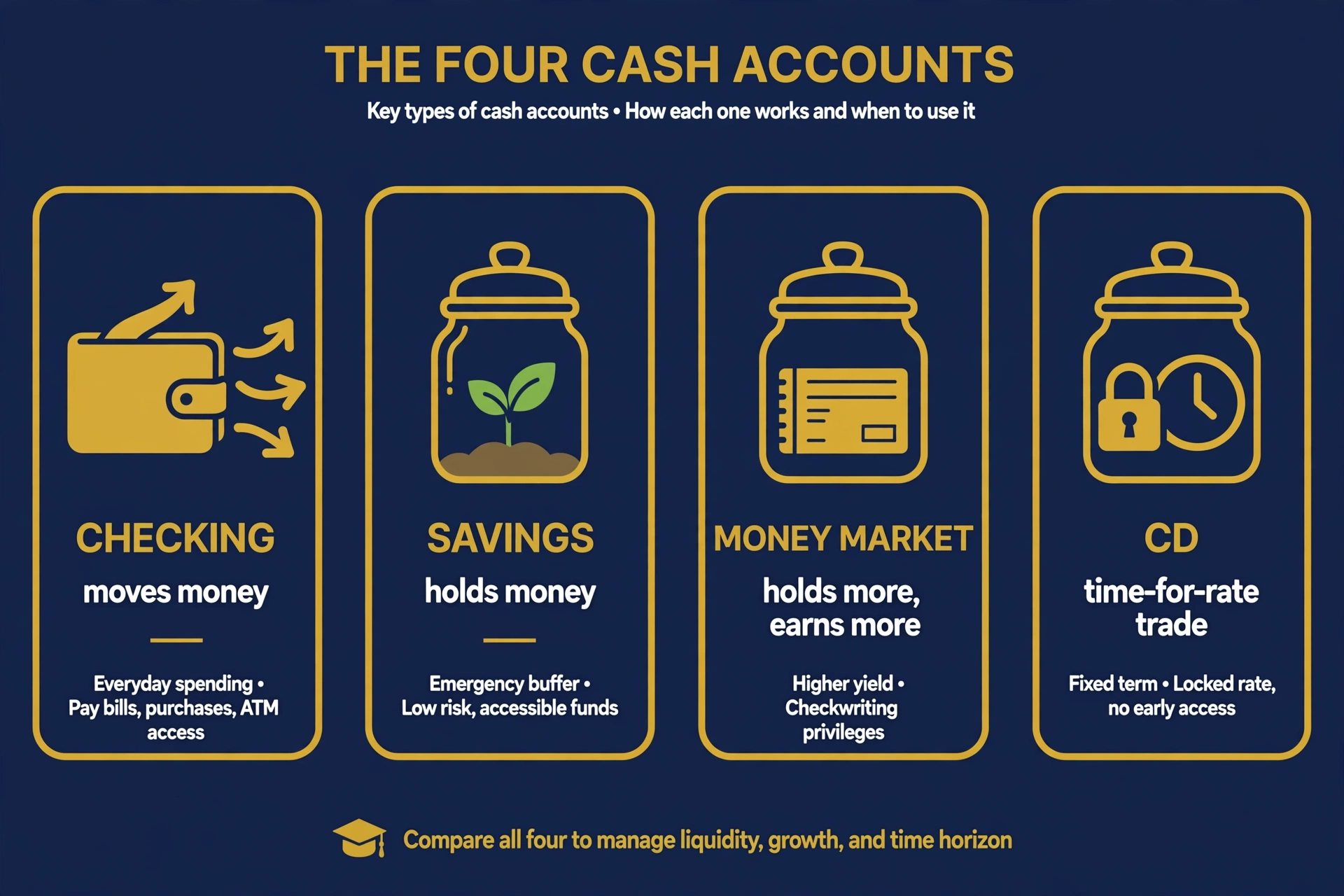
Checking is the money-movement account. Paychecks come in, and bills and daily spending go out. It is built for money to flow through it, not sit in it.
Checking usually earns little or no interest. That is fine — you do not judge a front door by how much it grows.
One thing to watch: overdrafts. If you spend more than the account holds, the bank may charge you a fee. Tracking your balance keeps this from happening.
Savings Accounts
Savings is the holding account. Money sits still here for the future — money you do not plan to touch week to week.
Your emergency fund lives in a savings account. So do short-term goals like a trip or a new set of tires.
Savings earns modest interest. The bank pays you a little for letting it hold your money.
Money Market Accounts
A money market account sits between savings and checking. It usually earns higher interest than regular savings, but it often requires a higher minimum balance. Many money market accounts also give you some check access, like a checking account would.
Read this warning carefully: a money market ACCOUNT at a bank is FDIC-insured, but a money market FUND is an investment and is NOT insured. The names sound almost identical, and the insurance is completely different.
Certificates of Deposit
A certificate of deposit, or CD, is a time deposit. You agree to leave your money in the account for a set term, and in exchange you get a fixed interest rate that is typically higher than regular savings.
Take the money out early and you will pay a penalty, often in lost interest. That penalty is what makes a CD a commitment.
A CD ladder means opening several CDs with different maturity dates — say one year, two years, and three years — so your money frees up on a schedule instead of all at once.
Liquidity
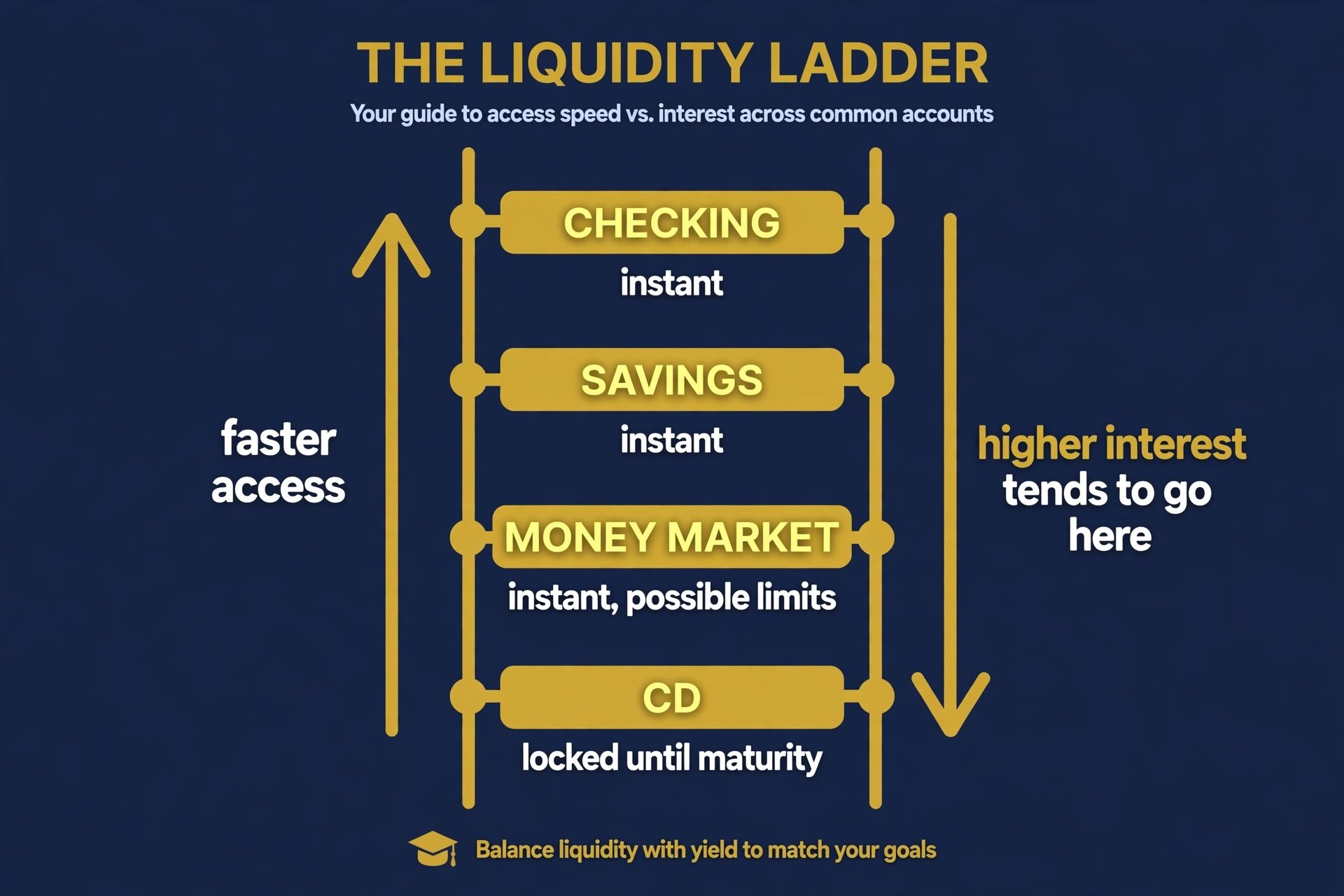
Liquidity is how fast you can turn an account into spendable cash without penalty or loss. Checking is the most liquid — the money is ready the moment you need it. CDs are the least liquid — the money is locked up until the term ends.
The trade is simple: more access usually means less interest. You are paid for giving up access, which is why cash you might need Thursday stays in savings while cash you will not need until next year can sit in a CD.
Deposit Insurance
Deposit insurance is the safety net under your cash. Banks almost never fail, and when one does, your deposits are protected.
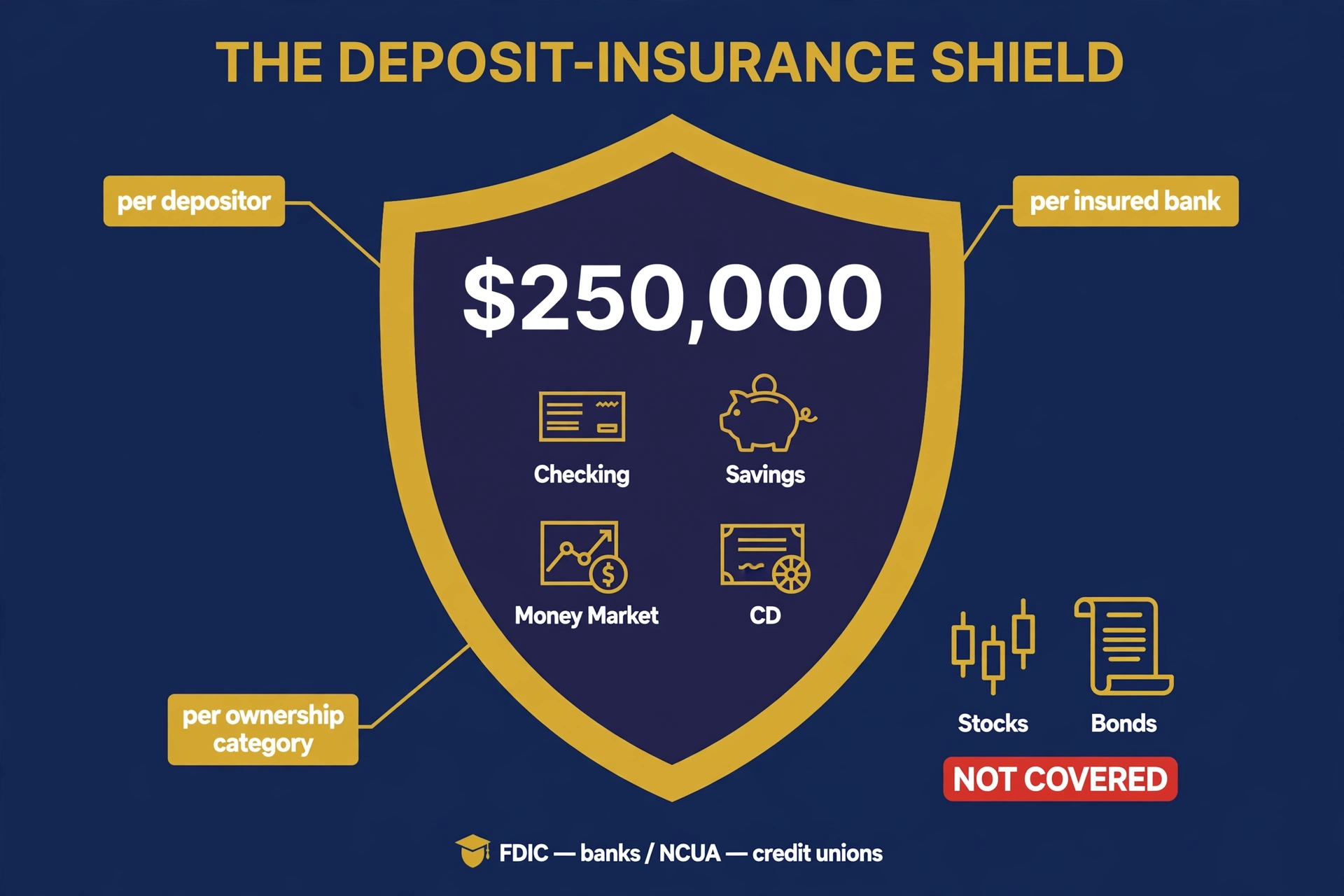
There are two kinds of institutions. Banks are for-profit businesses, and their deposits are insured by the FDIC — the Federal Deposit Insurance Corporation. Credit unions are member-owned nonprofits, and their deposits are insured by the NCUA — the National Credit Union Administration.
The coverage is $250,000 per depositor, per insured bank, per ownership category. It is automatic and free — you do not apply and you do not pay for it.
It covers deposits: checking accounts, savings accounts, and CDs. It does not cover investments: stocks, bonds, mutual funds, or crypto.
For most people, balances sit far below the limit. The whole rule is simple: keep your cash at an insured institution, and it is covered.
Your Cash Map
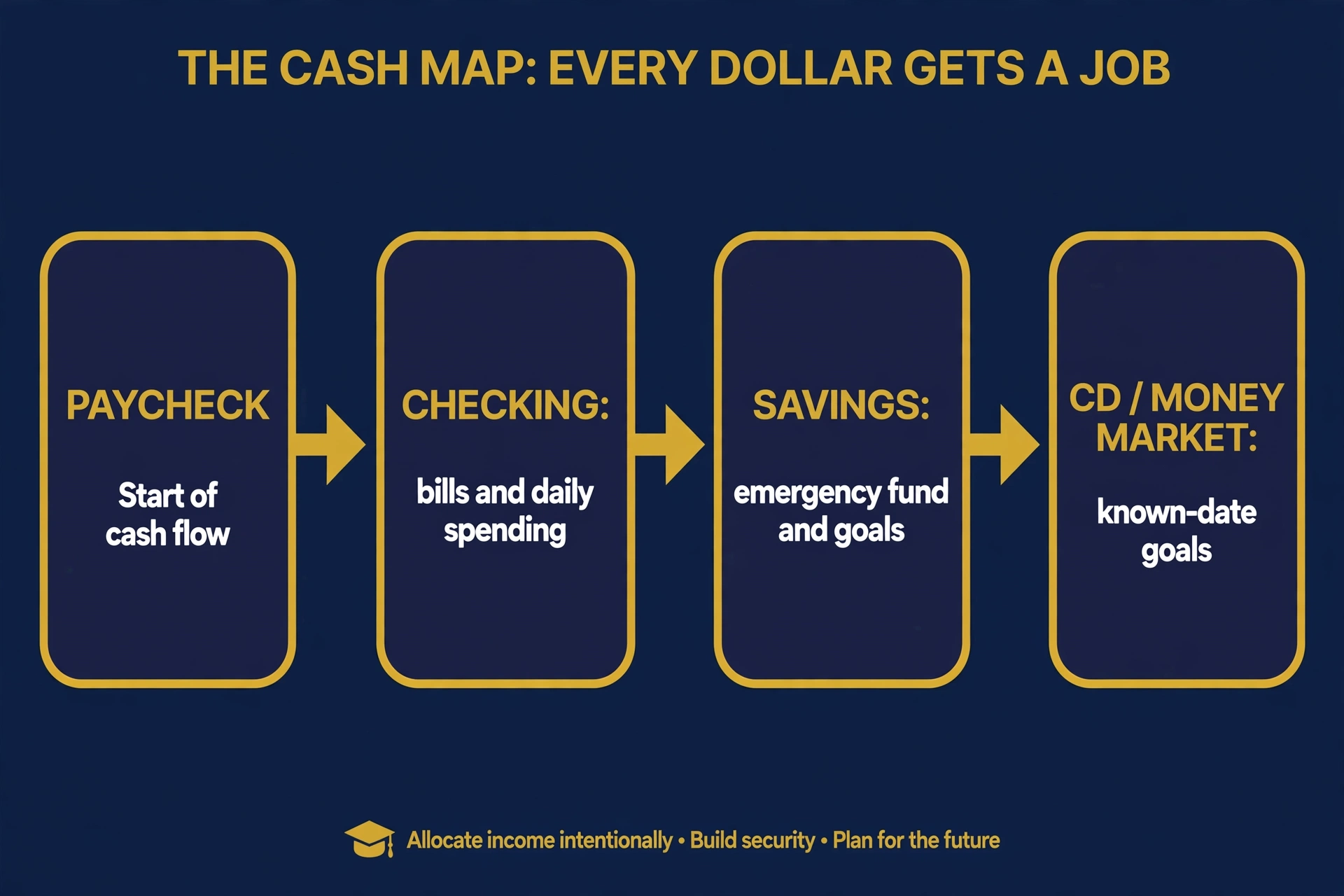
Your cash map is the whole system as one flow. Your paycheck lands in checking. Bills and daily spending flow out of checking. What is left over moves to savings — the emergency fund first, then your goals.
Money with a fixed date on it goes to a CD or a money market account. A down payment due in eighteen months does not belong in checking.
Every dollar has a job and a container. That is the system, and that is what keeps money from leaking.
Key terms
- Checking account
- the money-movement account; paychecks come in, bills and daily spending go out.
- Savings account
- the holding account where money sits still for the future; earns modest interest.
- Money market account
- a bank deposit account between savings and checking, usually with higher interest and a higher minimum balance; insured, unlike a money market fund.
- Certificate of deposit
- a time deposit: money left for a set term in exchange for a fixed, typically higher rate; early withdrawal costs a penalty.
- Liquidity
- how fast you can turn an account into spendable cash without penalty or loss.
- FDIC
- Federal Deposit Insurance Corporation; insures deposits at member banks.
- NCUA
- National Credit Union Administration; insures deposits at federally insured credit unions.
- Deposit insurance
- the automatic, free safety net protecting deposits up to $250,000 per depositor, per insured bank, per ownership category.
- Ownership category
- how accounts are grouped for insurance purposes (single, joint, retirement, trust, and others); the limit applies separately to each category.
- Overdraft
- spending more than an account holds, which can trigger a fee.
- CD ladder
- several CDs opened with different maturity dates so money frees up on a schedule instead of all at once.
What's next
Your cash is managed. Next up is MF-107 "Major Purchases" — pricing the biggest buys of your life.
---
The quiz
Banking and Cash Management — Quiz
4 questions · pass with 4 correct
1.What is a checking account designed for?
2.Rank these accounts from MOST liquid to LEAST liquid:
3.What is the FDIC deposit-insurance limit?
4.What is the difference between a money market account and a money market fund?
Ready to Start
Hand-picked resources that fit this lesson — only ever one or two, and only when they're genuinely useful.
- Learn more
SoFi
Checking and savings in one app, with early direct deposit.
- Learn more
Bankrate
Compare checking and savings accounts before you move your money.
We may earn a commission if you sign up — at no extra cost to you.