
Major Purchases
School 01 — Money Foundations
Listen — 15-second overview
A quick spoken preview of this class
School 1 · Money Foundations · About 15 minutes
Big purchases — a car, a home, anything costing thousands — deserve a different approach than everyday spending, because the true cost is always bigger than the price tag and a bad decision follows you for years. Handling them well means seeing the full cost before you buy, understanding how loans change the bill, reading the paperwork instead of skimming it, comparing your options honestly, and running every big decision through a checklist. In this class you'll learn tips on handling and taking on major purchases: total cost of ownership, car loans, reading loan disclosures, renting versus buying, and the major-purchase checklist.
Total Cost of Ownership
Total cost of ownership is everything you will pay to own and use something, start to finish. Not just what you pay on the day you buy it. Everything after that counts too: every loan payment, every insurance bill, every repair, every tank of gas, for as long as you own it.
For a car, the full cost falls into five buckets. The purchase price — that is the vehicle's price minus your down payment and any trade-in, because that is what you actually finance. The interest — what the lender charges you for borrowing. The insurance — required as long as you finance, and it never goes away while you own the car. Maintenance and repairs — oil, tires, brakes, and the surprise breakdowns. And fuel — what it costs to keep the car moving.
Miss any bucket and you have priced the purchase wrong. Count all five and you are finally looking at the real number instead of the price tag.
Car Loans: Rate and Term
A car loan has two dials, and together they decide how much borrowing really costs you. The first dial is the rate — the price of borrowing, the percentage the lender charges you for using their money. The second dial is the term — how many months you take to pay the loan back.
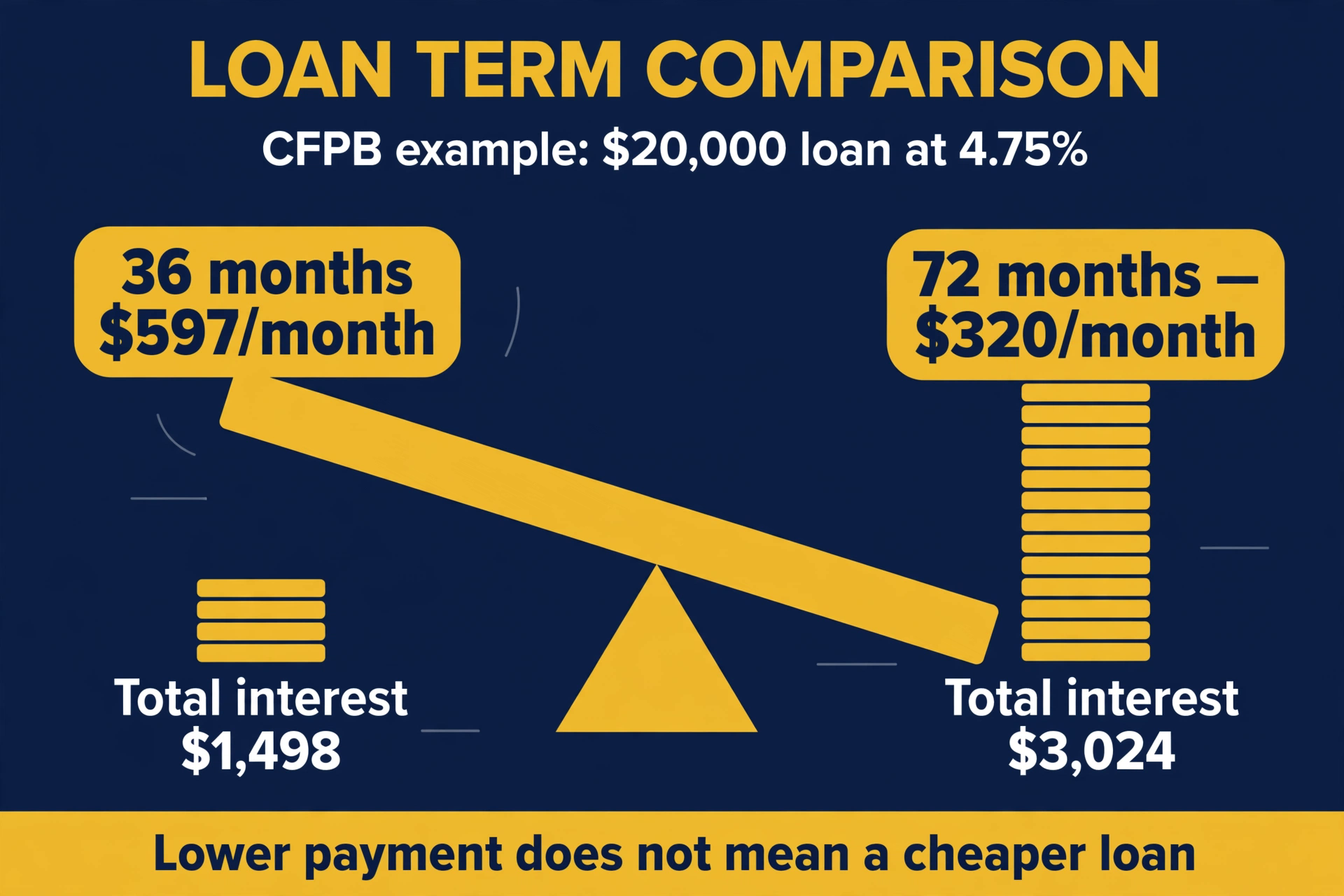
Here is the trade between them. A longer term means a smaller monthly payment, but you pay interest for many more months, so the total interest grows much larger. A shorter term means a bigger monthly payment, but the loan ends sooner and the total interest stays much smaller. Time costs money when you borrow.
That is why monthly-payment shopping hides the real decision. Two offers can feel the same at the register — the same monthly payment — while one costs you far more in total interest over the life of the loan. Always judge a loan by what the whole thing costs, not by what it costs each month.
Reading Loan Disclosures
Federal law requires lenders to show you five key boxes before you sign a loan. They exist so no dealer or lender can rush you past the real numbers. Learn what each one means now, and you will know exactly what to look for on any loan paperwork.
The APR — annual percentage rate — is the yearly cost of borrowing, stated as a percentage. It is your interest rate plus fees rolled in, so it shows the all-in price of the loan for one year. The finance charges are the total interest and fees you will pay over the entire life of the loan if you make every payment on time. The amount financed is what you are actually borrowing — the part left over after your down payment and trade-in.
The total of payments is every payment added up from start to finish — the number the monthly payment hides. The total sale price is the full cost of the purchase on credit, including your down payment — the complete bill for buying the thing with borrowed money.
If you cannot find one of these boxes, or cannot understand what one means, ask questions until you do. And if you are not comfortable, walk away. Nobody can pressure you into a loan.
Renting vs. Buying
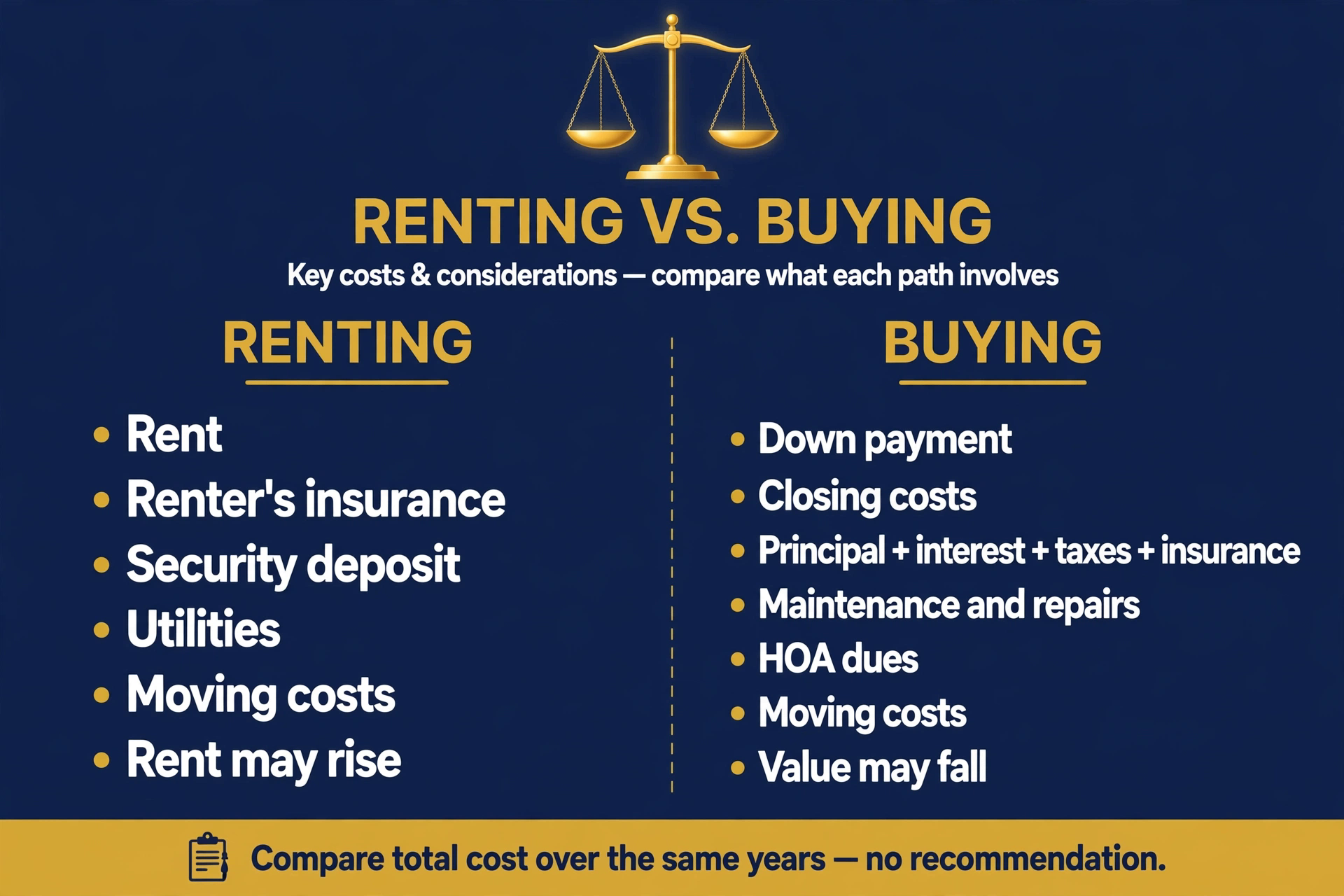
This is the biggest money question most people ever face, and the Academy recommends neither side. Renting is not throwing money away. Buying is not always building wealth. Both are bundles of costs, and the honest move is to lay the full bundle on each side and compare them over the same years.
Renting's bundle includes the monthly rent, renter's insurance for your belongings, the security deposit (refundable, but cash you cannot use while it sits there), the utilities you pay, moving costs, and the risk that rent rises next year.
Buying's bundle includes the down payment, the closing costs paid at purchase, and the monthly mortgage payment — which is really four things: principal (paying down the loan itself), interest, property taxes, and homeowner's insurance, often collected together through an escrow account. Then add maintenance and repairs, which are now yours to pay, HOA dues if the home has them, moving costs, and the risk that the home's value falls or that you need to move before the up-front costs have paid for themselves.
The comparison that matters is total cost over the same years, with the same assumptions, using the total-cost-of-ownership method from this lesson. Buying concentrates costs up front and ties you to one place; renting spreads costs monthly and keeps you mobile. For a decision this large, talk to a licensed professional before you decide.
The Major-Purchase Checklist
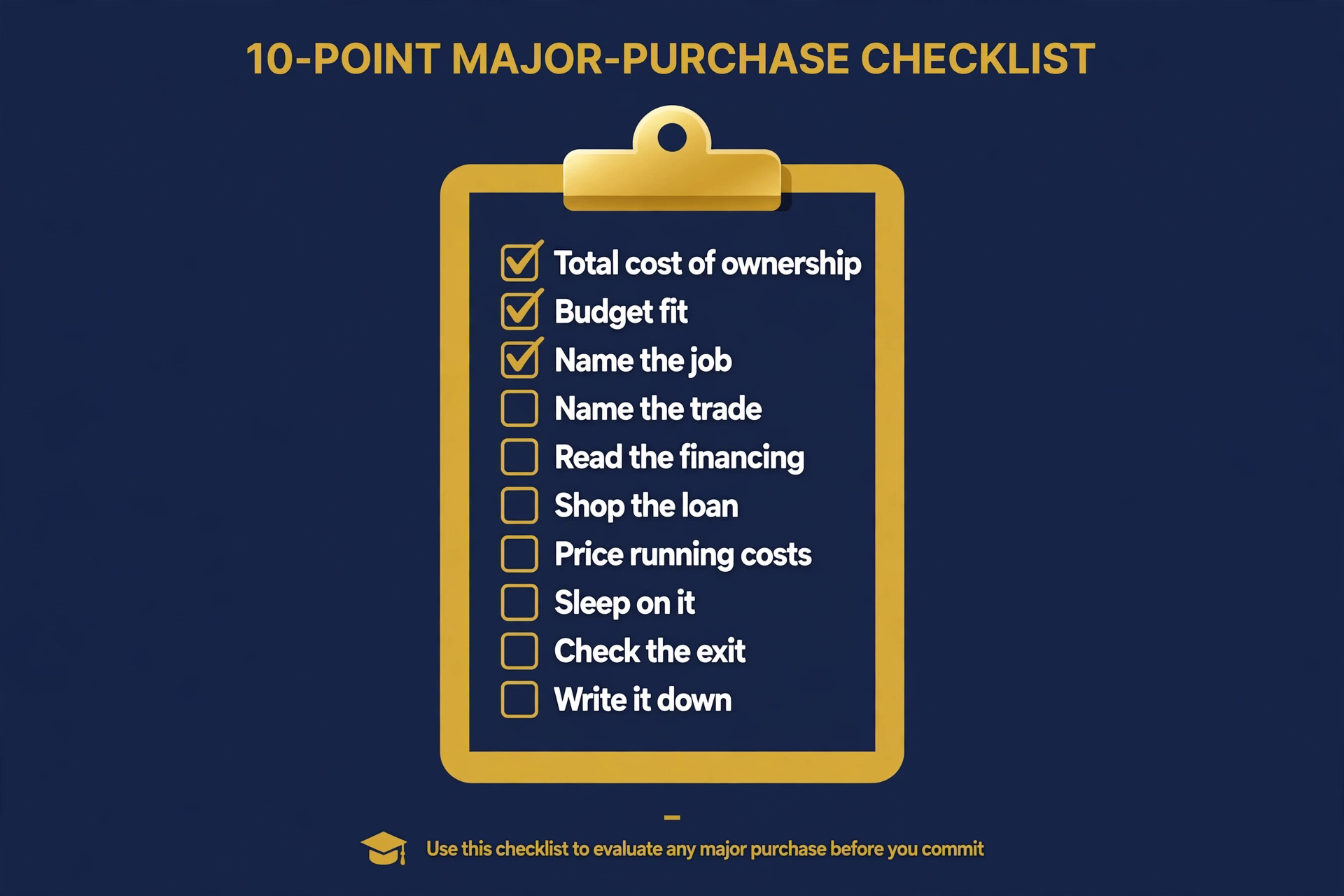
Run every big purchase through this checklist — car, house, anything over a few thousand dollars. It catches the mistakes that excitement and sales pressure try to hide.
First, write the total cost of ownership, not the price tag — all five buckets. Second, check the budget first: does the monthly cost fit after bills, savings, and the emergency fund are covered? Third, name the job: what does this purchase actually do for you — a need, a want, or status? Write it in one sentence.
Fourth, name the trade: what will you not do with this money? Every dollar spent is a dollar not saved or invested. Fifth, read the financing: check the APR, the total of payments, and the finance charges — and ask whether you can pay it off early without a penalty. Sixth, shop the loan separately: compare rates and terms across multiple lenders, because the seller's financing is one offer, not the only offer.
Seventh, price the running costs before you sign — insurance, maintenance, fuel or utilities. Call for a real quote instead of guessing. Eighth, sleep on it: big purchases deserve a few days of distance, because urgency is a sales tool. Ninth, check the exit: how hard is it to undo? A car you owe more than it is worth, a house in a down market — exits have costs too. Tenth, write your reason down, then re-read it in a week. If it still makes sense, proceed.
Key terms
- Total cost of ownership
- everything you will pay to own and use something, start to finish: purchase price, interest, insurance, maintenance, fuel, and more.
- Down payment
- cash paid up front that reduces the amount you borrow.
- Amount financed
- what you are actually borrowing after down payment and trade-in.
- Interest rate
- the percentage charged for borrowing, before fees.
- APR
- the yearly cost of borrowing as a percentage: interest rate plus fees.
- Finance charges
- the total interest and fees paid over the life of a loan.
- Total of payments
- every loan payment added up from start to finish.
- Loan term
- how many months you take to repay a loan.
- Principal
- the amount borrowed, or the part of a mortgage payment that pays down the loan balance.
- Escrow
- an account, often managed by the lender, that holds funds for property taxes and insurance as part of the monthly mortgage payment.
- Closing costs
- fees paid when a home purchase is finalized.
- Equity
- what you own outright: an asset's value minus what you still owe on it.
What's next
School 1 — Money Foundations — is behind you. You know your numbers, you can run a budget, you can handle debt, you can protect what you save, and now you can price a major purchase before it prices you. That closes the foundations arc. Ahead lies School 2 — Earn More, where the other half of the equation gets built: skills, careers, and side income that raise what flows in.
---
The quiz
Major Purchases — Quiz
4 questions · pass with 4 correct
1.What are the five buckets of a car's total cost of ownership?
2.Why does a longer loan term cost more in total interest even though the monthly payment is lower?
3.What does the Annual Percentage Rate (APR) measure?
4.Before financing a major purchase, the checklist says you should…
Recommended Tools
Hand-picked resources that fit this lesson — only ever one or two, and only when they're genuinely useful.
- Learn more
LendingTree
Compare auto and home loan offers before you sign anything.
- Learn more
Bankrate
Look up current rates so you know a good deal when you see one.
We may earn a commission if you sign up — at no extra cost to you.