
Your Next-Dollar Plan
School 01 — Money Foundations
Listen — 15-second overview
A quick spoken preview of this class
School 1 · Money Foundations · About 15 minutes
Every dollar that comes into your life asks the same question: where do I go? Saving, debt, and investing all compete for the same dollar, and guessing the order costs you real money. This class gives you the Prosper Academy next-dollar decision tree — a simple step-by-step framework that puts every new dollar in the right place, in the right order. One important note before we start: this is a general educational framework, not personal advice, because individual situations differ; a licensed financial professional can help you adapt it to your own life. We will now teach you about the next-dollar question, the small emergency buffer, attacking high-interest debt, capturing the employer retirement match, growing a fuller emergency fund, and investing for the long term.
The Next-Dollar Question
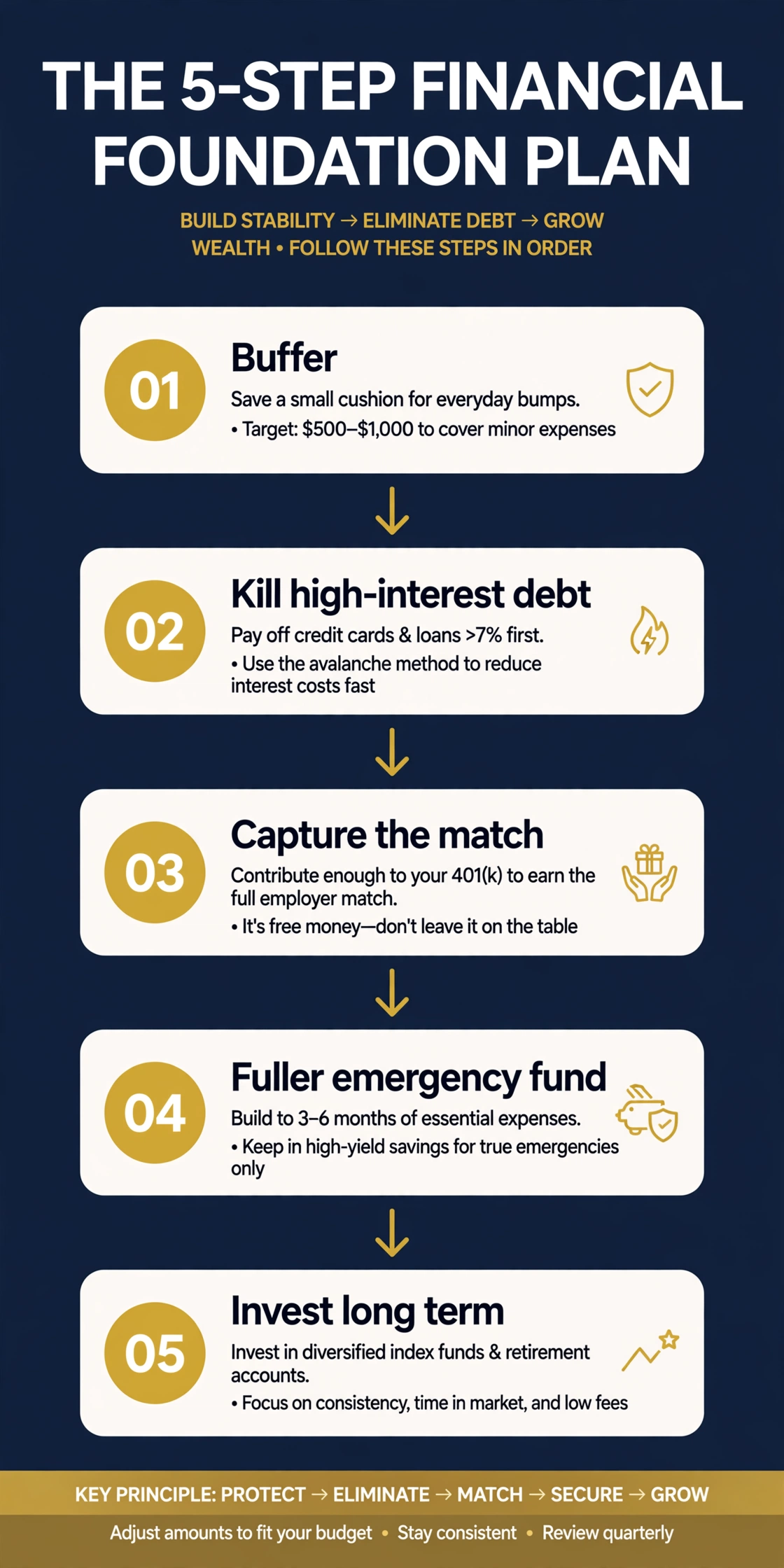
Without an order, every dollar is a fresh argument with yourself: save it, spend it, throw it at a bill? A decision tree ends that argument. It is a simple flowchart: each new dollar goes to step one until that step is done, then to step two, and so on. You never have to decide from scratch again.
The order below is the Academy's recommended sequence for beginners. Each step exists for a reason, and the reasons build on each other — a buffer keeps emergencies from becoming debt, killing expensive debt frees up cash, the match captures free money, a fuller fund buys real security, and only then does long-term investing get its turn.
Step 1: A Small Emergency Buffer
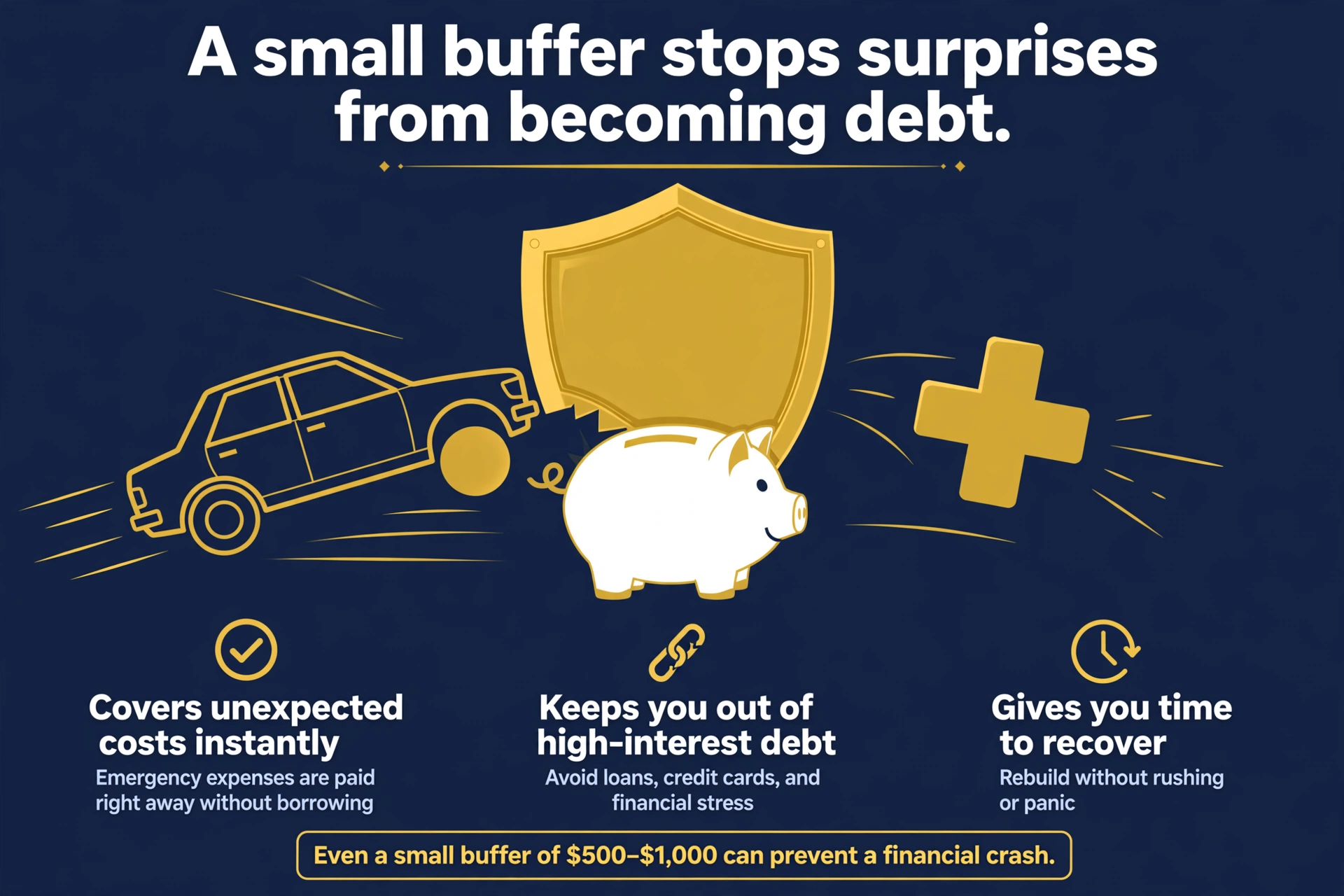
Your first dollars build a small emergency buffer — a modest cash cushion in a savings account, separate from your everyday spending money. For most beginners, a starter target is around five hundred to one thousand dollars: enough to absorb a car repair or a medical bill without reaching for a credit card.
The buffer comes before everything else — before extra debt payments, before investing — because it breaks the cycle where every surprise becomes new debt. Without it, one bad week can undo months of payoff progress. With it, surprises stay small.
Keep this money boring and reachable: a regular savings account, not an investment. Its job is not to grow. Its job is to be there.
Step 2: Attack High-Interest Debt
With the buffer in place, extra dollars go to high-interest debt — credit cards and other expensive balances — using the payoff system you built in MF-105. High-interest debt usually costs you far more than any savings account pays, so every dollar aimed at it earns the equivalent of that rate, guaranteed.
This is why debt comes before investing in this framework: killing a balance that charges you a high rate is a certain return, while investment returns are never certain. Certainty wins when the rate is high.
Stick with your avalanche or snowball plan from MF-105. The next-dollar tree does not replace it — it tells you when to start it.
Step 3: Capture the Employer Match
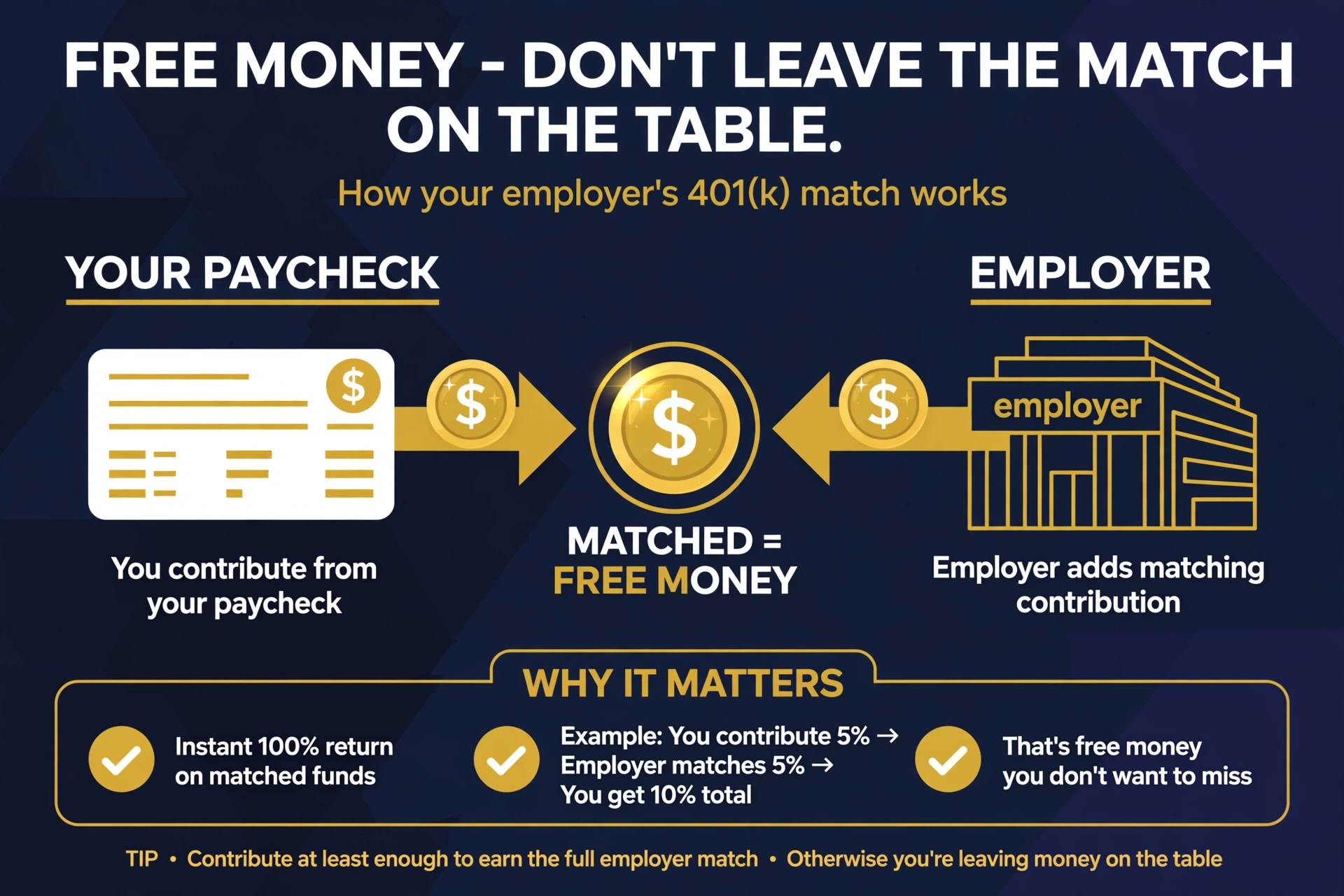
Many employers offer a retirement plan — often called a 401(k) — and some add their own money when you contribute, which is called a match. A common setup: you put in a percentage of your paycheck, and your employer adds, say, fifty cents for every dollar you put in, up to a limit.
That match is free money. Turning it down is the same as refusing part of your pay. So once your high-interest debt is under control, your next dollars go here: contribute enough to capture the full match, and not a dollar less.
Two quick notes. First, if your employer offers no match or no plan at all, skip this step — it does not apply to you. Second, employer contributions sometimes come with vesting, which means you must stay at the job for a set time before that free money is fully yours. Ask your HR department for the plan's details.
Step 4: Grow a Fuller Emergency Fund
Once expensive debt is gone and the match is captured, your next dollars grow the buffer into a fuller emergency fund: enough to cover three to six months of essential expenses — rent, food, utilities, minimum bills — if your income stopped tomorrow.
This fund is what turns a job loss or a long illness from a catastrophe into a manageable problem. It is the difference between having time to make good decisions and being forced into desperate ones.
Keep it where step one kept it: a savings account, separate and reachable, never invested. Money you might need in an emergency must not be riding the ups and downs of the market.
Step 5: Invest for the Long Term
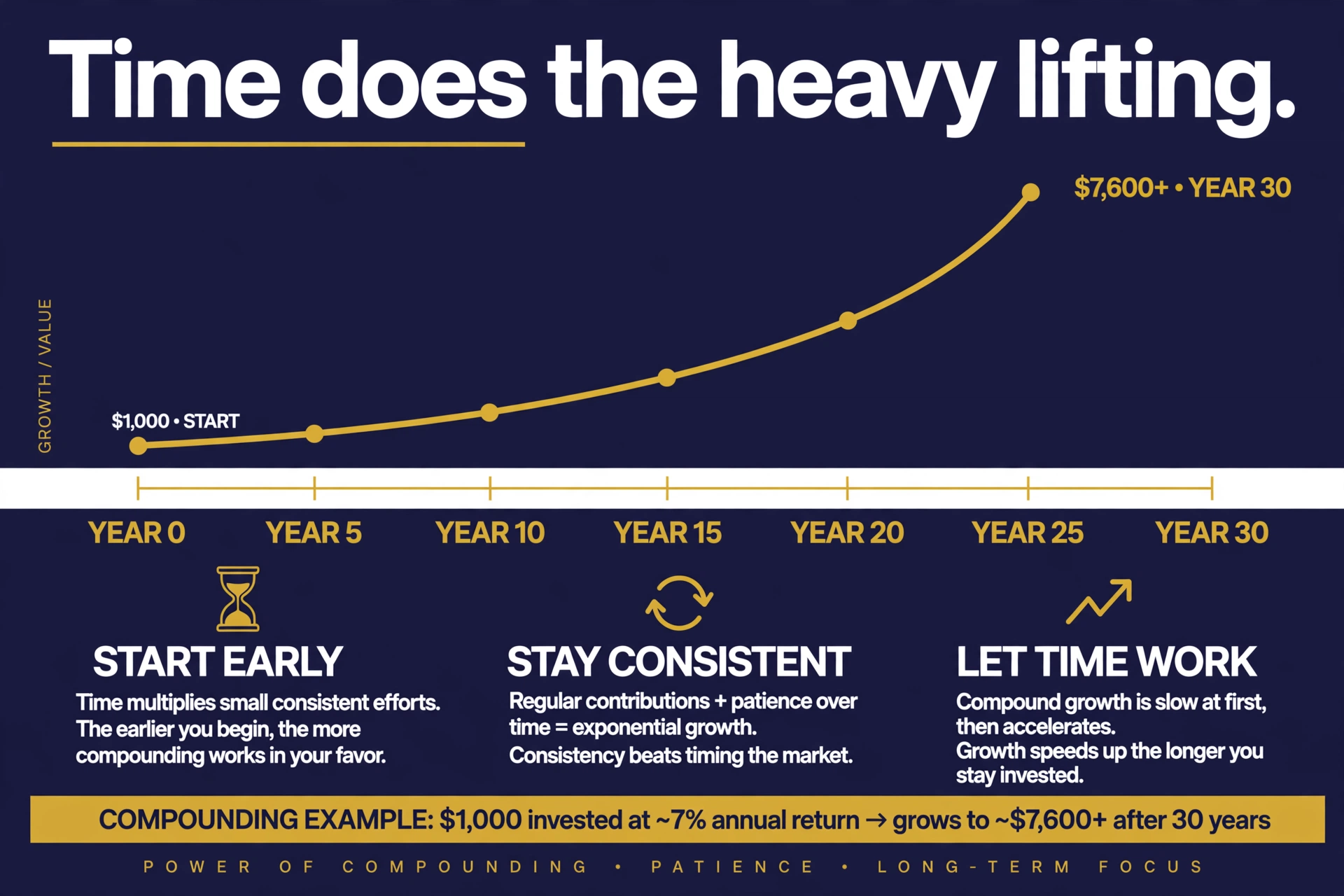
Only now — buffer built, expensive debt gone, match captured, emergency fund full — do your extra dollars go to long-term investing: putting money into assets, which are things you own that can grow in value (like stocks), with the goal of growing wealth over years and decades.
This order matters because investing last means investing safely. You are not investing money you might need next month, and you are not paying high interest while hoping investments beat it. The foundation carries the risk so your investments do not have to.
School 2 of the Academy will show you how investing works in detail. For now, remember the principle: the next-dollar tree builds the foundation first, and growth comes after.
Key terms
- Decision tree
- a step-by-step flowchart that sends each new dollar to the right place in the right order.
- Emergency buffer
- a small cash cushion (around five hundred to one thousand dollars for most beginners) that keeps surprises from becoming debt.
- Emergency fund
- a fuller savings reserve covering three to six months of essential expenses.
- Employer match
- free money your employer adds to your retirement plan when you contribute; capturing the full match means contributing enough to earn all of it.
- 401(k)
- a common employer retirement plan where you contribute part of your paycheck toward retirement.
- Vesting
- the rule that you must stay at a job for a set time before your employer's matching contributions are fully yours.
- Asset
- something you own that can grow in value, like a stock.
What's next
School 1 is complete — your foundation is built and every new dollar has a job. School 2 begins the climb: EM-101 "Career Capital" shows you how to turn your skills and time into higher income, because the fastest way to grow wealth is to grow what you earn.
---
The quiz
Your Next-Dollar Plan — Quiz
3 questions · pass with 3 correct
1.In the next-dollar decision tree, where does the FIRST dollar go?
2.Why does high-interest debt come BEFORE investing in this framework?
3.What is an employer retirement match?
Recommended Tools
Hand-picked resources that fit this lesson — only ever one or two, and only when they're genuinely useful.
- Learn more
Acorns
Put your next dollar to work automatically with spare-change investing.
- Learn more
SoFi
Banking, saving, and investing in one place as your plan grows.
We may earn a commission if you sign up — at no extra cost to you.